Google said on November 12, 2026, that Gemini 4 Hydrogen is now available globally in Google Search for all users, calling it the biggest model upgrade to Search so far.
Google says the model can follow complicated requests more closely, including messy natural-language questions with several constraints or hard-to-read typos. It also applies more reasoning to query fan-out, the technique Google uses to run simultaneous related searches across subtopics before building an AI response.
The result, according to Google, should be more structured answers, more images, more comparison tables and more custom tools in AI-powered Search responses. Google also says the upgrade applies across all languages currently supported by its AI Mode systems.
Why Hydrogen matters beyond the model name
Hydrogen is not being positioned as Google’s deepest reasoning model. Google describes Gemini 4 Carbon and Gemini 4 Argon as models for difficult, long-horizon reasoning, while Hydrogen is built for fast execution across everyday coding, search, tool use and agentic workflows.
This distinction matters because Search does not only need a model that can answer difficult questions. It needs a model that can handle huge volumes of mixed queries, call tools reliably, assemble links, work with visual formats and return results quickly enough to feel like Search. Google is using Hydrogen to bring more of the Gemini 4 family into that high-volume role.
Search is becoming a task interface
The upgrade extends a direction Google has been building through AI Mode. Earlier in 2026, Google said it was upgrading Search with Gemini 3.5 Flash as the default AI Mode model globally and preparing custom generative interfaces and agent-style search features. Hydrogen moves that same path into the Gemini 4 family.
For regular searchers, that means more answers may look less like a ranked results page and more like a workspace: a summary, a table, an image set, a set of suggested links, or a small interactive tool. The classic links still matter, but they may sit inside a generated response rather than being the entire experience.
What site owners should take from the rollout
Google’s own guidance does not add a new “Hydrogen SEO” checklist. Search Central says the same core SEO practices apply to AI Overviews and AI Mode, and that pages do not need special schema, AI text files or new machine-readable files to be eligible. To appear as a supporting link, a page must be indexed and eligible to appear in Search with a snippet.
The practical change is in how Google may discover supporting material for complex questions. If Hydrogen improves query fan-out as Google claims, a page may be found because it answers a precise subtopic inside a larger query, not only because it ranks for a short keyword. Clear headings, complete answers, visible text, accurate structured data and useful internal links become even more valuable in that environment. Tech Help Canada’s guide to making content easier for AI search systems to understand covers the same content-first direction.
Measurement may still be messy
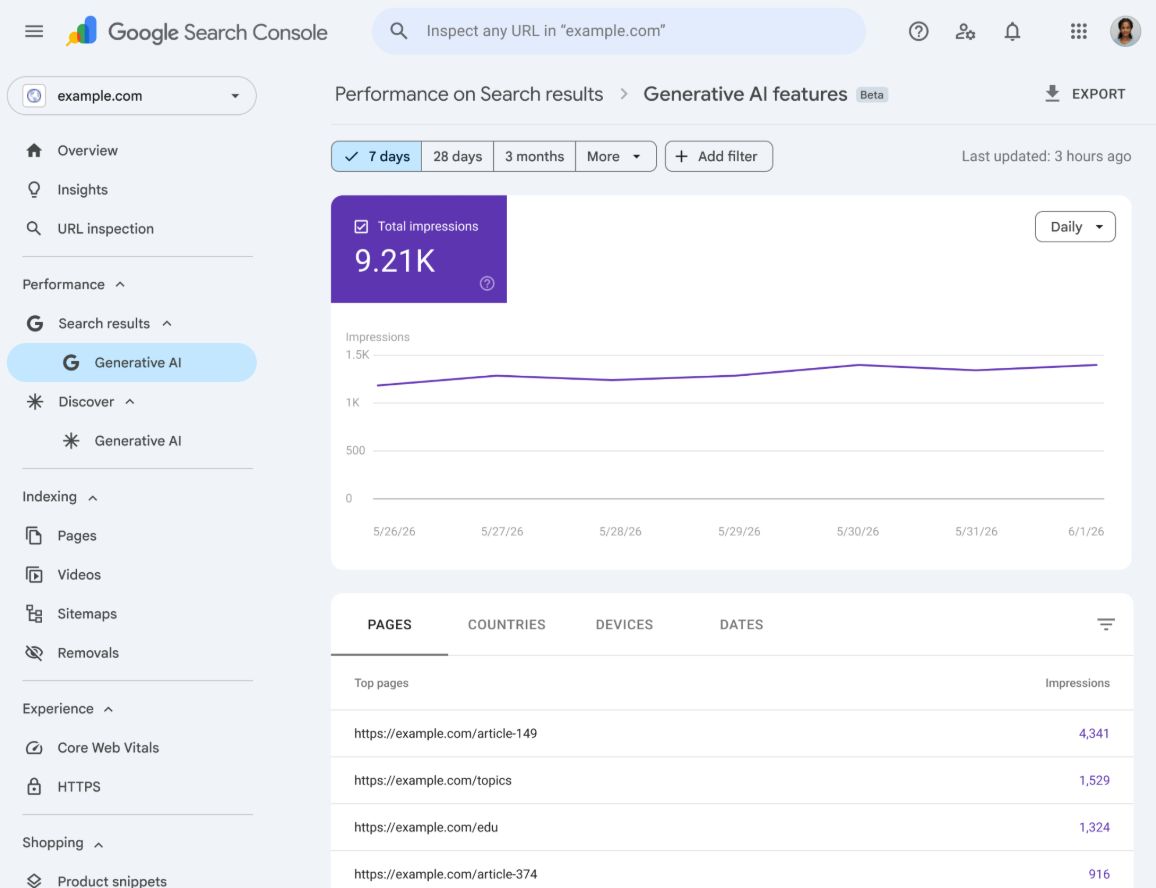
Hydrogen could make Search feel more capable, but it may not make Search traffic easier to diagnose. Clicks from AI Overviews and AI Mode count toward overall Web performance in Search Console. A separate Generative AI performance report shows combined impressions from those features. It does not break out clicks by feature or identify which model generated an answer.
Google has been adding more inline links, official-site sections and timely article carousels in AI Search features. Those changes suggest Google is aware that source visibility is a core issue as generated answers take up more of the results experience. Hydrogen’s rollout raises the same question at a larger scale: will broader query fan-out send more qualified visits to useful pages, or will more complete AI answers reduce the need to click?
What developers and businesses get
Outside Search, Google is also rolling Hydrogen into the Gemini app, Google AI Studio, the Gemini API, Gemini for business, Google Antigravity for paid Google AI Pro and Ultra subscribers, and Gemini in Google Sheets for eligible users. Free Gemini app users are expected to receive Hydrogen through automatic model selection when Google decides it is appropriate for the prompt.
For developers, the model ID is listed as gemini-4-hydrogen. Google Cloud documentation lists a 1,048,576-token context window, multimodal inputs, function calling, code execution, computer use and grounding tools. Google lists its standard paid Gemini API rates at US$1.50 per million input tokens and US$7.50 per million output tokens, including thinking tokens.
Benchmarks should be treated as early evidence, not final proof
Google and Google DeepMind published benchmark results for Hydrogen, including agentic coding, knowledge work, computer use, multimodal understanding, science and math, and reasoning tests. The model card lists Hydrogen at 71.6% on Agents’ Last Exam v1.1, 76.1% on AutomationBench-AA and 77.6% on OSWorld-2.1’s offline subset, while also showing areas where competing models score higher.
Those numbers help explain part of Google’s positioning, but they do not answer every quality question. Search quality depends on source selection, citation behavior, freshness, interface choices and how well Google handles sensitive or ambiguous queries. Hydrogen is a major model change for Search, but its real impact will show up in day-to-day results, traffic patterns and user trust over time.
Related: Tech Help Canada’s Google Workspace review covers how Gemini fits into everyday work in Sheets, Gmail and other Workspace apps.

I can suggest related Tech Help Canada articles based on the topic you’re reading now.

Tech Help Canada Staff researches, writes, and reviews practical content for business owners and professionals. Our coverage spans business, marketing, SEO, technology, and the tools and systems people use to grow and operate online. We focus on clear, useful information backed by research, hands-on experience, and editorial review. Learn more about our team and editorial standards. Need help with something? Contact Us