In 1955, a scientist could find an important research paper and still miss the studies that challenged it. The criticism might sit in another journal, filed under a subject heading nobody thought to search.
Eugene Garfield, then 29, proposed a fix: follow the references. Decades later, Google applied a related idea to the links between websites. Now AI search tools follow those trails for you and hand back a finished answer, often before you’ve opened a single source. Each step made information easier to find. The latest one also puts distance between the person asking and the websites behind the answer, because customers can now compare companies and settle on one without visiting any of their sites.
Before Google, scientists followed the references
Garfield wasn’t trying to build a search engine. He wanted to fix a problem researchers ran into all the time.
Scientific publishing was growing fast, and the usual way to find relevant work was through indexes organized by subject, author or journal. Those worked when you knew where to look. They failed when the paper you needed sat in a field you’d never think to search. Garfield gave an example from his own reading. An article on a reading aid for the blind, a device RCA had developed years earlier, turned up as a citation in an information theory paper in the journal Electronic Engineering. He spotted that unexpected citation while reading the information theory paper “because of an entirely different interest.” As he put it, “No subject indexer could have anticipated this crossbreeding of interests.”
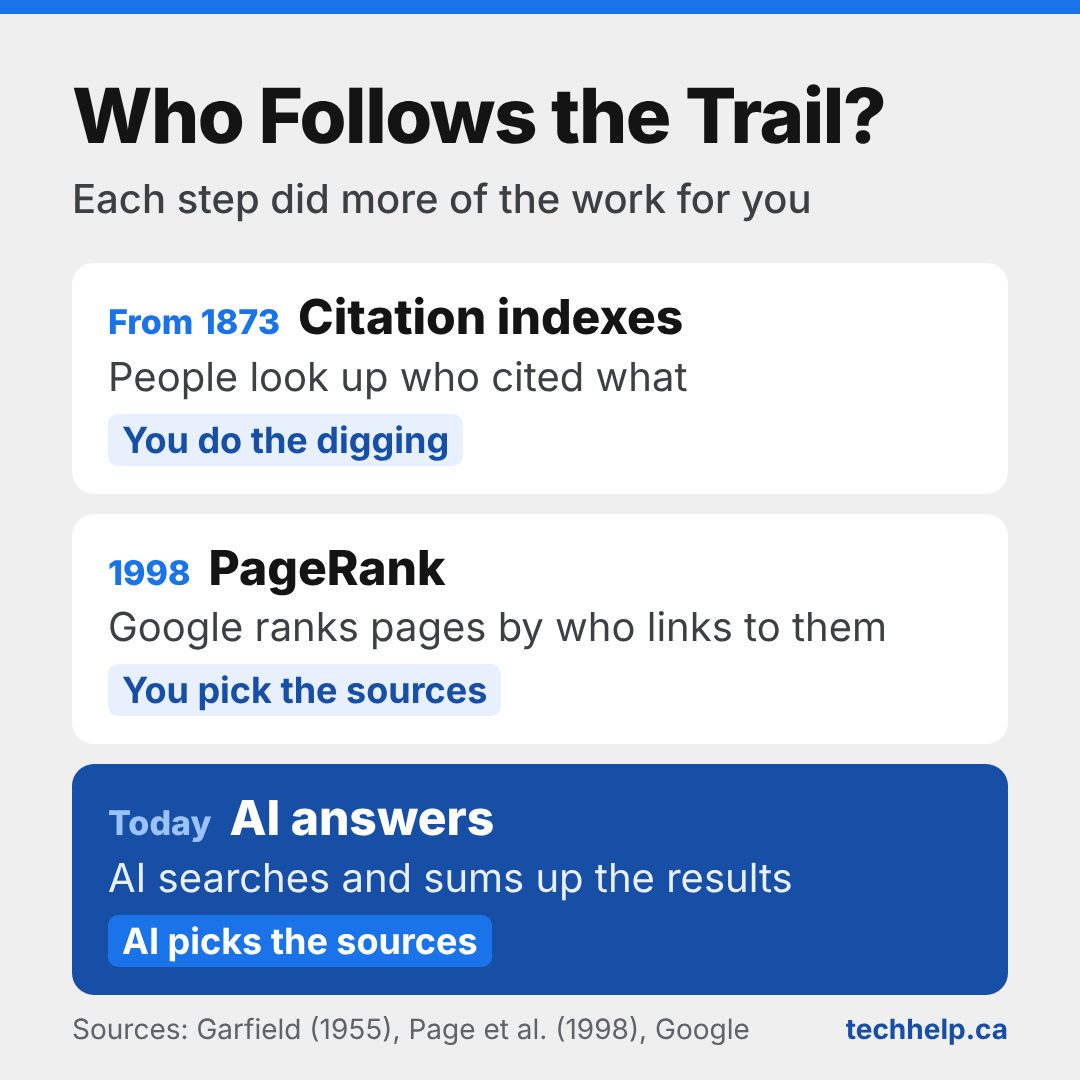
Lawyers already had a way around this. Since 1873, they’d been able to use Shepard’s Citations, which listed court cases alongside the later decisions that cited them. Start with a ruling, and you could see whether later courts had followed it, questioned it or overturned it. In a field where so much rests on precedent, you can’t rely on a decision without knowing what happened to it next.
In a 1955 paper in Science, Garfield proposed doing the same for research. Instead of relying only on subject headings, you could index papers by the references they contained. Begin with a paper you know, and the index would point you forward to the later papers that cited it, whatever field they came from.
He had two jobs in mind for it. The first was catching bad information. Garfield described a system that “can eliminate the uncritical citation of fraudulent, incomplete, or obsolete data” by making scholars aware of criticisms of earlier papers. A thorough scholar, he argued, should check the papers that had cited or criticized an earlier study, if they could be found quickly. A citation index would make that practical. The second job was measurement. Citations, he suggested, could help historians gauge a paper’s influence, which he called its “impact factor.”
Turning the idea into a working product took nearly a decade. Garfield’s company, the Institute for Scientific Information, produced the first Science Citation Index in 1964.
Notice what Garfield didn’t assume. A citation wasn’t automatically a compliment. A paper might be cited because it broke new ground, or because someone had just shown it was wrong. Being referenced and being endorsed were different things, and part of the index’s value was that it led you to the papers that could tell you which was which.
Google treated links like citations
By the mid-1990s, the web had its own version of Garfield’s problem, only bigger and messier. Anyone could publish a page, and as Sergey Brin and Larry Page put it, “automated search engines that rely on keyword matching usually return too many low quality matches.”
Brin and Page, then graduate students at Stanford, borrowed from the scientists. A paper on their method, dated January 1998 and co-written with Stanford professors Rajeev Motwani and Terry Winograd, was titled “The PageRank Citation Ranking: Bringing Order to the Web.” In its discussion of related work, it notes that “there has been a great deal of work on academic citation analysis,” with a reference to Garfield. Brin and Page’s paper describing their prototype search engine, Google, spelled it out in a term SEO people still use: “Academic citation literature has been applied to the web, largely by counting citations or backlinks to a given page.”
PageRank went further than a simple count. A link from an important page carried more weight than a link from an obscure one, and each page’s influence was divided among all the pages it linked to. A page could rank highly because many pages linked to it, or because a few highly ranked ones did. The prototype in that paper worked from a database of at least 24 million pages.
The authors also saw where the comparison with scientific papers broke down. The PageRank paper warned that “unlike academic papers which are scrupulously reviewed, web pages proliferate free of quality control or publishing costs.” The prototype paper noted that there were already “numerous companies which specialize in manipulating search engines for profit.”
Once links could move rankings, backlinks, meaning links from other websites to yours, became something businesses chased. A whole industry grew up around getting them, honestly or otherwise. Garfield’s caveat came back in a new form. A link might point to genuinely useful information, or someone might have paid for it. Google’s spam policies now list “buying or selling links for ranking purposes” as link spam.
PageRank hasn’t stood still. Google says it has “evolved a lot” since launch and is still one of its core ranking systems, working alongside many others that judge relevance and quality. The company still uses links to understand what pages are about and which ones might be most helpful.
Garfield’s index and PageRank were built for different jobs. One traced scientific literature, the other ranked web pages. Both rested on the same insight, that the connections between documents can reveal things no single document shows on its own.
AI now follows the references for you
Say you’re looking for payroll software for a five-person business. A traditional search hands you a list of software vendors, comparison articles, reviews and government guidance. You open several tabs, piece the details together and decide which options deserve a closer look. An AI search tool can do much of that work for you, assembling a comparison of features, pricing, integrations and payroll tax considerations before you’ve visited a single vendor’s website.
Under the hood, the AI is doing the legwork itself. According to Google, AI Overviews and AI Mode can use a technique called query fan-out, “issuing multiple related searches across subtopics and data sources” to build a response. In Garfield’s day, the researcher followed the trail. With Google, you clicked through the links. Now the AI runs the searches and reads the sources, then tells you what it found.
Not every AI tool works this way. Some lean heavily on what the model learned during training, and not every answer comes with sources you can check. But when an AI answer does draw on websites, a business can show up in it in several ways that are easy to confuse:
A search result gives someone a destination they can choose to visit.
A citation names your page as a source behind part of the answer.
A mention puts your business name in front of the reader, with or without a link.
A recommendation presents your product or business as a good option.
Those outcomes aren’t interchangeable. A software company’s pricing page might be the source an AI tool cites, while the answer recommends a competitor. AI tools also make mistakes, from misdescribing what a company offers to mangling a comparison. Garfield would have recognized the pattern. In his index, too, a source could be cited without being praised.
It’s tempting to call AI search “PageRank 2.0,” but that misses most of what’s going on. Ranking and retrieval still happen underneath. What’s new is a layer that interprets those sources and combines them into one conversational response. For a business, that changes more than where its website appears. The AI’s summary becomes the first impression, and sometimes the only one.
Being cited doesn’t guarantee a visit
For years, the deal behind SEO was fairly simple. Rank well, and people click through to your site. AI answers loosen that connection.
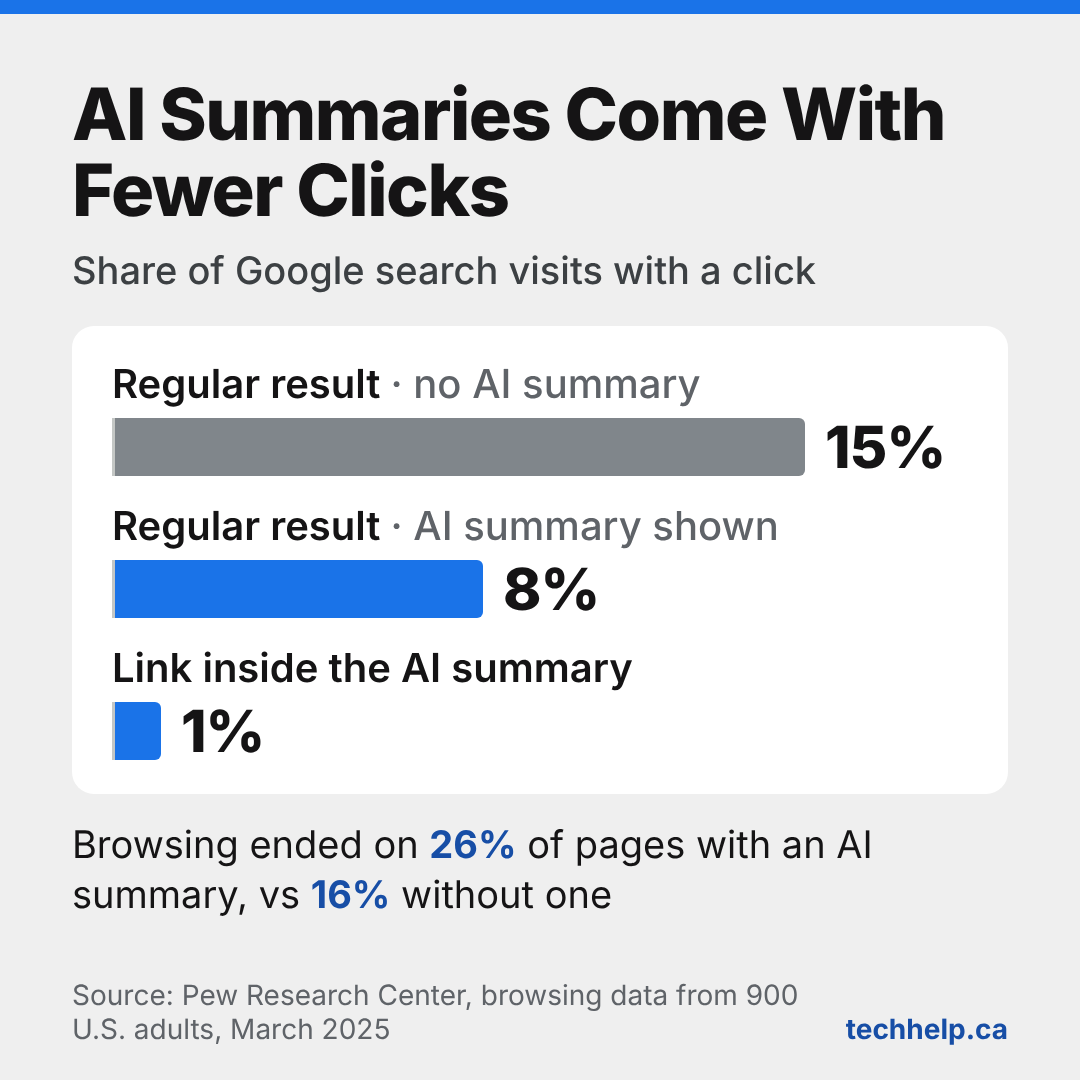
In July 2025, Pew Research Center published an analysis of the browsing data of 900 U.S. adults during March 2025. When a Google results page included an AI summary, people clicked a traditional search result in 8% of visits. Without a summary, they clicked in 15% of visits. Links inside the AI summary got clicked in just 1% of visits to pages that showed one. People were also more likely to end their browsing session entirely, which happened on 26% of pages with an AI summary compared with 16% of pages with only traditional results.
Pew’s analysis is observational, and the searches that trigger AI summaries may differ from the ones that don’t, so it doesn’t prove the summaries caused every difference. It’s also a snapshot of a single month in early 2025. Google has kept changing how links appear since then. In May 2026, it announced more inline links in AI responses, follow-up links to in-depth articles and desktop previews that show where a link leads before you click, which Google says “will help people feel more confident about visiting helpful websites.”
Still, the pattern creates a problem for anyone who depends on search traffic, and it plays out differently from one business to the next. Take a publisher whose guides inform hundreds of AI answers. Its research ends up in those answers, but readers may never reach the pages it came from. Now consider a local accounting firm that gets mentioned in an AI recommendation and, a week later, gets a call from someone who first heard its name there. That exposure turned into revenue, yet the firm’s analytics show nothing, because the customer never clicked a link.
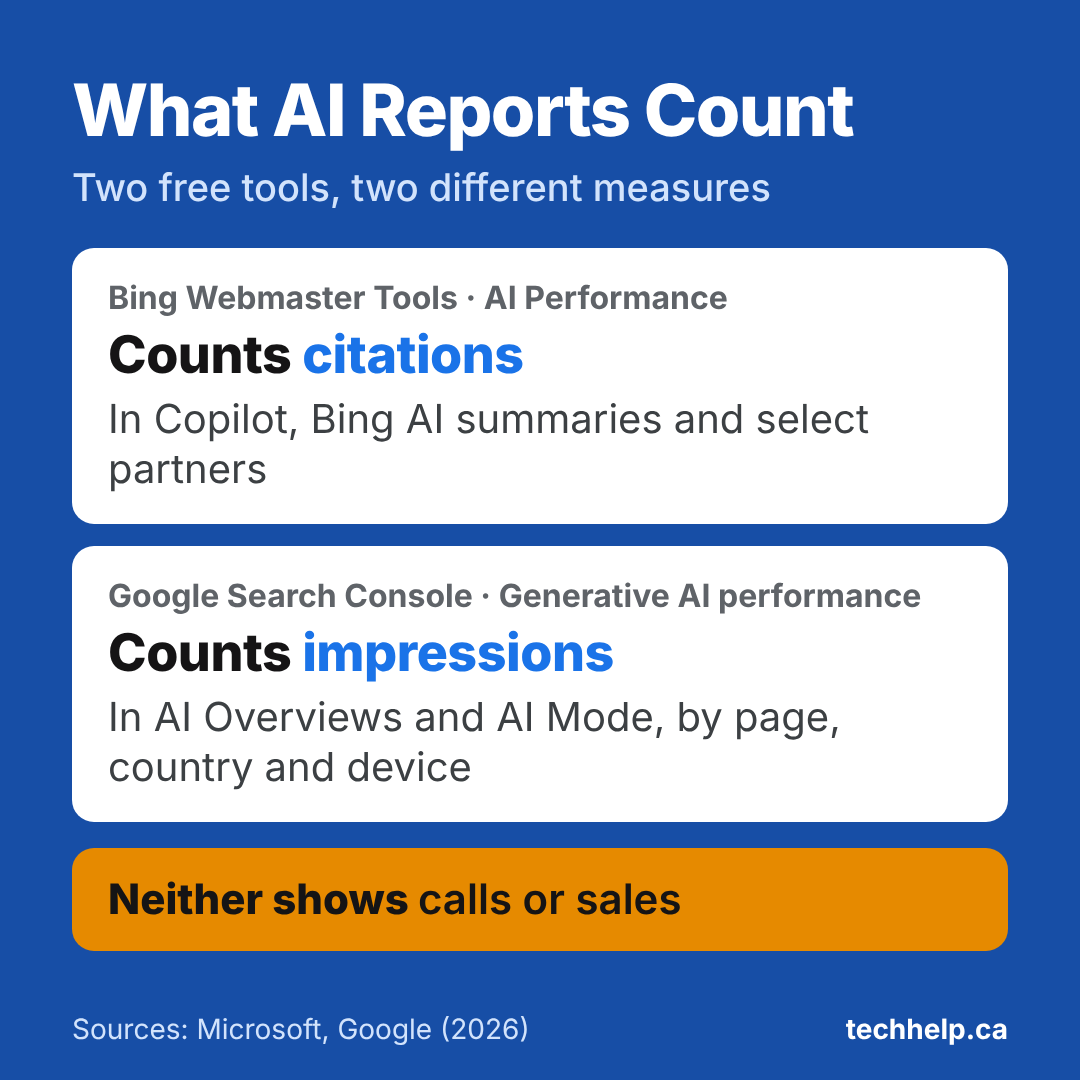
Platforms have started reporting on this. In February 2026, Microsoft launched a public preview of AI Performance in Bing Webmaster Tools. It shows how often your pages are cited in Microsoft Copilot, AI-generated summaries in Bing and select partner integrations, along with a sample of the “grounding queries” its AI used to retrieve that content. Microsoft is careful to say its page-level data “reflects how often pages are cited, not page importance, ranking, or placement.”
Google announced its own Generative AI performance reports for Search Console in June 2026 and had rolled them out to all websites worldwide by August 31. They count impressions, meaning how often links to your site were shown in AI Overviews and AI Mode, and you can break them down by page, country and device.
Both reports measure appearances. Neither tells you whether an appearance led to a call or a sale. Connecting the two is still your job, whether that means asking new customers how they found you or comparing those reports with what’s happening in your inquiries and sales.
What makes a business worth finding and citing
There’s no proven formula for getting into AI answers, and Google’s own guidance is refreshingly unexciting. Its guide to generative AI features in Search says the best practices for SEO “continue to be relevant.” You don’t need special AI text files or markup, and “there’s no requirement to break your content into tiny pieces for AI to better understand it.”
The same guide warns against two shortcuts. One is third-party tools that claim to use “internal” Google metrics, because “no third-party tool has access to our internal ranking or AI systems.” The other is creating a separate page for every variation of how people might search. Doing that mainly to manipulate rankings or AI responses violates Google’s scaled content abuse policy.
None of what follows guarantees a mention. It makes your business easier for customers and AI tools to understand and verify, and that part is in your hands.
Say exactly what you do
Your website should explain what you sell, who it’s for and where you work, without making anyone hunt for it. Compare a bookkeeping firm that offers “innovative financial solutions for growing organizations” with one that offers monthly bookkeeping packages for online stores that run on Shopify and QuickBooks. The second gives a potential customer something concrete to evaluate.
Useful details include the platforms you support, the types of businesses you serve, your service areas, your qualifications and, where it makes sense, your pricing. Every one of them is one less thing a customer, or an AI tool, has to guess about.
Publish what others can’t easily copy
When dozens of websites repeat the same advice, readers have no reason to prefer one over another. Google’s guide makes a similar distinction, noting that a first-hand review “provides a unique perspective based on personal experience, whereas a summary of existing content simply restates information already available elsewhere.”
Original information changes that. A software company can publish results from testing its product under realistic conditions. A marketing agency can walk through a campaign it ran, including what flopped. A consultant can share examples from client work, with permission and without revealing anything confidential.
That kind of material gives readers evidence a generic summary can’t, and it gives other publishers, researchers and AI tools something specific to reference. It doesn’t have to be an expensive research project, either. One carefully explained example or honest comparison can be enough to make a page worth citing. For the presentation side, Tech Help Canada’s guide on making content easier for AI search systems to understand covers how to structure that information so it’s clear.
Make your claims easy to check
Garfield’s index was valuable because it let researchers trace a claim back to the work behind it. People evaluating your business want the same ability.
Back up what you say with documentation and named experts. Independent customer reviews and credible third-party coverage add perspectives you can’t supply yourself.
Consistency matters too. If your address, services or business description differ across your website, directory listings and social profiles, anyone trying to verify you runs into contradictions. Keep the important details current everywhere they appear, and correct factual errors when you find them.
Don’t lock out the systems that find you
Good information won’t do much if search systems can’t reach it. According to Google, a page has to be indexed and eligible to appear with a snippet in regular Search before it can be shown as a supporting link in AI Overviews or AI Mode.
Your site also has to be included in Google’s generative AI features in Search Console, because Google now offers a toggle that lets site owners opt out. The company says the setting won’t be used as a ranking signal outside those features, but sites that opt out “will not receive traffic or impressions from our generative AI features.” It’s a fair choice with a real cost, so make it on purpose.
Other AI services use their own crawlers. OpenAI, for example, says that sites opted out of its OAI-SearchBot crawler won’t be shown in ChatGPT search answers, though they can still appear as navigational links. Security settings at your host or content delivery network can block crawlers like these without you realizing it. Cloudflare, for one, overhauled its AI crawler settings in September 2026, splitting them into separate controls for search, training and agent crawlers.
A Website Health Report is a good starting point for finding the technical, performance and SEO problems that get in the way. Fixing them also makes your site easier for customers to use, whether or not an AI tool ever cites it.
Test what AI tells customers about your business
You don’t need specialized software for a first experiment. Write three questions a potential customer might type into an AI tool. For a bookkeeping firm, that might mean finding a bookkeeper for an online store, deciding between bookkeeping software and outsourcing, and comparing firms in its city.
Run them through one AI search tool, then another, and read the answers the way a customer would. For each answer, note:
which companies appear and what the answer says about them
whether your business is linked, cited, mentioned, recommended or missing entirely
whether the information is current and correct
If your business shows up, make sure the description is accurate. If it doesn’t, study the businesses and sources that do. Look at what they explain that you don’t, whether their claims hold up and what a customer would learn from them.
Keep a record of the exact questions, dates, answers and cited sources so later comparisons mean something. AI answers shift with the wording, the tool, the information available and sometimes location or personalization, so a handful of tests won’t tell you how visible you are overall. What they can do is surface specific problems. Maybe an AI tool says you serve the wrong area. Maybe your site never explains a specialized service. Maybe competitors publish detailed comparisons and you don’t.
Fix what customers actually need, then run the same questions again. Just don’t treat every missing mention as proof that something’s wrong with your website.
The value of being found is changing
Garfield knew a citation could be a rebuttal. Google learned that a link could be bought. AI search adds another lesson: a citation doesn’t have to come with a visit. For businesses, that means earning attention is coming loose from earning a click.
That makes “Does AI mention us?” too narrow a place to start. Try this instead:
When someone asks about a problem your business solves, what reliable information can they find, and does it give them a reason to choose you?
Your answer will show you what to fix first.
Get new small business insights by email
Practical ideas and useful articles to help you make better business decisions.
Tech Help Canada Staff researches, writes, and reviews practical content for business owners and professionals. Our coverage spans business, marketing, SEO, technology, and the tools and systems people use to grow and operate online. We focus on clear, useful information backed by research, hands-on experience, and editorial review. Learn more about our team and editorial standards. Need help with something? Contact Us