

Most visitors don’t read every word. They skim, judge, scroll, and leave fast if the page doesn’t give them a reason to care.
Nielsen Norman Group’s research on web behavior found that users often leave pages within 10 to 20 seconds, and that pages need to communicate value quickly if they want people to stay. That’s exactly where storytelling earns its place in copywriting.
A story gives the reader context, tension, and a reason to keep going. Facts can prove a point. Stories make the point feel real.
You don’t need a long founder origin story or a dramatic customer journey on every page. In copywriting, storytelling is usually smaller and sharper than that. It might be a three-line opening, a before-and-after example, a customer moment, or a simple scene that helps the reader recognize themselves in the problem.
The goal isn’t to entertain for its own sake. The goal is to make the offer easier to understand, easier to remember, and easier to act on.
What storytelling in copywriting really means
Storytelling in copywriting is the use of narrative elements to move a reader toward a business action. Those elements usually include a relatable person, a specific problem, tension, a decision, and a result.
That sounds simple, but it changes how copy works. Instead of saying, “Our scheduling tool saves time,” you show a business owner ending the day with six missed calls, three double-booked appointments, and no easy way to know which lead came first. Then you show the shift: every request lands in one place, follow-ups happen automatically, and the next morning doesn’t start with damage control.
The feature is still there. The story makes the feature matter.
Good storytelling doesn’t hide the offer. It prepares the reader for it. By the time the call to action appears, the reader should already understand the problem, feel the cost of leaving it unsolved, and see why the offer belongs in the solution.
Why stories make copy more persuasive
Stories work because people don’t evaluate copy like a spreadsheet. They look for meaning, relevance, risk, and emotional fit. If the message feels disconnected from their life, they move on.
Narrative persuasion research helps explain this. The transportation-imagery model, developed by Melanie Green and Timothy Brock, describes how people can become mentally absorbed in a story. Later research in the Journal of Consumer Research looked at how narrative transportation can affect attitudes, beliefs, and intentions. For marketers, the practical lesson is straightforward: when readers can picture themselves inside the situation, the message becomes harder to ignore.
Harvard Business Review has also covered the neuroscience side of storytelling, including Paul Zak’s work on how character-driven stories with tension can affect attention and action. The takeaway for copywriters isn’t “add drama everywhere.” It’s more useful than that: give the reader a person, a problem, and a change they can follow.
Storytelling also helps because it turns abstract benefits into concrete moments. “Save time” is vague. “Send the proposal before lunch instead of chasing notes at 8 p.m.” is a scene. The second one gives the reader something to feel.
8 ways to use storytelling in copywriting
Storytelling works when it stays close to the reader’s actual buying situation. These eight techniques help you use story without making the copy bloated or theatrical.
1. Lead with a moment the reader recognizes
The fastest way to pull someone into a story is to start where they already are. Not with your brand history. Not with a broad claim. Start with a moment your reader has lived through.
For example, a landing page for a project management tool could open with: “The client asked for a quick status update. You opened three tabs, checked two Slack threads, and still weren’t sure which version of the file was final.”
That works because it’s specific. The reader doesn’t have to decode the problem. They feel it immediately.
This is especially useful on landing pages, where the page has to confirm relevance quickly. If you want to go deeper on page structure, Tech Help Canada’s guide on how to design landing pages that convert is a natural next step.
2. Make the reader the main character
Your customer doesn’t want to admire your brand from a distance. They want to know what changes for them.
That means the reader should usually be the main character. The business can be the guide, the tool, the system, or the support, but the customer’s progress should carry the story.
Weak copy says, “We built a powerful platform for growing teams.” Stronger copy says, “You can finally see which leads are stuck, which deals need follow-up, and which tasks are slowing the team down before the week gets away from you.”
The second version gives the reader a role. They’re not watching your company be impressive. They’re imagining themselves with more control.
3. Build the story around one clear promise
A story loses power when it tries to carry too many messages at once. One paragraph can’t sell speed, savings, simplicity, premium quality, security, and innovation with equal force.
Choose the main promise before you write. If the offer saves time, tell a time story. If it reduces risk, tell a risk story. If it helps someone feel prepared, tell a preparedness story.
For example, a tax preparation service might focus on relief: “You stop guessing which receipts matter, stop wondering if you missed a deduction, and walk into April with everything already organized.”
That copy doesn’t explain every service detail. It frames the emotional outcome the reader wants.
4. Use tension to create curiosity
Every useful story has tension. In copywriting, tension doesn’t have to mean disaster. It can be a gap between where the reader is and where they want to be.
The tension might be wasted time, uncertainty, stalled growth, missed opportunities, messy handoffs, or the quiet frustration of trying the same fix again and again.
For example: “You keep publishing content, but the leads still come in randomly. Some posts get traffic. Some get ignored. None of it feels connected to a real pipeline.”
That tension creates a reason to keep reading. The reader wants to know how the gap closes.
5. Connect emotion to a specific outcome
Emotion works in copy when it’s attached to something concrete. Don’t just tell readers they’ll feel confident, relieved, or excited. Show what that feeling changes in their day.
Relief might mean the invoice gets paid without three follow-up emails. Confidence might mean the sales call starts with clear numbers instead of scattered notes. Pride might mean the founder can finally show the new website without apologizing for it.
This matters because vague emotional copy can feel manipulative. Specific emotional copy feels honest. It shows the reader exactly what kind of better they’re buying.
6. Show the change with vivid detail
“Show, don’t tell” is useful advice, but it’s often misunderstood. You don’t need poetic description. You need enough detail to make the outcome visible.
Instead of saying, “Our software improves team communication,” you might write, “The designer uploads the file once, the account manager sees the latest version instantly, and the client gets one clear approval link instead of a messy email chain.”
That’s vivid because it’s operational. The reader can picture the workflow.
Strong details usually come from real customer language: reviews, support tickets, sales calls, onboarding notes, and objections. That’s where you’ll find the phrases your audience already uses to describe the problem.
7. Put proof inside the story
Storytelling doesn’t replace proof. It gives proof a better frame.
A customer story is stronger when it includes a clear before, a believable change, and a specific result. That result doesn’t always need to be a dramatic percentage increase. It can be a shorter approval cycle, fewer missed calls, faster onboarding, cleaner reporting, or a calmer Monday morning.
For example: “Before switching, the team needed two days to prepare each monthly report. Now the dashboard is ready before the meeting starts, and the manager spends the conversation making decisions instead of explaining spreadsheets.”
That story gives the reader a result they can understand.
8. Bridge naturally from story to offer
The story should lead into the offer without feeling like a trapdoor opened underneath the reader.
If the story is about a business owner missing leads after hours, the offer should connect directly to faster response, automated follow-up, or better intake. If the story is about a buyer overwhelmed by options, the offer should connect to clarity, comparison, or guidance.
The transition can be simple: “That’s why the system starts with intake.” Or: “That’s the problem this checklist fixes.” Or: “That moment is what the service is built around.”
The key is alignment. The offer should feel like the next logical step, not a sales pitch pasted onto a scene.
4 storytelling formulas for conversion copy
You don’t have to invent a new structure every time. These formulas give your copy a useful starting point.
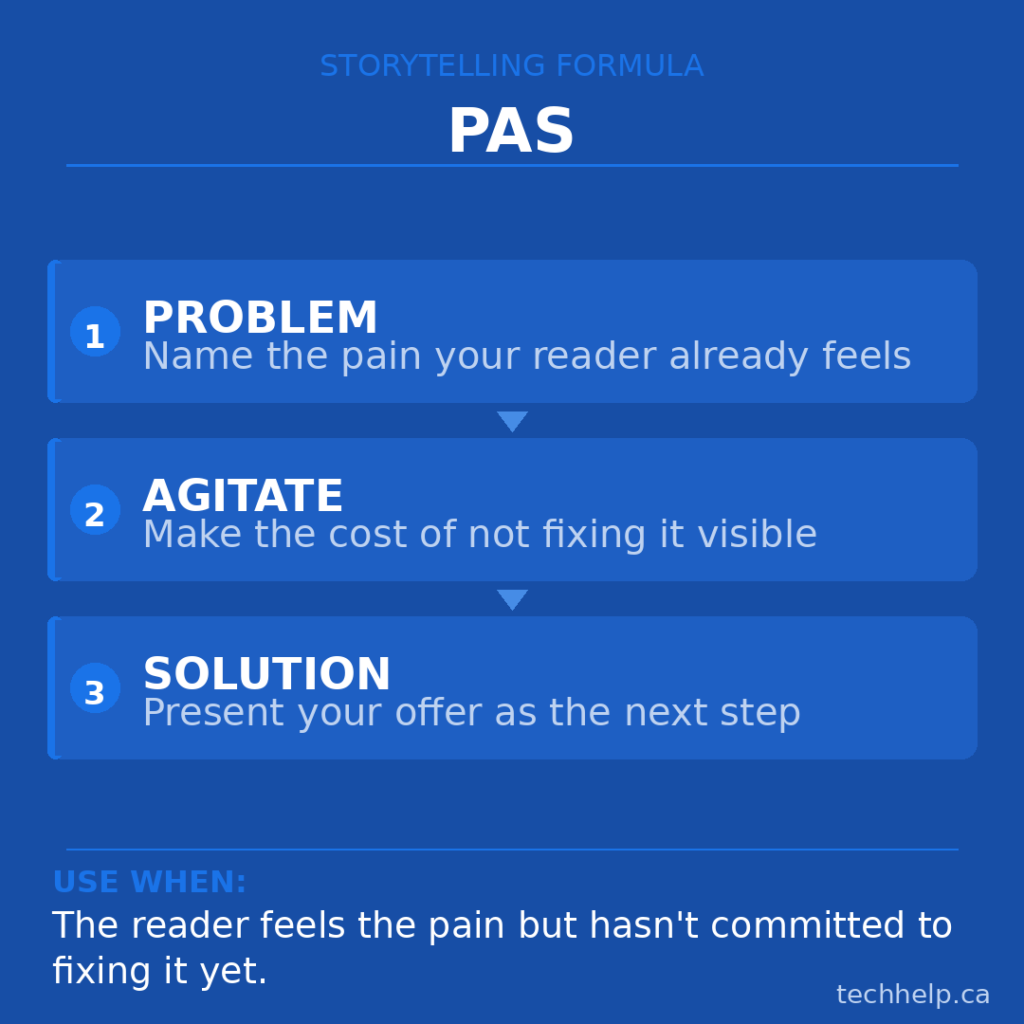
PAS: problem, agitate, solution
PAS works because it follows the emotional order of a buying decision. First, name the problem. Then make the cost of the problem visible. Then introduce the solution.
Example: “Your leads are coming in, but follow-up is scattered. Some prospects get a reply in minutes. Others wait two days and go quiet. Our CRM workflow puts every inquiry into one pipeline so the next step is always clear.”
Use PAS when the reader already feels the pain but hasn’t committed to fixing it yet.
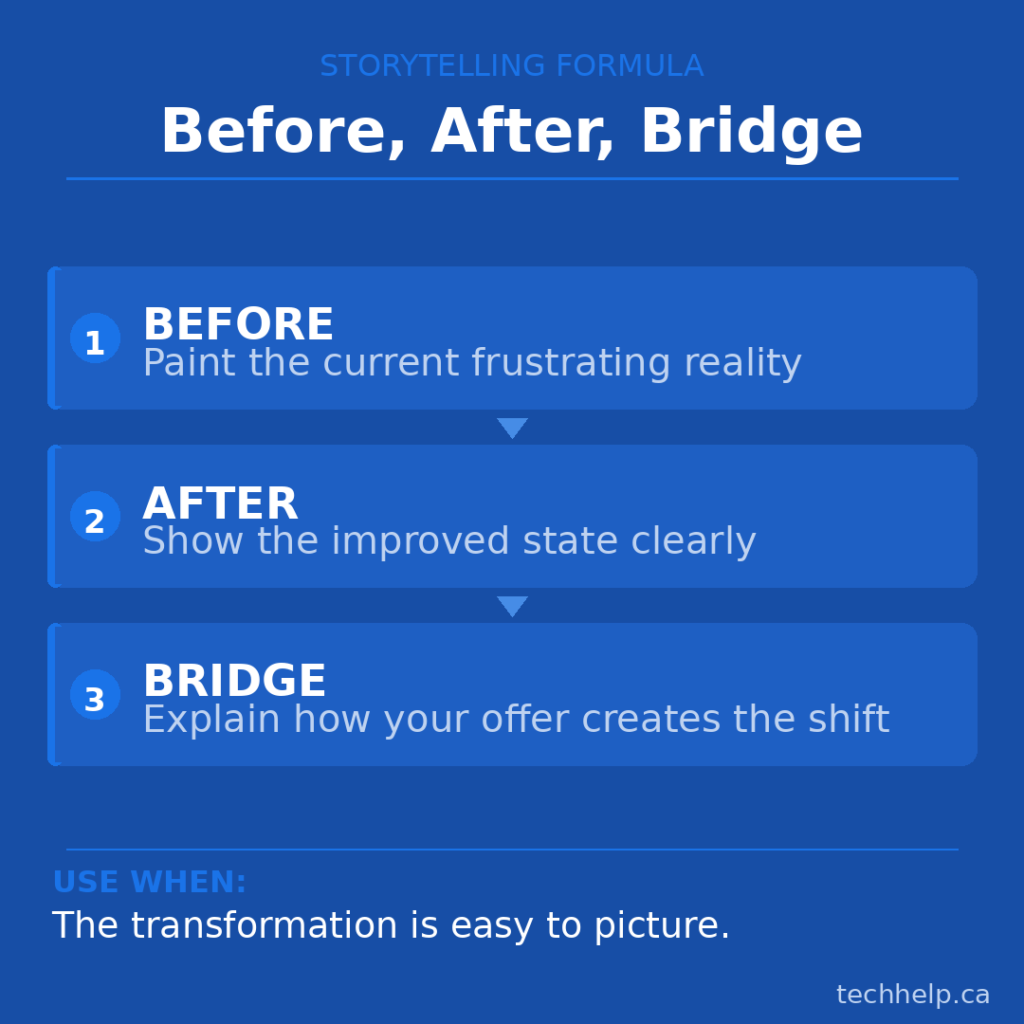
Before, after, bridge
Before, after, bridge shows contrast. You start with the current state, show the improved state, then explain how the offer creates the shift.
Example: “Before, every campaign report meant opening five tabs and hoping the numbers matched. After, the team sees performance, leads, and revenue in one dashboard. The bridge is a reporting setup that connects the tools you already use.”
Use this when the transformation is easy to picture.
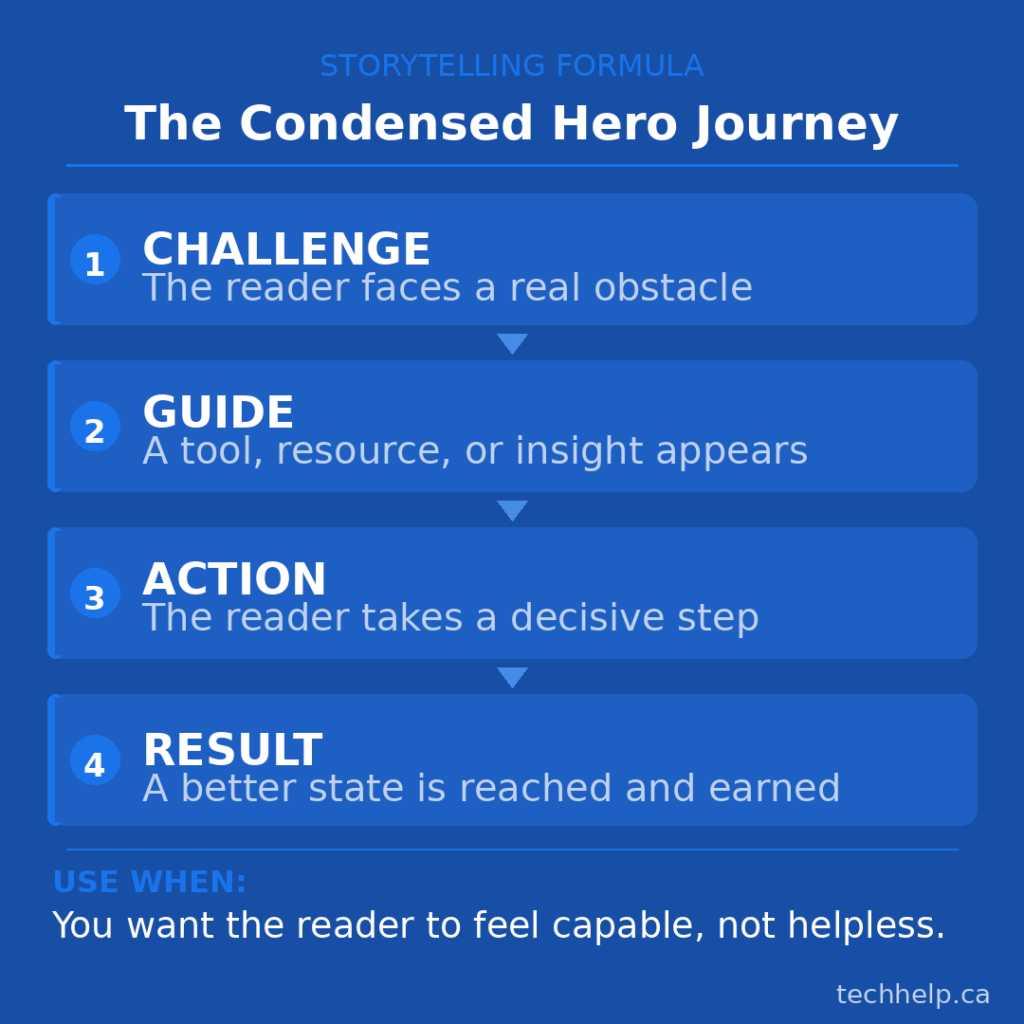
The condensed hero journey
The hero journey can work in copywriting when you keep it tight. The reader faces a challenge, finds a guide or tool, takes action, and reaches a better state.
Example: “You’ve built the offer, but the launch page still feels flat. With the right story, the page stops listing features and starts showing buyers why the offer fits their problem.”
Use this when you want the reader to feel capable, not helpless.
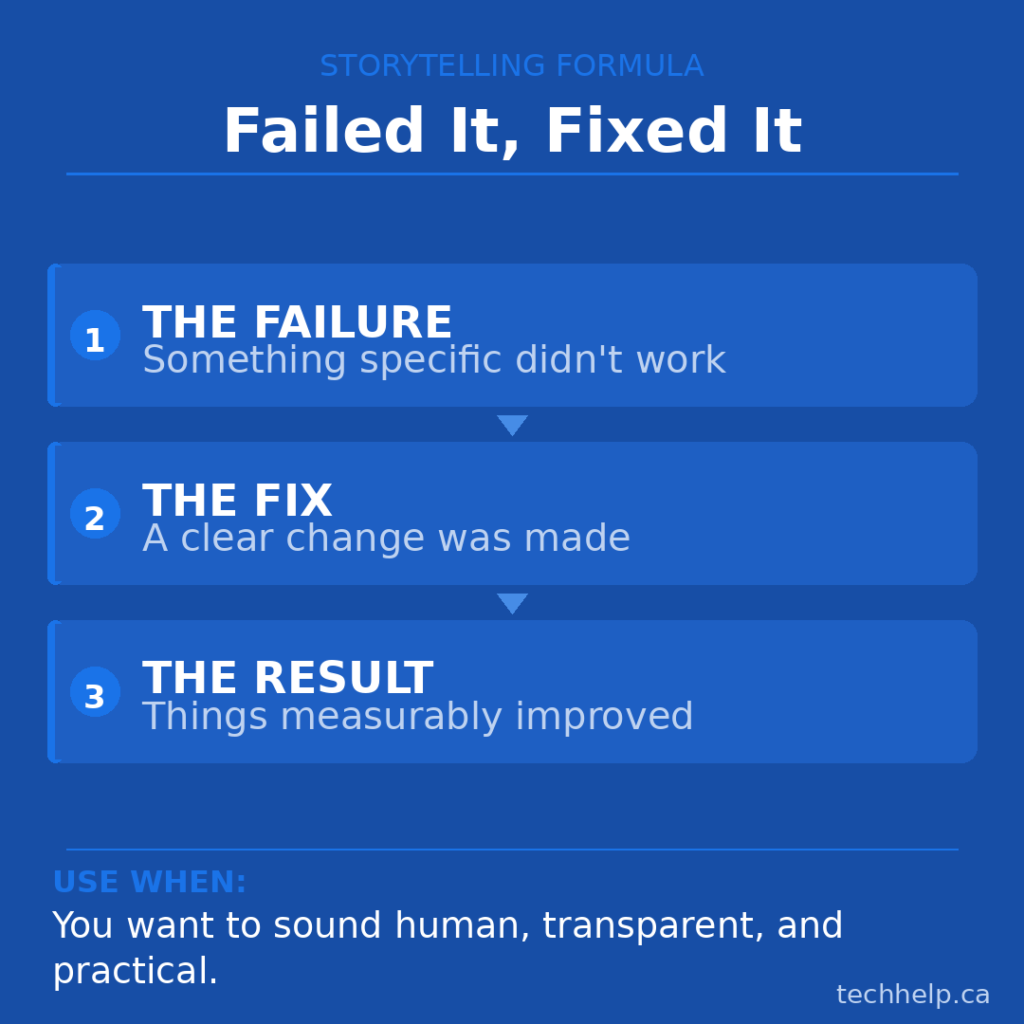
Failed it, fixed it
This is the simplest version of a lesson story. Something didn’t work. A change was made. The result improved.
Example: “We used to open every sales email with a list of features. Replies were polite but rare. When we rewrote the first three lines around the buyer’s actual problem, prospects started replying with, ‘This is exactly what we’re dealing with.'”
Use this when you want to sound human, transparent, and practical.
Where storytelling fits
Storytelling can improve almost any copy, but it doesn’t belong everywhere in the same way.
On landing pages, story helps the reader understand the problem and see the offer as the next step. In product descriptions, it shows the product in use instead of leaving the reader with specs. In emails, it earns attention before the pitch. In ads, it compresses tension and payoff into a few lines. In case studies, story gives proof a clear beginning, middle, and result.
Story also works well in About pages when the origin story actually explains why the business is different. A founder story that says, “We care about quality” isn’t enough. A better story shows the moment the founder noticed a broken industry habit and decided to build against it.
The test is simple: does the story clarify the offer, reduce doubt, or make the result easier to picture? If it doesn’t, cut it.
How to measure whether storytelling is working
Storytelling should still be measured like copy. If the story is doing its job, you should see better behavior from the right visitors.
On a page, watch scroll depth, time on page, CTA clicks, form starts, form completions, and conversion rate. In email, compare open rate, reply rate, click rate, and unsubscribes. In ads, test story-led hooks against direct benefit hooks and compare click-through rate, conversion rate, and lead quality.
Qualitative data matters too. Sales calls, customer replies, survey answers, and support messages can show whether people are repeating the story back to you. When prospects use your framing in their own words, the message is landing.
The simplest reliable test is an A/B test with one meaningful change. Keep the offer, audience, and CTA the same. Change the opening, example, or story frame. Then measure whether the story version gets more people to the next step.
Common storytelling mistakes in copy
The first mistake is making the story too long. If the reader came to compare services, book a call, or understand a product, don’t make them walk through a 900-word backstory first.
The second mistake is making the brand the hero. The customer should be the person who changes. Your product, service, or system helps them make that change.
The third mistake is using emotion without proof. A moving story may get attention, but if it doesn’t connect to a real offer and believable evidence, it won’t convert the right people.
The fourth mistake is confusing vivid with vague. “Imagine your dreams coming true” is not vivid. “You approve payroll in 10 minutes instead of rebuilding the spreadsheet Friday night” is vivid.
The fifth mistake is ending with a weak bridge. If the story doesn’t lead naturally to the offer, the CTA feels bolted on. The reader should feel, “Of course, this is the next step.”
Make the story do business work
Storytelling in copywriting isn’t decoration. It’s how you turn a claim into a moment your reader can recognize.
Start with the situation they’re already in. Show the tension. Make the outcome specific. Prove the shift. Then connect the story to one clear next step.
That’s how story-driven copy earns attention without wasting words. It doesn’t ask readers to admire your writing. It helps them see themselves moving from problem to progress, so the conversion feels like the next step. Need a workspace to draft story-driven copy? Try CopyHub.
Sources
- https://www.nngroup.com/articles/how-long-do-users-stay-on-web-pages/
- https://hbr.org/2014/10/why-your-brain-loves-good-storytelling
- https://hbr.org/2015/11/the-new-science-of-customer-emotions
- https://academic.oup.com/jcr/article-abstract/40/5/797/2907552

I can suggest related Tech Help Canada articles based on the topic you’re reading now.

Tech Help Canada Staff researches, writes, and reviews practical content for business owners and professionals. Our coverage spans business, marketing, SEO, technology, and the tools and systems people use to grow and operate online. We focus on clear, useful information backed by research, hands-on experience, and editorial review. Learn more about our team and editorial standards. Need help with something? Contact Us