The Google search results page you’ve been optimizing for? It’s being rebuilt from the ground up, and ads are now part of the blueprint.
According to third-party SEO tracking cited in industry analysis, Google’s AI Overviews appeared on roughly 48% of tracked queries as of March 2026. That’s up 58% from just December 2025. And on May 20, 2026, at Google Marketing Live, the company highlighted several AI ad updates, including four formats that show how ads are being built directly into AI-generated search experiences.
If you run ads, manage a marketing budget, or depend on Google for leads, this isn’t something you can afford to catch up on later. The rules of paid and organic search are changing right now, and the businesses that understand what’s happening have a real head start.
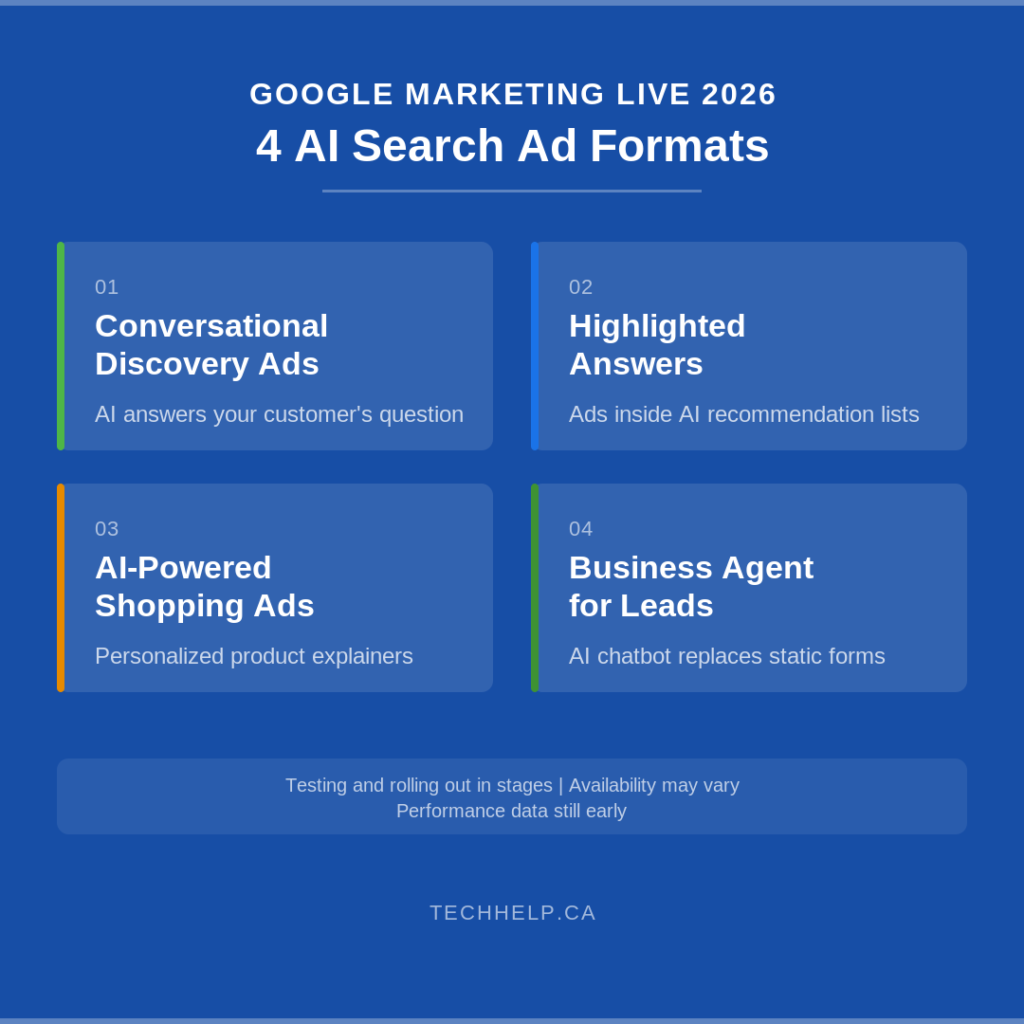
Google introduced several Gemini-powered ad experiences at Marketing Live 2026, and four of them show how different AI search advertising is becoming from the traditional search ads you’re used to.
Conversational Discovery Ads
These are built to answer a searcher’s specific question inside AI Mode. Say someone’s looking for ways to make their home smell like a spa. Instead of showing a standard text ad, Gemini generates creative that’s tailored to that exact query and pairs it with an independently generated explainer. That explainer isn’t the advertiser’s pitch. Gemini evaluates and synthesizes product information on its own, giving the searcher a layer of context alongside the ad.
Highlighted Answers
These show up when AI Mode generates a list of recommendations. If someone asks for the best language apps before a trip, relevant ads can now appear directly in that recommendation list. It’s subtle. Your ad looks like one of the suggestions, not an interruption.
AI-Powered Shopping Ads
These take product search a step further. When someone searches for an espresso machine, Gemini pulls up matching products and writes a custom explainer for each one, highlighting why a particular machine might be the right fit based on what the person asked. It’s a personalized product pitch, generated in real time.
Business Agent for Leads
This replaces the static lead-gen form with a Gemini-powered chatbot that lives inside your ad. Instead of filling out a form and waiting for a callback, potential customers can have a conversation with an AI that answers based on information from your website. It handles their questions and qualifies them before they ever talk to a human on your team.
Google is still testing and rolling out these formats in stages, so availability is limited and likely to shift. Conversational Discovery Ads and Highlighted Answers are being tested in AI Mode, AI-powered Shopping ads are coming through Performance Max and AI Max for Shopping, and Business Agent for Leads is being positioned as a conversational lead-qualification experience inside Search ads.
The Numbers Behind the Shift
These new ad formats aren’t landing in a vacuum. They’re part of a much larger shift in search attention, ad inventory, and campaign strategy toward AI-driven search surfaces.
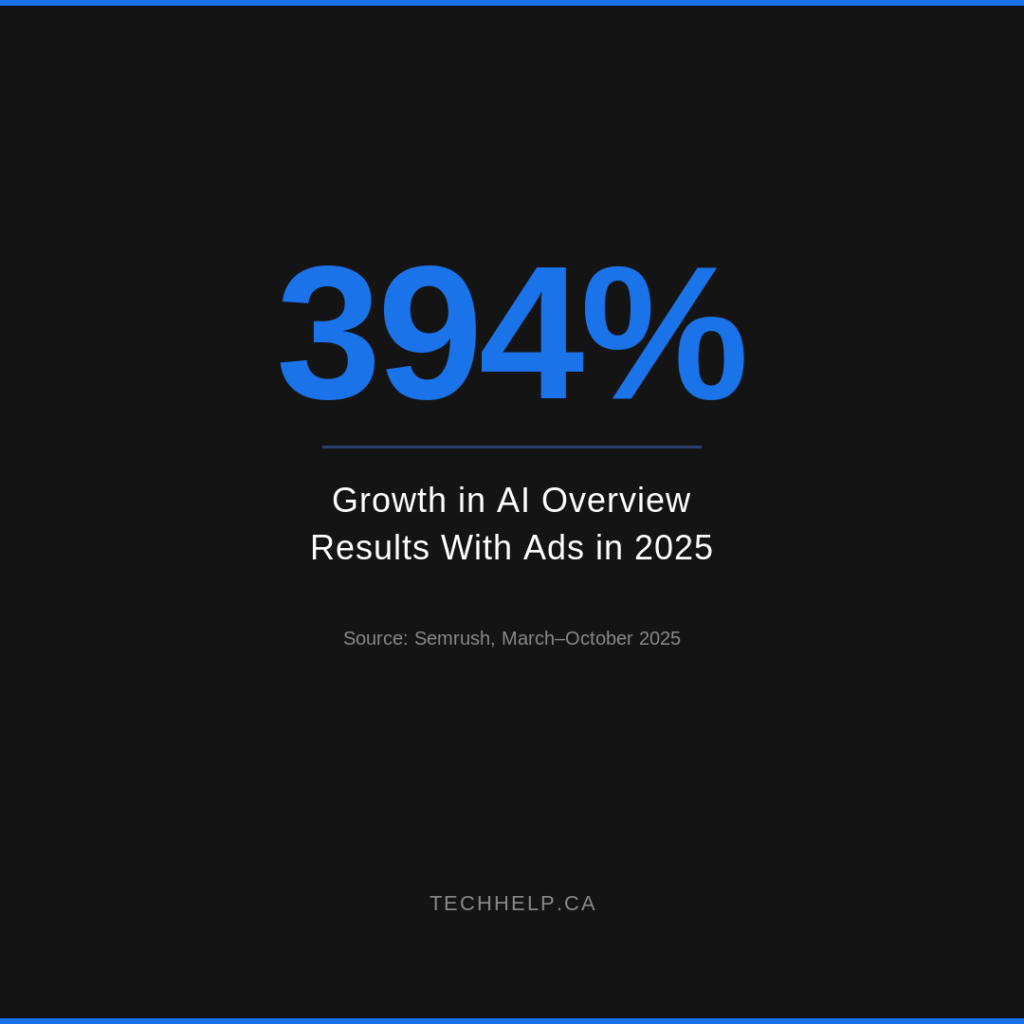
Semrush found that in 2025, the share of AI Overview search results that included ads jumped from roughly 5% in March to over 25% by October, a 394% increase in eight months. Google’s AI Mode has grown fast too. At Google I/O 2026, Sundar Pichai said AI Mode in Search had more than 1 billion monthly active users.
On the revenue side, Google Search and other advertising revenue reached $60.4 billion in Q1 2026, up 19% year over year. But there’s a counterpoint: Google Network ad revenue, which includes ads on partner websites, fell 4% to $7 billion in the same quarter.
What does that mean? Ad dollars aren’t disappearing. They’re moving. One of the clearest new destinations is AI search surfaces, and Google is building the ad infrastructure to capture that demand.
What This Is Doing to Your Traffic and Ad Costs
This is where the shift starts hitting budgets.
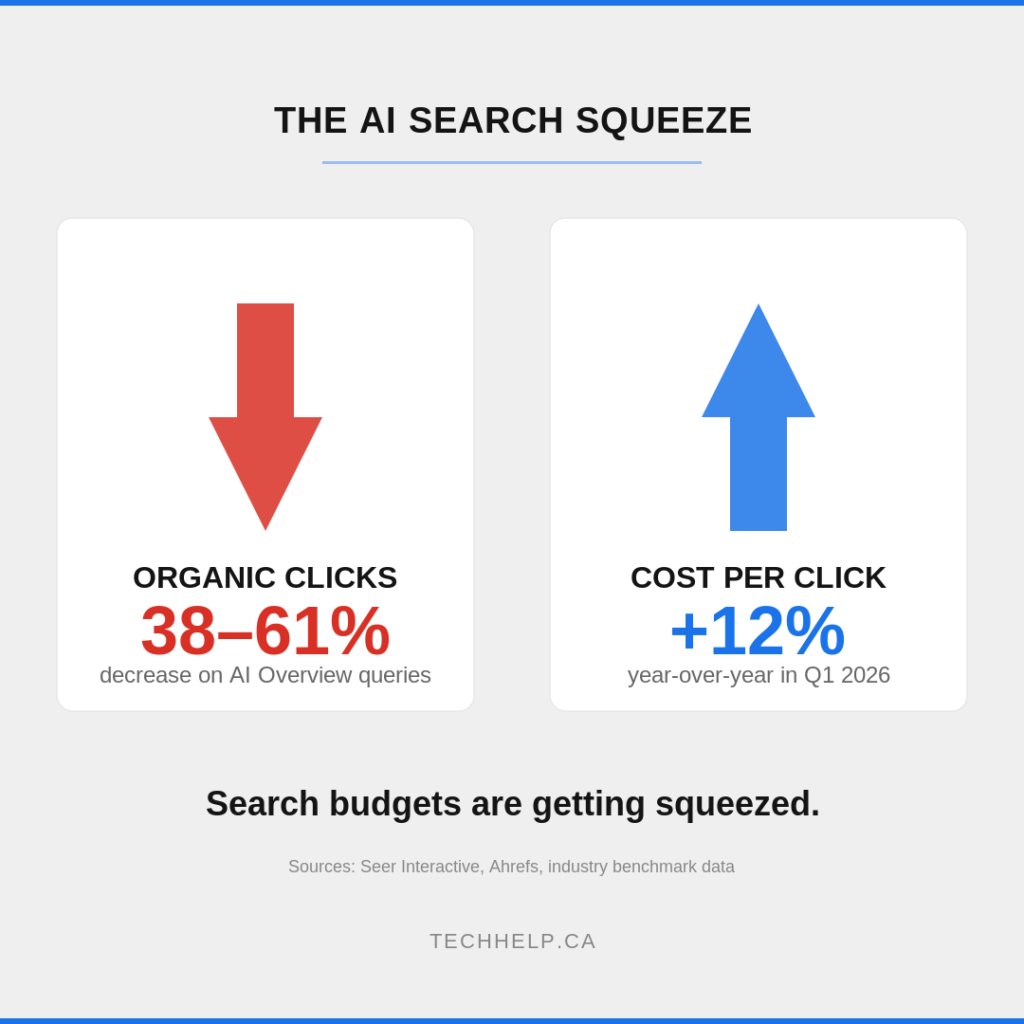
Multiple studies now show that organic click-through rates drop between 38% and 61% on queries where AI Overviews appear. A Seer Interactive study found organic CTR fell from 1.76% to 0.61% on those queries. Ahrefs reported a 58% drop for top-ranking pages. And zero-click searches, where the user gets their answer without clicking any result, hit 80% to 83% when an AI Overview is present.
The paid side is more complicated. Some data shows paid search behavior has been steadier than organic on AI Overview queries, but costs are still rising. Industry benchmark data puts the average search CPC at $2.96 in Q1 2026, up 12% from Q1 2025, which means advertisers may still feel pressure even when paid CTR doesn’t collapse.
Put those two things together and you get the core tension: you’re paying more per click while getting fewer clicks overall. The math is squeezing advertisers from both sides.
There’s a small silver lining in the data. Organic CTR on AI Overview queries showed signs of stabilizing in early 2026, rebounding from 1.3% in December 2025 to 2.4% by February. It’s not a recovery, but the freefall may be slowing.
Who Gets Hit Hardest — and Who Benefits
Not every business feels this equally, and understanding where you sit matters a lot for deciding what to do next.
Businesses that rely heavily on informational or educational queries are taking the biggest hit. If you’re in B2B, SaaS, or lead generation and your strategy depends on people clicking through research-stage content, AI Overviews are absorbing a significant chunk of that traffic before anyone reaches your site. The AI just answers the question, and the searcher moves on.
E-commerce businesses and local service providers are holding up better, especially on high-intent product searches. When someone’s ready to buy, the search results still tend to drive clicks. AI Overviews are less likely to fully satisfy a purchase-intent query with a summary alone.
There’s also a meaningful advantage for brands that get cited in AI Overviews. In Seer Interactive’s 2025 analysis, websites cited in AI Overviews saw 35% higher organic CTR and 91% higher paid CTR. Its 2026 update also found that citation status remains one of the biggest drivers of how brands perform when AI Overviews appear.
Publishers, meanwhile, have been hit hard. Press Gazette and Chartbeat data covering the year through November 2025 showed that Google search traffic to publishers dropped roughly a third globally, with U.S. publishers experiencing the steepest decline at around 38%. That pressure is continuing as AI Overviews expand, though the exact impact will vary by publisher, category, and audience mix.
How to Adapt Your Strategy
If you’re running Google Ads and haven’t adjusted for AI placements, you’re leaving yourself exposed to rising costs without the upside of the new formats. Here’s what to prioritize.
Get Eligible for AI Placements
Build around the products Google is pointing advertisers toward for these new surfaces: AI Max for Search, AI Max for Shopping, and Performance Max where they fit your account. The goal is to give Google enough signal, creative, and product data to match your offer to more conversational queries.
Rewrite Your Ad Copy to Educate, Not Just Sell
AI Overviews often start from research-style queries. Ads that answer questions, explain benefits, and guide decisions are more aligned with these placements than traditional “Buy Now” copy. Think of your ad as a helpful answer that happens to come from your brand.
Target Conversational, Long-Tail Keywords
Queries like “how to prevent knee pain while running” trigger AI Overviews far more often than “running shoes.” These longer, more specific queries are where the new ad formats live, and they tend to attract users who are further along in their decision-making.
Upgrade Your Landing Pages
These placements put more pressure on the page after the click. If the searcher asked a detailed question, a thin conversion page may not be enough. Build pages that genuinely answer the question the searcher asked, with your conversion path woven naturally into the content.
Pursue AI Citation Optimization
Getting your content cited in AI Overviews isn’t just an organic play. It amplifies your paid performance too. Create authoritative, well-structured content on topics in your niche. Use clear headings, direct answers, and data-backed claims. The brands that show up in AI answers get a credibility boost that carries over to your other listings.
Track AI Placements Separately
Google doesn’t yet separate AI placement performance in most dashboards. Use campaign naming, query themes, landing page segments, and UTMs where possible to build your own baseline data around AI-focused tests. You can’t optimize what you can’t measure, and right now, measurement requires some manual work.
Audit Your Current Campaigns for Readiness
Review your account structure, match types, and bidding strategies against the eligibility requirements for AI placements. This is a low-effort, high-payoff step you can take right now.
The Trust Problem Google Has to Solve
There’s a bigger question underneath all of this: will people actually trust ads that are woven into AI-generated answers?
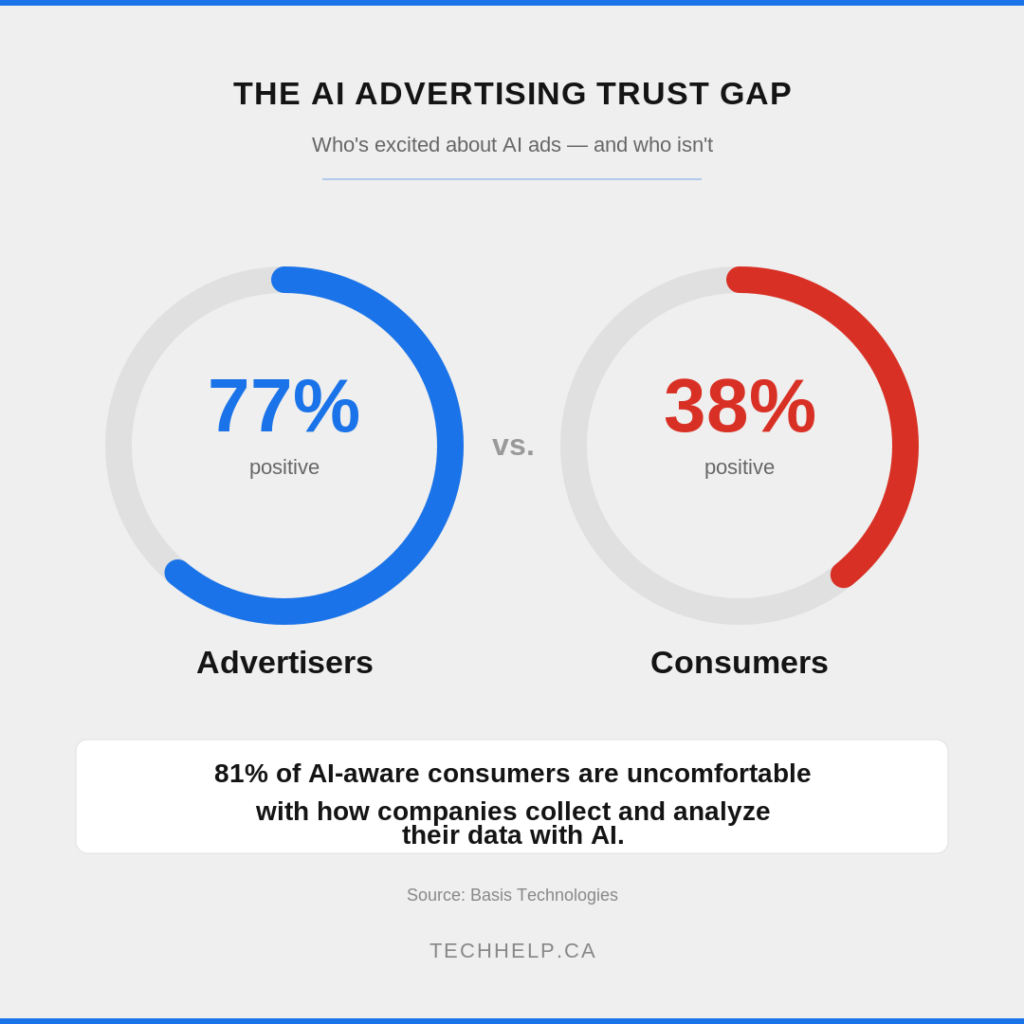
The gap between advertiser enthusiasm and consumer comfort is wide. According to research from Basis Technologies, 77% of advertisers have a positive view of AI in advertising. Only 38% of consumers feel the same way. And among consumers who are familiar with AI, 81% say they’re uncomfortable with how companies use the technology to collect and analyze their personal data.
That discomfort isn’t abstract. A 2026 study found that AI can accurately infer sensitive personal attributes, including political preferences, education level, and employment status, solely from the pattern of ads shown to a user. The profiling happens quickly, scales easily, and can occur outside the platform’s direct oversight.
Google has taken some steps to address trust concerns. In 2026, UK regulatory pressure pushed Google toward giving publishers more control over whether their content appears in AI search features, though industry groups have questioned how meaningful those controls will be in practice. And all of the new ad formats announced at Marketing Live include labeling to distinguish ads from organic AI content, though how effective that labeling is in practice remains to be seen.
Microsoft is approaching the same challenge differently with its Copilot ads, embedding product recommendations directly into the conversational flow rather than placing ads adjacent to AI answers. Early data suggests Copilot ad placements are about 25% more effective than traditional search ads, though Microsoft’s search market share, roughly 2.5% globally, limits the scale of comparison.
For you as an advertiser, the trust question matters because it affects performance. If users start distrusting AI answers because they can’t tell what’s a recommendation and what’s a paid placement, click quality could suffer even as impression volume grows.
What to Watch Going Forward
This is still early. Google’s new formats are in testing or staged rollout, not mature ad products with years of benchmark data behind them. That means the rules, placements, and performance data will shift significantly over the coming months.
A few things are worth tracking closely. First, watch whether Google breaks out AI placement performance in standard reporting. Right now, measurement is clunky. If Google makes it easier to see how AI placements perform relative to traditional ones, that’ll accelerate adoption and optimization.
Second, keep an eye on CPC trends. If the 12% year-over-year rise continues while click-through rates stay compressed, smaller advertisers will feel the squeeze. The businesses with the deepest pockets can absorb rising costs. Everyone else needs a sharper strategy.
Third, pay attention to how consumers respond. If trust in AI-generated answers holds, these ad formats could become some of the highest-performing placements in Google’s inventory. If trust erodes, the whole model faces headwinds.
Google isn’t just adding AI to search. It’s turning AI search into paid inventory. You don’t have to move all your budget tomorrow, but you do need to understand the new search environment and start testing.
The businesses that learn conversational advertising first will have an advantage when these formats scale. Not because they chased every new Google feature, but because they figured out the hard parts early: campaign setup, measurement, landing pages, and trust.
That’s the real test now. Not whether AI ads are coming, but whether your budget is ready for search when the answer, the ad, and the buying path start blending together.
Get new small business insights by email
Practical ideas and useful articles to help you make better business decisions.
We empower people to succeed through practical business information and essential services. If you’re looking for help with SEO, copywriting, or getting your online presence set up properly, you’re in the right place. If this piece helped, feel free to share it with someone who’d get value from it. Do you need help with something? Contact Us