Canada Day is over. The fireworks went off, patios filled, staff schedules got tested, and a midweek holiday gave business owners a useful read on where customers are spending now.
This year’s Canada Day didn’t follow the normal holiday pattern. July 1 landed on a Wednesday, which meant no built-in long weekend and no natural three-day spending curve. Some customers treated it as a one-day break. Others likely turned Thursday and Friday into vacation days and stretched the week themselves.
For small businesses, that kind of calendar wrinkle can expose a lot: whether your staffing model holds, whether your inventory planning matches demand, whether customers are still spending on experiences, and whether “Buy Canadian” has moved from sentiment into actual behaviour.
If you tracked what happened in your business on July 1 and the days around it, you’ve got useful planning data for the rest of the summer. If you didn’t, you can still use the broader signals to prepare for the August long weekend.
A Wednesday holiday changed the spending pattern
When Canada Day falls on a Friday or Monday, demand often spreads across a long weekend. Restaurants get multiple service windows. Retailers can build momentum over several days. Service businesses can plan around a more predictable pause.
Wednesday compressed the pattern. Customers who wanted to celebrate had to decide whether to spend on the holiday itself, save plans for the weekend, or create a longer break by taking Thursday and Friday off. That can produce a sharper spike on the day itself, followed by a softer end of week if too many people are away.
Staffing and stock planning change with that pattern. A business set up for a long-weekend rhythm may have carried too much labour across the wrong days. A business treating July 1 like a normal weekday may have missed the one day when demand concentrated.
The lesson isn’t complicated: holiday revenue should be reviewed by day, not just by week. A decent weekly total can hide the fact that you were overstaffed on Thursday and underprepared on Wednesday.
Canadians are still spending, but they’re choosing more carefully
The spending data heading into Canada Day points in one direction: Canadians haven’t stopped spending, but they’re more selective about where the money goes.
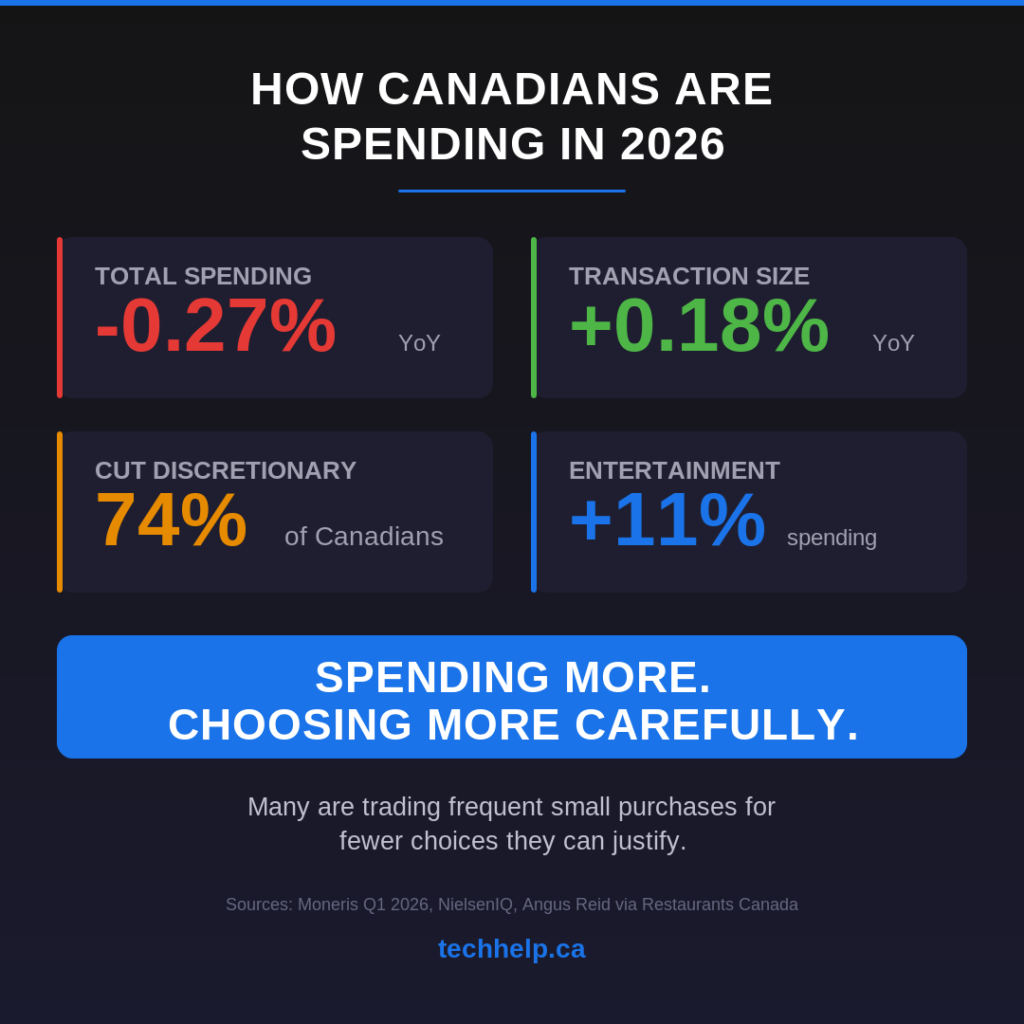
Retail Insider, citing Moneris data, reported that total Canadian spending declined 0.27% year over year in the first quarter of 2026, while the average transaction size rose 0.18%. Grocery spending rose 3%, mass merchant spending climbed nearly 7%, apparel fell 2%, and department stores dropped 8%.
Taken together, that looks less like a collapse and more like a sorting process.
NielsenIQ found a similar pattern in fast-moving consumer goods. Spending rose 4.8% year over year, but units per trip fell 3.2%. Customers are spending more dollars while putting fewer items in the basket. They are buying, but they’re thinking harder about what makes the cut.
Restaurants Canada also pointed to pressure on discretionary spending, citing Angus Reid data showing 74% of Canadians had reduced discretionary spending, with dining out and takeout among the most common areas for cuts. At the same time, Moneris reported entertainment spending rose 11% in the first quarter, with average transaction size up 17%.
So the story isn’t “customers are broke.” It’s more precise than that. Many are trading frequent small purchases for fewer choices they can justify.
For businesses, this makes customer retention more valuable. If people are visiting less often, every visit has to carry more weight. The customer who already trusts you is easier to bring back than the one who has to be convinced from zero.
Buy Canadian has measurable momentum
Canada Day also landed inside a wider consumer shift toward domestic spending.
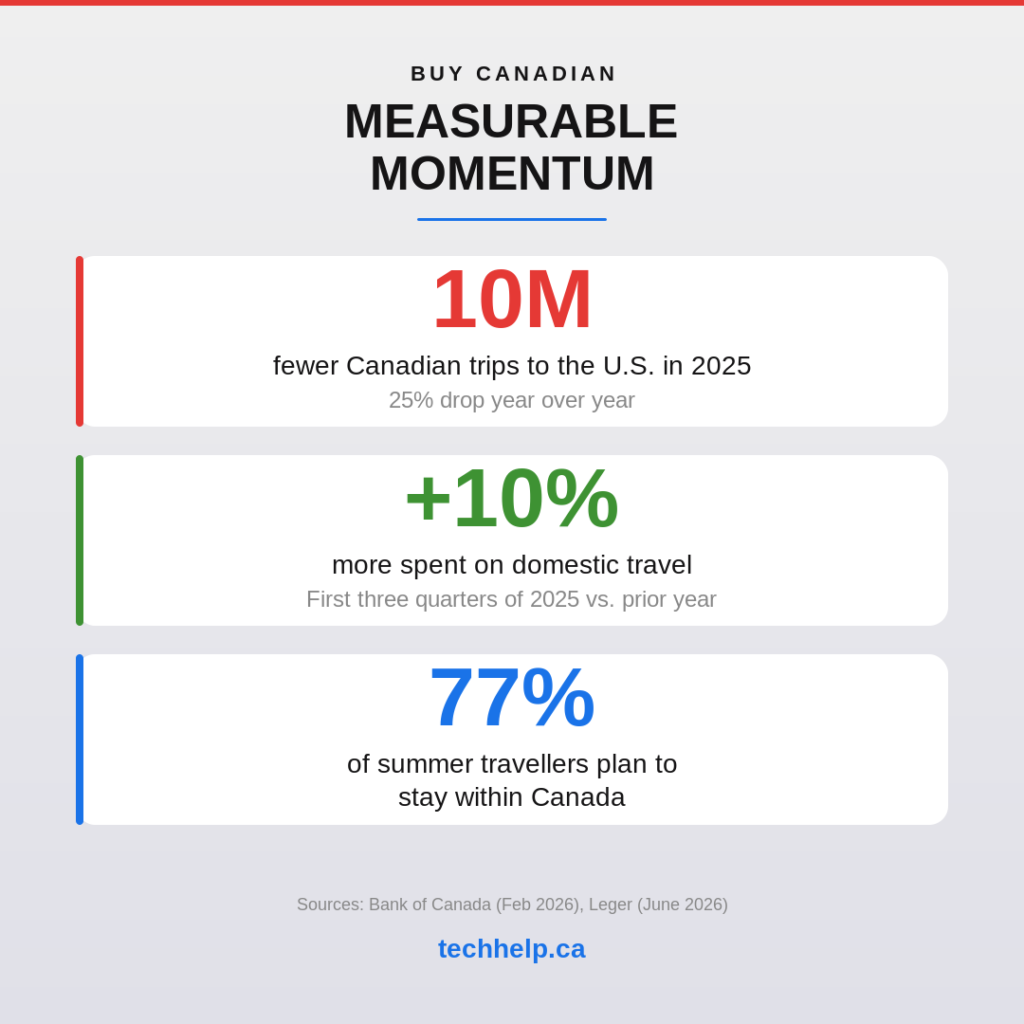
The Bank of Canada reported that Canadians took close to 10 million fewer trips to the United States in 2025 than in 2024, a 25% drop. Land trips fell about 30%, while air trips declined 12%. During the first three quarters of 2025, Canadians took 4% more domestic trips and spent about 10% more in Canada on travel and tourism than they did during the same period the year before.
That domestic tilt has continued into summer planning. Leger reported in June 2026 that 56% of Canadians planned a summer leisure trip, unchanged from 2025 and up from 2024. Among summer travellers, 77% intended to travel within Canada. Interest in U.S. travel rose from 2025, but it remained well below 2024 levels.
Food spending has shifted too. The Bank of Canada found that Canadian consumers increased their share of grocery spending on products from Canadian companies, while spending on comparable U.S. products fell by a similar amount.
That gives Canadian businesses an opening, but only if customers can see the connection. The Bank of Canada also flagged a practical barrier: consumers often struggle to identify domestic products and services clearly. Good intentions don’t always survive a busy shelf, unclear packaging, or a checkout page that buries the local angle.
If your business is Canadian-owned, sells Canadian-made products, sources locally, or keeps money in the community, don’t make customers work to figure that out. Put it in plain sight on menus, signage, product pages, email campaigns, receipts, and social posts. Around national holidays, clarity can turn sentiment into revenue.
The economy stalled, but wallets didn’t shut
The recession label doesn’t fit the current Statistics Canada release. The agency reported that real GDP was unchanged in Q1 after a 0.2% decline in Q4 2025. That’s still a weak economy, but it calls for a more precise read.
For business owners, the details change the decision. Household spending rose 0.4% in Q1, led by areas such as financial services and food. At the same time, business capital investment fell 0.7%, marking a fifth consecutive quarterly decline, and the household saving rate slipped to 3.5%.
In other words, consumers kept spending in some categories while businesses stayed cautious. CFIB’s June 2026 Business Barometer shows why that caution is still rational. Long-term small business optimism sat below the neutral 50 mark, while 53% of small businesses named insufficient demand as a constraint. Fuel costs, taxes, regulatory costs, wages, and input costs were all major pressure points.
That’s the environment Canada Day landed in: customers still willing to spend, but business owners dealing with thinner room for mistakes. If you’re trying to lead through business uncertainty, the job is to separate weak demand from misread demand.
A slow day may mean customers don’t want the offer. It may also mean the offer was right but the timing, price point, staffing, or promotion missed the moment.
Stat holiday labour costs need closer attention
If you had employees working on July 1, Canada Day wasn’t just a sales day. It was a payroll test.
Statutory holiday rules vary by province, but many employers need to account for two separate pieces: holiday pay eligibility and premium pay when an eligible employee works the holiday. In several provinces, that premium is 1.5 times the regular wage. Newfoundland and Labrador uses a different premium structure, and Quebec, Prince Edward Island, and other provinces have their own rules and formulas.
The risk for owners is treating holiday labour as a simple overtime calculation. It often isn’t.
A good post-holiday review should compare total labour cost, including holiday pay, premium pay, overtime, schedule changes, and manager coverage, against the revenue generated on the holiday and surrounding days. A busy Canada Day can still be weak if payroll swallowed too much of the margin.
This is where a basic cost-benefit analysis is useful. Don’t just ask whether sales were higher. Ask whether the extra revenue justified the extra labour cost, inventory risk, and operational strain.
Online and in-store behaviour both count
Canada Day also offered a useful reminder that customer journeys are split across channels.
Landmark Global estimates that e-commerce represents 14.5% of Canadian retail sales, with cross-border purchases accounting for about 34% of e-commerce buying. Meanwhile, Moneris has pointed out that many shopping journeys now begin online even when the purchase still happens in person. For holiday planning, the sale may not start where it finishes.
A customer might search for your hours online, check your menu, compare prices, look for a Canadian-made product, or confirm curbside pickup before ever walking in. If your holiday information is missing or wrong, you can lose the sale before your staff sees the customer.
For the next holiday, review your website, Google Business Profile, social profiles, product pages, booking pages, and email reminders before the rush. If the customer has to guess whether you’re open, whether an offer applies, or whether stock is available, some will move on.
What to measure before the August long weekend
The next major summer test is August 3, when Civic Holiday, British Columbia Day, and other provincial holiday equivalents arrive depending on where your business operates. Canada Day gave you the preview. August gives you the chance to adjust.
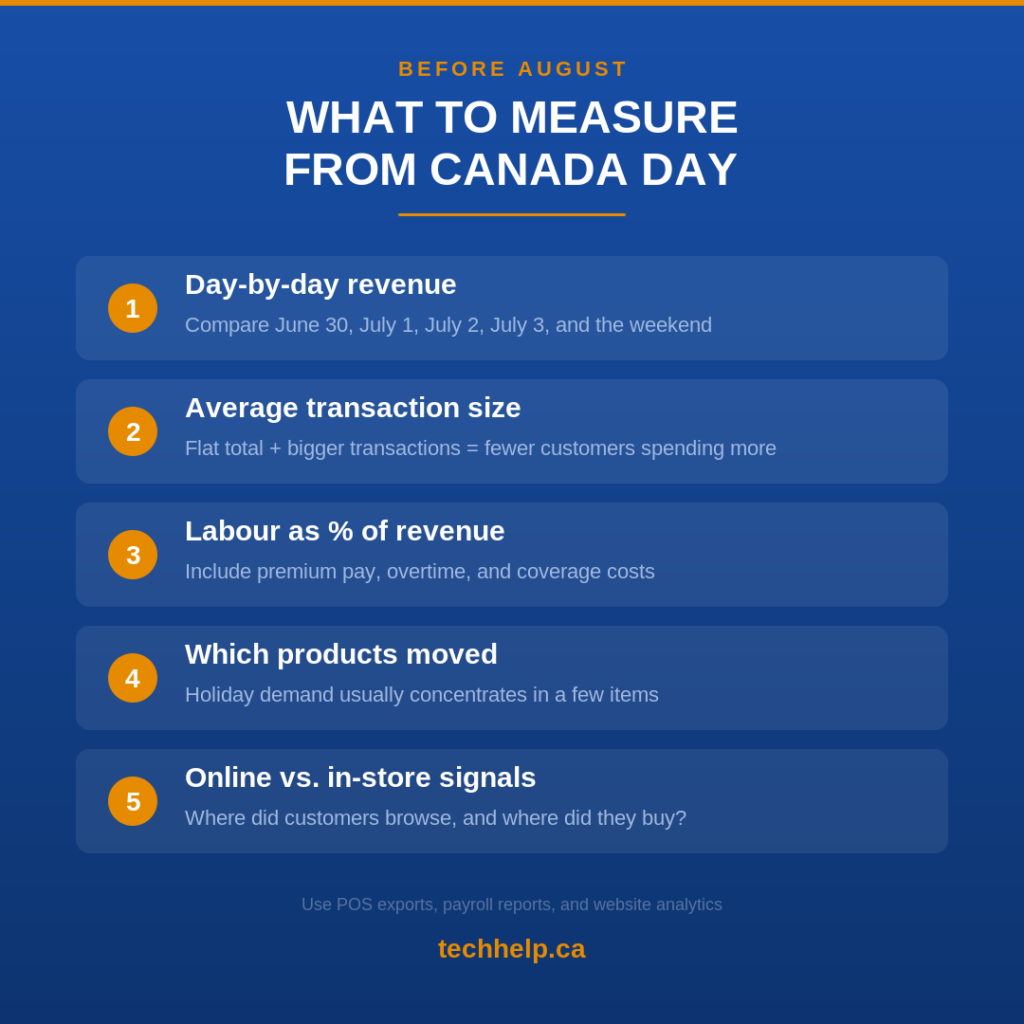
Start with day-by-day revenue. Compare July 1, June 30, July 2, July 3, and the following weekend. You want to know whether customers spent on the holiday, ahead of it, after it, or not at all.
Then look at average transaction size. If total revenue was flat but transaction size increased, you had fewer customers spending more. That calls for a different plan than a high-traffic, low-ticket day.
Review labour as a percentage of revenue, including premium pay and coverage costs. This number will tell you whether your staffing plan made money or only made the day feel busy.
Check which products, services, menu items, or offers moved. Holiday demand usually isn’t evenly spread. A few items often carry the day, while other inventory sits still.
Finally, compare online signals with in-store activity. Did people check hours, click pickup options, browse Canadian-made items, or open holiday emails without buying? That tells you where friction showed up.
If you don’t already track these pieces, build the system before the next holiday. It doesn’t have to be complicated. A spreadsheet, POS export, payroll report, and quick notes from staff can tell you more than a vague memory of whether the day “felt busy.”
Canada Day was an operations test
Canada Day 2026 doubled as an operations test. The day showed how a midweek holiday changes demand, how selective Canadian consumers have become, how domestic loyalty can influence buying, and how quickly payroll can eat into a strong sales day. It also showed that the economy can look weak on paper while customers still spend when the offer feels worth it.
You can’t redo July 1, but you can use what it revealed. Before the next holiday hits, review the numbers, fix the obvious misses, and make the Canadian value of your business easier to see. The businesses that treat holidays as data points get sharper each time. The ones that rely on memory usually repeat the same mistakes.
Get new small business insights by email
Practical ideas and useful articles to help you make better business decisions.
Tech Help Canada Staff researches, writes, and reviews practical content for business owners and professionals. Our coverage spans business, marketing, SEO, technology, and the tools and systems people use to grow and operate online. We focus on clear, useful information backed by research, hands-on experience, and editorial review. Learn more about our team and editorial standards. Need help with something? Contact Us