On September 24, 2026, Google said a prototype satellite developed with Planet will carry Tensor Processing Units (TPUs) into low Earth orbit aboard SpaceX’s Transporter-18 rideshare mission. As of September 29, 2026, SpaceX listed Transporter-18 for Thursday, October 1, 2026, at 11:18 a.m. PT from Space Launch Complex 4E at Vandenberg Space Force Base in California.
The first test is about survival
Project Suncatcher, which Google announced in November 2025, explores whether future machine learning infrastructure could run on constellations of solar-powered satellites. The October 2026 mission narrows that large idea to a practical question: can AI accelerators that were designed for data centers operate in orbit?
Google’s public announcement frames the mission around survivability. A rocket trip into low Earth orbit lasts about 10 minutes, during which the spacecraft experiences vibration and sustained acceleration loads as much as 10 times the force of gravity. Google said individual components, including TPU chips, can experience even greater forces in the 50 to 100 g range.
The company said its team conducted vibration testing by shaking the satellite across all three axes to mimic launch conditions. That ground testing is useful, but the actual orbit test is meant to show how the hardware behaves after launch and during operation in space.
The satellite is small on purpose
Ars Technica reported that the first satellite is called MVP, is roughly refrigerator-sized and carries four TPUs. It also reported that Google plans to run Gemini models on the chips in short bursts of about 15 minutes before cooling periods.
Four chips in a compact spacecraft are a long way from the thousands of accelerators used in terrestrial AI data centers. The point of MVP is to learn how the hardware behaves in orbit before Google attempts larger satellite clusters.
Radiation and heat are the hard problems
Radiation is one of the biggest unknowns for AI hardware in orbit. Google said it tested TPUs in a proton beam facility at UC Davis’s Crocker Nuclear Laboratory while running AI workloads. The company said initial Trillium TPU results showed the chips could survive a total ionizing dose greater than what they would receive during a five-year space mission.
Google’s research paper still treats radiation errors as an open engineering issue. It says the impact of single-event effects on training jobs and system-level mitigations requires further study.
Heat may be the more visible limit for the first satellite. TPUs put a lot of heat into a compact area. In space, there is no airflow, so heat has to move through materials into radiators and then radiate away.
Google said its team has tested a combination of heat pipes and radiators in a thermal vacuum chamber. That work is central to Suncatcher because a satellite cannot rely on the kind of airflow, service access and physical cooling infrastructure available in a ground data center.
Why Google is interested in orbit
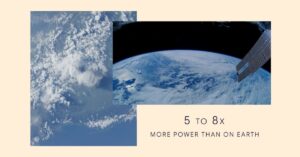
Project Suncatcher exists because Google is exploring whether compute can be placed closer to a large energy source. Google’s research paper says solar panels in certain orbits are exposed to nearly continuous sunshine and receive as much as eight times more solar energy per year than a panel located on Earth at mid-latitude.
The longer-term design is not one satellite. Google’s concept uses clusters of solar-powered satellites, each eventually carrying dozens of TPU chips and communicating with neighbouring spacecraft by laser. The company says those laser links need very high bandwidth across short distances, with precision comparable to hitting a coin-sized target from miles away while both points are moving.
Planet’s role fits that longer plan. Planet said in November 2025 it would build and operate two prototype satellites for Google, targeting a launch by early 2027, to test both TPU performance and high-bandwidth cross-link communications. Google now says it expects to test satellite laser communication work in 2027 when two satellites are in orbit.
The economics are still uncertain
A successful mission would not solve launch cost, repair, replacement, ground links, orbital debris, or large-scale thermal management.
Google’s own paper keeps the economics conditional. It describes launch costs as a critical part of the system and says its launch-cost discussion is not a full economic analysis. It also notes that failed TPUs are easy to replace on Earth and impractical to replace in space, making reliability and redundancy central to any future design.
For businesses watching AI infrastructure, the mission is an experiment, not a public cloud service. Google is testing a path that may take years to become a product, if it becomes one at all. The test shows how far AI infrastructure planning is stretching as compute and energy demand keep rising.
What to watch after launch
Launch and deployment: whether Transporter-18 launches on the current target and whether the satellite checks out after reaching orbit.
TPU health: whether radiation creates errors, reboots, bit flips, or other issues while the chips run AI workloads.
Thermal limits: how long the chips can run before cooling becomes necessary and whether the radiator system performs as expected.
The 2027 link test: whether the two-satellite milestone can handle the high-bandwidth laser communication needed for future clusters.
The most useful result may be failure data. If Suncatcher stays small and experimental, it will still show where orbital AI compute runs into hard physical limits.
Get new small business insights by email
Practical ideas and useful articles to help you make better business decisions.
Tech Help Canada Staff researches, writes, and reviews practical content for business owners and professionals. Our coverage spans business, marketing, SEO, technology, and the tools and systems people use to grow and operate online. We focus on clear, useful information backed by research, hands-on experience, and editorial review. Learn more about our team and editorial standards. Need help with something? Contact Us