Affiliate marketing isn’t the opposite of digital marketing. It’s one way to make money with digital marketing skills.
But when people search “digital marketing vs affiliate marketing,” they usually want a more practical answer: which path is better if you want to earn online?
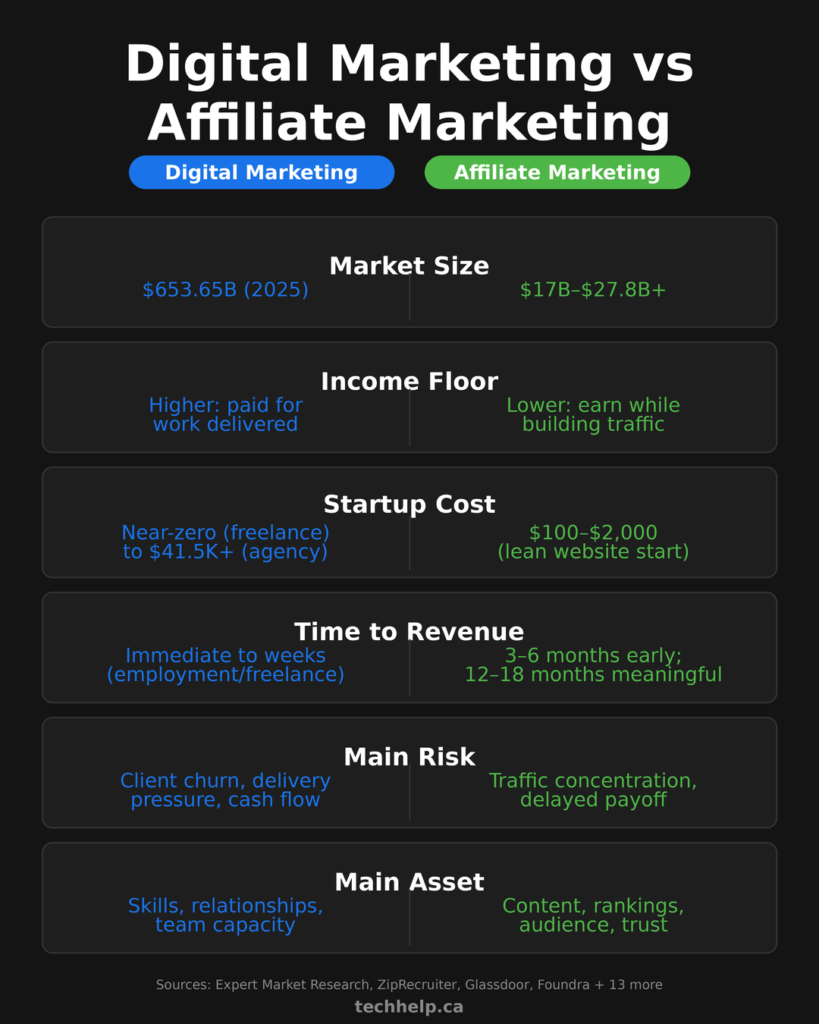
The answer depends on what you need first. Digital marketing services can pay faster because you sell skills directly to employers or clients. Affiliate marketing usually takes longer because you build traffic, trust, and content assets before the commissions become meaningful. One has a stronger income floor. The other can create more leverage once the system works.
The useful comparison is in the numbers: market size, income ranges, startup costs, time to revenue, risk, ROI, and the related models people often mix together.
The short answer
Digital marketing is the broader field. It includes SEO, paid ads, email marketing, social media, content marketing, analytics, conversion optimization, web design, and marketing strategy.
Affiliate marketing is a performance-based business model inside that field. Affiliates use digital marketing tactics to promote another company’s product and earn a commission when a tracked sale, lead, signup, or click happens.
So the better question isn’t whether digital marketing or affiliate marketing is “better.” It’s which income model fits your situation.
If you need income quickly, digital marketing services usually win. You can get hired, freelance, consult, or start with a small service offer. You’re paid for work delivered.
If you can afford a slower ramp and want to build a long-term asset, affiliate marketing can be attractive. You publish content, build an audience, and earn commissions from traffic you control or influence. You’re paid for outcomes, not hours.
Digital marketing vs affiliate marketing at a glance
Metric
Digital marketing services
Affiliate marketing
Definition
A marketing field and service category
A commission-based revenue model
How you earn
Salary, freelance fees, retainers, consulting, agency work
Commissions on sales, leads, trials, clicks, or recurring subscriptions
Market size
Expert Market Research valued the global digital marketing market at $653.65 billion in 2025
Estimates vary by definition, with recent global figures ranging from about $17 billion to $27.8 billion-plus
Income floor
Higher, because employment and freelance work can pay immediately
Lower, because most beginners earn little while building traffic
Income ceiling
High for agency owners, senior leaders, and specialized consultants
High for affiliates with strong traffic, trust, and profitable offers
Startup cost
Near zero for freelancing; much higher for a staffed agency
Often $100 to $2,000 for a lean website-based start
Time to first revenue
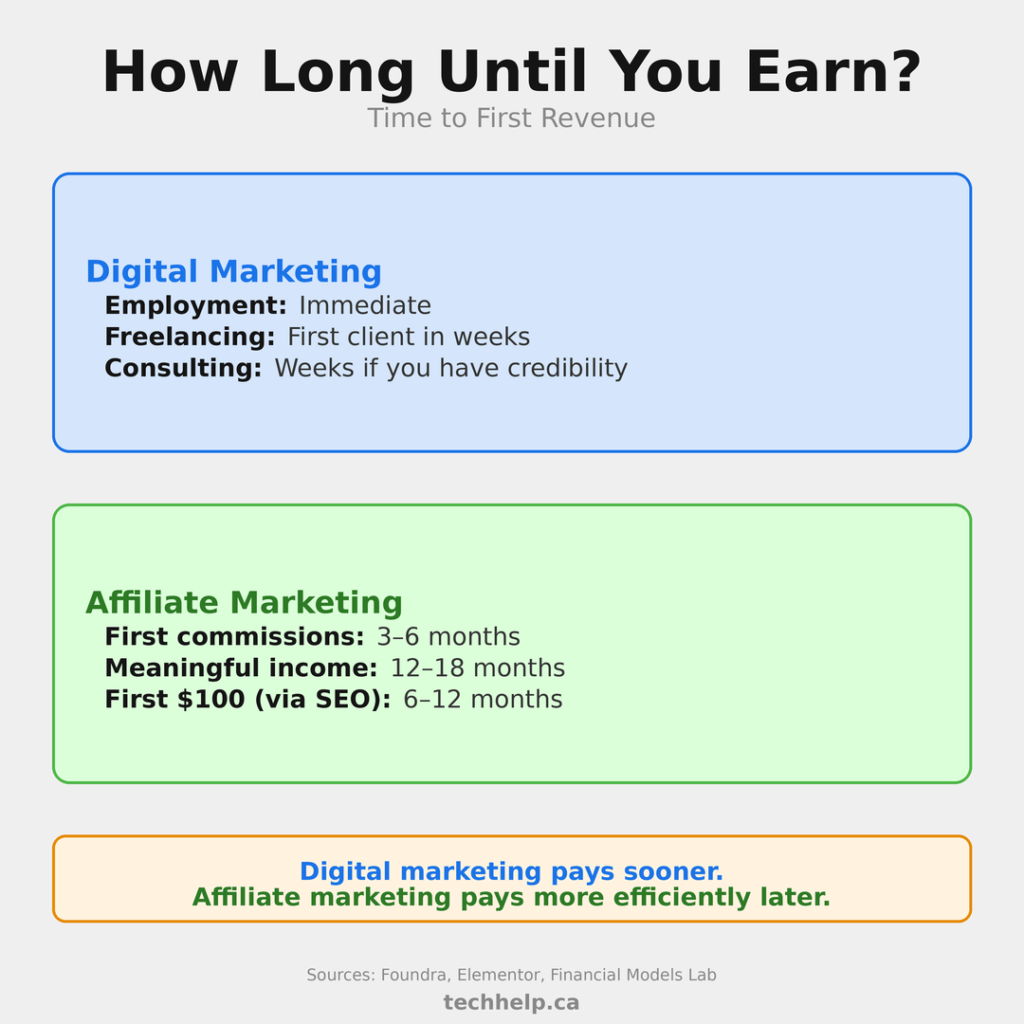
Immediate for employment; weeks to months for freelancing
Often 3 to 6 months for early commissions and 12 to 18 months for meaningful income
Main risk
Client churn, delivery pressure, competition, hiring, and cash flow
Skills, relationships, case studies, systems, and team capacity
Content, rankings, audience, email list, trust, and offer relationships
That table is the whole comparison in miniature. Digital marketing is usually the faster way to make money. Affiliate marketing is usually the more leveraged way to make money once it works.
Why the market size numbers don’t line up perfectly
The market-size comparison is useful, but it needs context.
Expert Market Research valued the global digital marketing market at $653.65 billion in 2025 and projected it to reach more than $1.5 trillion by 2035. That number covers the broader market: paid media, SEO, email, social media, websites, marketing technology, and related digital channels.
Affiliate marketing is smaller because it’s one slice of that market. Post Affiliate Pro places the 2025 global affiliate marketing industry around $17 billion to $18.5 billion, with U.S. spend near $12 billion. FirstPromoter cites a broader estimate, saying the global affiliate market was $27.8 billion in 2024 and could reach $48 billion by 2027.
Those estimates aren’t identical because they may measure different things: affiliate program spend, affiliate network activity, affiliate software, partner-driven commerce, or broader affiliate-attributed revenue.
For comparison, the key point is simple: digital marketing is the larger career and business field. Affiliate marketing is a narrower monetization model that depends on many of the same digital marketing skills.
How digital marketing pays you
Digital marketing pays through direct work. You provide a service, manage a channel, improve a business outcome, or help a company acquire customers.
The common paths are employment, freelancing, consulting, and agency ownership.
Employment is the simplest. You work as a digital marketer, SEO specialist, paid ads specialist, email marketer, content marketer, social media manager, marketing analyst, or marketing manager. ZipRecruiter listed the average U.S. digital marketer salary at $77,381 as of July 2026, while Glassdoor showed a median total pay estimate of $97,000 for digital marketing roles. The exact number depends heavily on title, seniority, location, and whether the role includes base pay, bonus, or commission.
Freelancing is the fastest independent path. You sell a specific service to clients, such as SEO audits, landing pages, email campaigns, ad management, analytics setup, content strategy, or conversion optimization. Talent.com listed an average U.S. freelance digital marketing salary of $93,750, but that kind of number needs caution. Freelancers don’t all have steady pipelines. Some earn far less, and specialists with strong positioning can earn much more.
Consulting is the higher-trust version of freelancing. Instead of only doing execution, you advise on strategy, channel selection, measurement, positioning, or growth systems. Consulting usually pays better when you have proof, experience, and a clear specialty.
Agency ownership is the scalable version. You package services, hire people or subcontractors, build systems, and sell retainers. The upside is larger, but so is the operating complexity. Financial Models Lab’s 2026 planning model for a digital marketing agency uses $41,500 in capitalized startup costs for a base setup, with much larger cash needs if you include payroll runway, sales ramp, and working capital.
The pattern is simple: digital marketing pays sooner because someone is paying for your skill directly.
How affiliate marketing pays you
Affiliate marketing pays when your recommendation produces a tracked action.
Most affiliate programs pay on one of four models. Pay-per-sale gives you a percentage of the purchase. Pay-per-lead pays when someone fills out a qualified form, starts a trial, books a call, or becomes a lead. Pay-per-click pays for traffic, though this model is less common in mature affiliate programs. Recurring commissions pay monthly or annually as long as the referred customer stays subscribed.
Commission rates depend on the product category and the margin behind it. Shopify’s affiliate commission guide explains the basic structure: the brand pays a partner when that partner influences a sale or agreed action. Tapfiliate’s 2026 benchmarks put SaaS programs often around 20% to 30% recurring, ecommerce and DTC programs commonly around 10% to 15%, and lower-margin categories like electronics closer to 5% to 10%. Rewardful also notes that SaaS and digital businesses often have gross margins high enough to support recurring affiliate commissions.
Niche selection changes the math. A $40 product with a 5% commission requires enormous volume. A $200 monthly SaaS tool with a 30% recurring commission can change the economics fast if the audience trusts you and the product retains customers.
Affiliate marketing has leverage because one content asset can keep producing. A comparison article, tutorial, YouTube video, newsletter issue, or review page can generate commissions long after publication. But that leverage only appears after you have traffic and trust.
Earnings: income floor vs income ceiling
Digital marketing has a stronger income floor. If you can do useful work, you can usually find a path to income through employment, freelancing, or a small service offer. The early money may not be glamorous, but it can arrive quickly.
Affiliate marketing has a weaker income floor. A new affiliate site, YouTube channel, newsletter, or social account can produce nothing for months. You might publish 40 pieces of content before the first meaningful commission arrives. That’s emotionally harder than most beginners expect.
The ceiling is different too.
Digital marketing can scale into six-figure employment, high-ticket consulting, or an agency with a team. The ceiling rises when you specialize, prove results, and stop selling generic “marketing help.”
Affiliate marketing can also scale into a serious business, but the earnings distribution is uneven. FirstPromoter cites estimates suggesting that about 10% to 20% of affiliates make enough to treat it as a primary income, with about 1% to 5% reaching six figures. Treat those as directional estimates, not guaranteed odds. They are useful because they show the distribution: many casual participants earn little, while a smaller group with durable traffic and strong offers earns a lot.
That trade-off is the decision: digital marketing services are more reliable early, while affiliate marketing can become more efficient later.
Startup costs and cash risk
Affiliate marketing is cheaper to start. Foundra’s 2026 startup-cost breakdown puts a lean affiliate marketing business between $100 and $2,000. At the low end, that can cover hosting, a domain, and a free WordPress theme. At the higher end, it may include a premium theme, a few months of SEO tools, basic design help, or outsourced content.
You can also start affiliate marketing without a website by using YouTube, TikTok, Instagram, LinkedIn, Reddit, Medium, or an email newsletter. The trade-off is control. A website and email list are assets you own more directly. Social platforms can change reach, rules, and monetization options overnight.
Digital marketing services can also be cheap to start if you freelance. You need a laptop, internet access, a clear offer, and enough skill to solve a problem someone will pay for. You don’t need a full brand, office, or expensive software stack on day one.
The cost changes when you start an agency. A founder-led service business can stay lean. A staffed agency has payroll, contractors, tools, reporting systems, insurance, sales costs, and client onboarding. That’s why agency ownership isn’t just “freelancing with a logo.” It’s an operations business.
If your budget is tight, the safest move is often digital marketing freelancing first and affiliate marketing on the side. Freelancing funds the learning curve. Affiliate content builds the long-term asset.
Time to revenue
Digital marketing services usually produce revenue faster.
Employment pays as soon as you’re hired. Freelancing can produce your first client within weeks if you have a clear offer and can reach the right people. Consulting can also move quickly if you already have credibility.
Affiliate marketing is slower because search traffic, audience trust, and conversion data take time. Foundra’s 2026 breakdown estimates 3 to 6 months for first commissions and 12 to 18 months for meaningful income. Elementor’s 2026 affiliate earnings guide gives a similar beginner expectation, saying many new affiliates building a website need 6 to 12 months to make their first $100.
Affiliate marketing can still be the better long-term play, but the payoff curve is delayed.
Digital marketing services are linear at first. You do work, you get paid. Affiliate marketing is delayed at first, then more leveraged if the content starts ranking, converting, and compounding.
Failure rates and risk
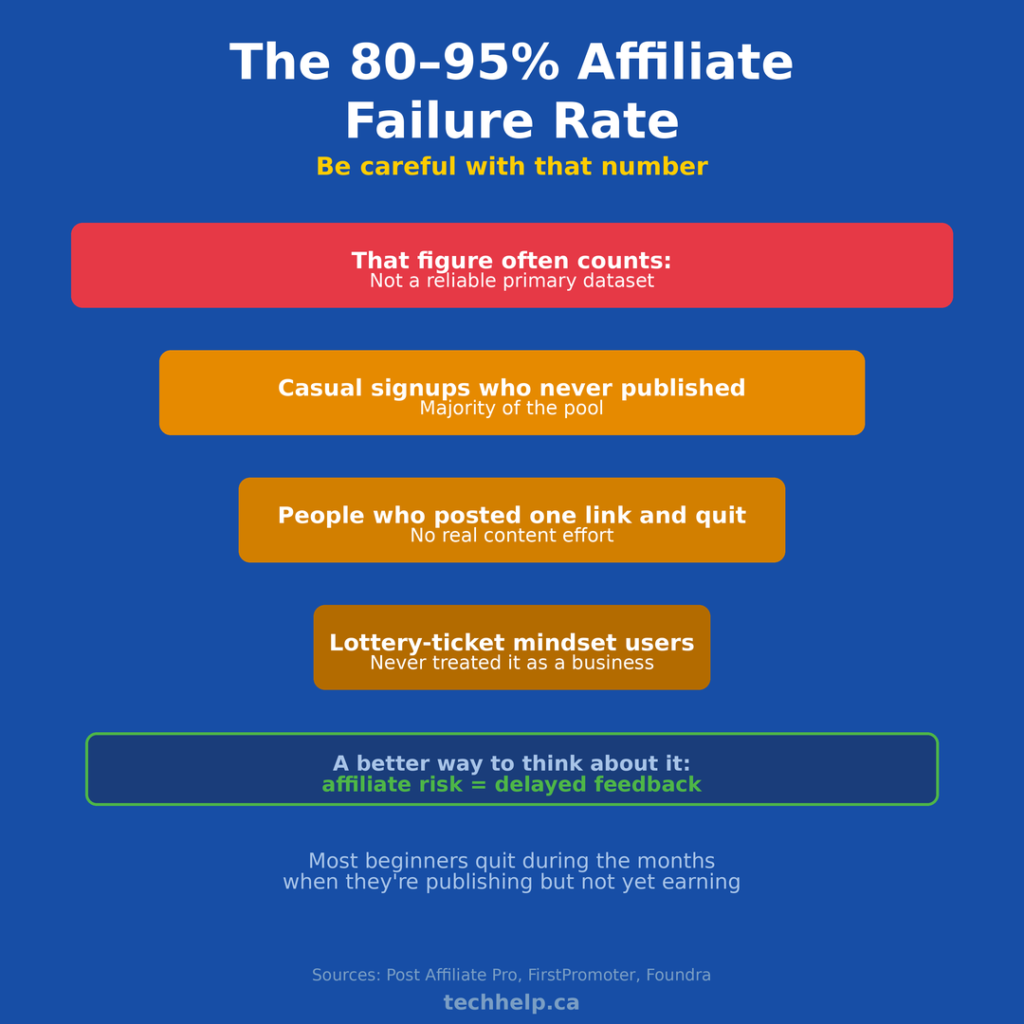
You’ll often see claims that 80% to 95% of affiliate marketers fail. Be careful with that number.
The figure is widely repeated, but it’s rarely tied to a reliable primary dataset. It often counts casual signups, people who post one link, people who never publish useful content, and people who treat affiliate marketing like a lottery ticket.
A better way to think about affiliate risk is delayed feedback. Most beginners quit during the months when they are publishing but not yet earning. They don’t have enough traffic to know whether the niche works, enough conversion data to know whether the offer works, or enough content depth to earn trust.
The biggest affiliate risks are traffic concentration, weak content, low-trust recommendations, poor niche selection, commission changes, and dependence on one platform or one program.
Digital marketing services have different risks. Freelancers can lose clients. Agencies can grow too fast, hire poorly, underprice retainers, or depend on one large account. Employees face job-market risk. Consultants can struggle if their expertise is too broad or hard to prove.
The difference is timing. Digital marketing services usually reveal problems faster because clients respond, pay, reject, churn, or refer. Affiliate marketing can take longer to reveal whether the work is working.
ROI from the business side
If you’re a business owner deciding where to invest, the comparison changes.
Digital marketing is the larger toolkit. SEO, paid search, email, content, social, conversion optimization, and analytics all play different roles. WebFX’s 2026 ROI guide lists Google Ads at about $8 in revenue for every $1 spent, while email marketing remains one of the highest-return channels. Litmus found that 35% of companies get $10 to $36 back for every $1 spent on email, 30% get $36 to $50, and 5% get more than $50.
Affiliate marketing is more performance-based. You pay commissions when partners drive the agreed action. FirstPromoter cites an average return of $6.50 for every $1 spent on affiliate marketing and says more than 80% of brands use affiliate programs to drive leads and sales.
Those numbers don’t make one model universally better. They show the job each one does.
Digital marketing is better when you need control over positioning, funnel strategy, owned audience growth, search visibility, paid acquisition, and brand demand. Affiliate marketing is better when you have an offer that partners can credibly promote and enough margin to pay commissions without hurting profitability.
For many businesses, affiliate marketing shouldn’t replace digital marketing. It should sit inside the digital marketing plan.
Skills required for both paths
The skill overlap is large.
Both paths reward audience research, SEO, content creation, copywriting, analytics, conversion optimization, offer evaluation, and basic funnel thinking. If you understand how people search, compare, trust, click, and buy, you can use that knowledge in either model.
Digital marketing services add client and business skills. You need to scope work, manage expectations, build reports, explain trade-offs, set budgets, run campaigns, and communicate results to people who may not understand marketing.
Affiliate marketing adds publisher skills. You need to choose niches, evaluate offers, write content that earns trust, understand commissions, build traffic sources, manage disclosure, and keep going without a client or manager giving you deadlines.
That’s why the two paths pair well. A freelancer who understands SEO can build affiliate sites. An affiliate who proves traffic and conversion can sell consulting. A content marketer can use affiliate projects as a testing ground for search, copy, and conversion ideas.
The skills aren’t competing. The monetization models are different.
Compliance and trust
Affiliate marketing has one extra responsibility that beginners sometimes ignore: disclosure.
In the U.S., the FTC says creators and endorsers need to disclose material connections, including financial relationships, when recommending products. The disclosure should be hard to miss and close to the endorsement. In Canada, the Competition Bureau says influencers should disclose material connections such as commissions, payment, free products, discounts, trips, tickets, or personal relationships.
This applies to affiliate links. A vague note buried in a footer isn’t enough if the recommendation itself appears earlier on the page or in the video.
Digital marketing services have their own compliance issues too: privacy, email rules, ad claims, data handling, consent, testimonials, and platform policies. But affiliate marketing makes the trust issue more visible because the reader needs to know when your recommendation can earn you money.
The practical rule is simple: recommend products you understand, disclose the relationship clearly, and don’t make claims you can’t support.
Affiliate marketing vs ecommerce, referral marketing, and MLM
These comparisons show up often because they all involve promotion, sales, or recommendations. They’re not the same model.
Comparison
Main difference
Affiliate marketing vs ecommerce
Affiliates promote another company’s product and earn a commission. Ecommerce sellers own or control the product, checkout, customer experience, fulfillment, and support.
Affiliate marketing vs referral marketing
Affiliate marketing is usually a partner or publisher monetization model. Referral marketing usually turns customers into advocates by rewarding them for bringing in friends, users, or buyers.
Affiliate marketing vs MLM or network marketing
Affiliate marketing pays for tracked sales, leads, or actions. MLM compensation can involve a sales network and recruiting structure. The FTC warns businesses to avoid compensation plans that reward recruitment over genuine retail sales.
Digital marketing vs affiliate marketing
Digital marketing is the broader discipline. Affiliate marketing is one way to monetize digital marketing skills through commissions.
If you’re choosing a path to earn online, affiliate marketing and digital marketing services are the closest comparison. Ecommerce, referral programs, and MLMs come with different economics, responsibilities, and risk.
Which is better for you?
Choose digital marketing services if you need income soon, want a clearer career path, or prefer being paid for work you can deliver directly. This path works especially well if you already have a marketable skill: SEO, paid ads, email, copywriting, analytics, social strategy, landing pages, or content.
It’s also the better first move if you need feedback. Clients and employers will quickly show you what businesses value, what problems they pay to solve, and where your skills need work.
Choose affiliate marketing if you can afford a slower ramp and want to build an asset that can earn without trading every hour for money. This path works best if you’re comfortable publishing consistently, learning SEO or audience growth, reviewing products carefully, and waiting long enough for traffic to compound.
Affiliate marketing also fits people who like research and comparison content. Product reviews, best-of lists, tutorials, alternatives pages, and buying guides can perform well when they are genuinely useful.
The strongest path for many people is both. Start with digital marketing services to earn and sharpen your skills. Build affiliate assets on the side. Our guide on how to make money with digital marketing covers the broader income paths, while our guide on how to start affiliate marketing walks through the affiliate setup.
If you want a smaller starting point, a digital marketing side hustle can help you test service income before you commit to a full agency or long affiliate runway.
The best strategy is often a hybrid
Treat digital marketing as the skill stack and affiliate marketing as one possible business model.
That mindset gives you more options. You can freelance for cash flow, consult for higher margins, build affiliate content for leverage, and eventually turn proven affiliate insights into services, products, newsletters, courses, or tools.
For example, someone who learns SEO through client work can use that knowledge to build affiliate review pages. Someone who builds an affiliate site in a profitable software niche can use the case study to land SEO or content clients. Someone who builds deep knowledge of affiliate marketing niches can later consult for companies that want better partner programs.
The paths support each other because the underlying skill is customer acquisition.
Final decision
Digital marketing is the bigger field. Affiliate marketing is a specific commission model within it.
If you need money sooner, choose digital marketing services first. Get hired, freelance, consult, or sell a focused offer. You’ll learn faster because the market gives you feedback quickly.
If you want leverage and can wait for the payoff, build affiliate assets. Choose a niche carefully, publish content that earns trust, disclose properly, and avoid depending on one traffic source or one program.
If you want the most practical route, combine them. Let digital marketing services pay for your learning curve. Let affiliate marketing build long-term upside. You don’t have to pick only one.
Frequently Asked Questions
Is affiliate marketing the same as digital marketing?
No. Digital marketing is the broader field, while affiliate marketing is a commission-based model that uses digital marketing tactics. An affiliate may use SEO, email, social media, paid ads, or content marketing to promote products, but the way they earn is through tracked referrals.
Which is better, digital marketing or affiliate marketing?
Digital marketing is usually better if you need income quickly because you can earn through jobs, freelance work, consulting, or retainers. Affiliate marketing is better if you can wait longer and want to build content assets that may keep earning after the work is published.
Can you do affiliate marketing without learning digital marketing?
Not well. Affiliate marketing depends on digital marketing skills such as audience research, content creation, SEO, copywriting, analytics, and conversion optimization. You don’t need to master every channel, but you need at least one reliable way to attract and convert the right audience.
How long does affiliate marketing take to make money?
Many beginners need several months to earn their first commissions, especially if they rely on SEO and content. A realistic timeline is often 3 to 6 months for early commissions and 12 to 18 months for more meaningful income, assuming consistent publishing and a good niche.
Is affiliate marketing better than ecommerce?
Affiliate marketing is simpler to start because you don’t own inventory, handle fulfillment, or manage customer support. Ecommerce gives you more control over the product, pricing, customer data, and brand experience. The better choice depends on whether you want lower operational responsibility or more control over the business.
Is affiliate marketing MLM?
No. Affiliate marketing usually pays commissions for tracked sales, leads, or other customer actions. MLM or network marketing can include compensation tied to recruiting and downline activity. A legitimate affiliate program should reward genuine customer referrals, not recruitment.
Tech Help Canada Staff researches, writes, and reviews practical content for business owners and professionals. Our coverage spans business, marketing, SEO, technology, and the tools and systems people use to grow and operate online. We focus on clear, useful information backed by research, hands-on experience, and editorial review. Learn more about our team and editorial standards. Need help with something? Contact Us