The advice on getting cited by AI search keeps piling up. Add an llms.txt file. Put schema on everything. Chop your pages into bite-sized chunks. Rewrite your blog so language models can “understand” it.
A lot of that advice spread before anyone had tested it. Some of it has been tested now, and the results aren’t flattering. Ahrefs tracked pages that added schema markup. SE Ranking compared sites with and without an llms.txt file. Neither study found a meaningful lift in AI citations.
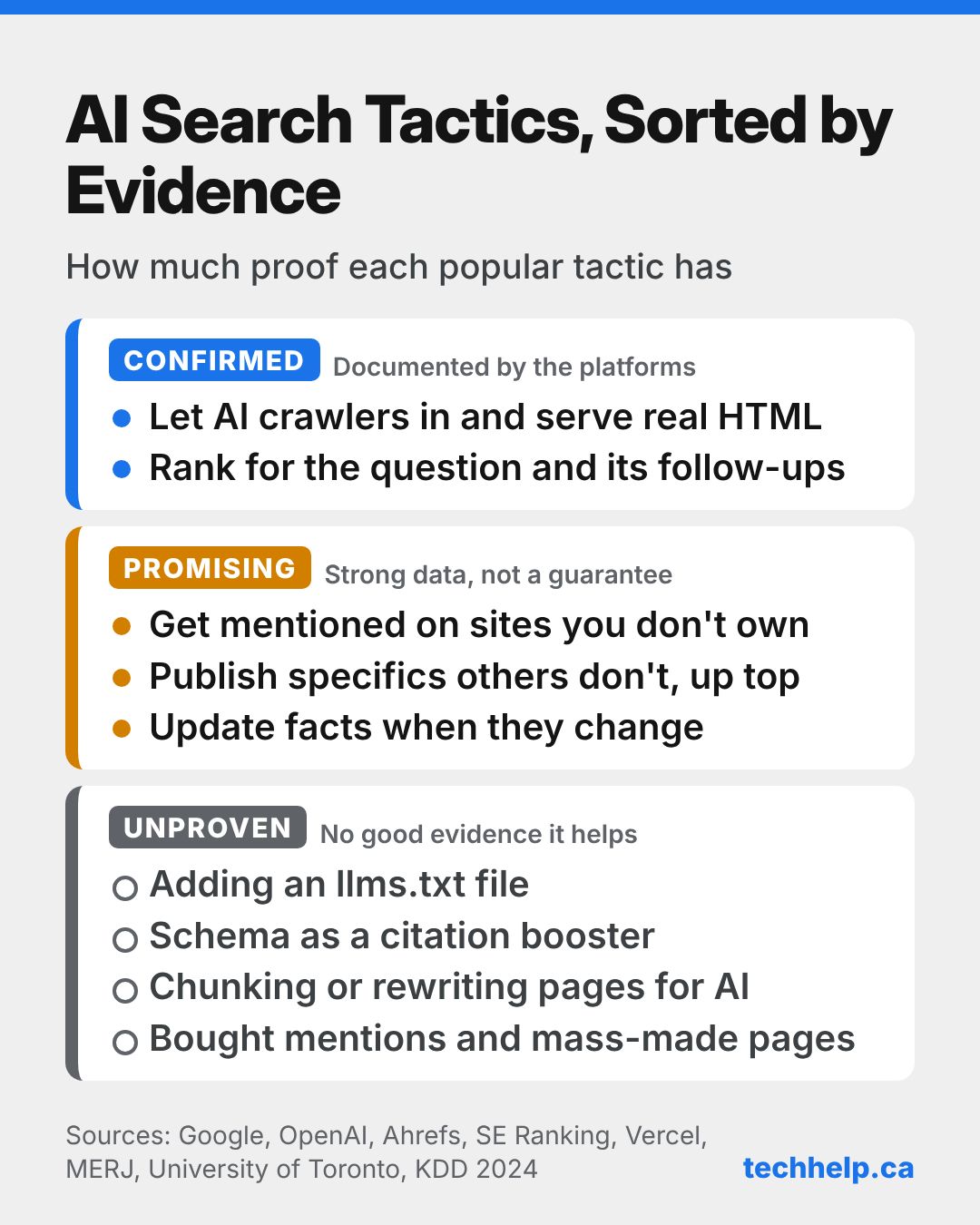
What does hold up is less exciting. Make sure AI crawlers can reach your pages and that those pages appear in regular search. Give other websites a reason to mention your business, and publish details competing pages don’t offer. If that sounds like ordinary SEO with a few new wrinkles, that’s roughly what the evidence suggests.
You don’t have to take anyone’s word for it, including ours. Below, you’ll see how Google’s AI features, ChatGPT, Perplexity and Microsoft Copilot choose their sources. We’ll also show you which tactics have evidence behind them and how to test changes on your own site. Each tactic opens with one of three labels:
Confirmed means the platform documents it as a requirement or explains it as part of how its system works.
Promising means big datasets or controlled experiments point the same way, but they show correlation or lab results, not a guaranteed lift.
Unproven means there’s no good evidence it helps, or testing found no effect.
How AI search picks the sources it cites
AI search tools mostly follow the same routine. Someone asks a question. The system runs one or more searches, pulls a handful of pages, writes an answer from them and links to the pages it relied on. Google calls this grounding, also known as retrieval-augmented generation, and says it uses its core ranking systems to find relevant, up-to-date pages in its index.
Google adds what it calls query fan-out. The model runs several related searches at once to cover angles the person didn’t spell out. In Google’s example, a question about fixing a lawn full of weeds might fan out to searches about the best herbicides for lawns and how to remove weeds without chemicals. Each of those searches can bring in different pages.
That makes the first rule blunt: if an AI search tool can’t discover or access your page, it can’t cite it. Some tools rely on search indexes, while others can also fetch pages live. Here’s how the major platforms find their sources.
Platform
Where it finds sources
Bot or fetcher to allow
Report for site owners
Google AI Overviews and AI Mode
Google’s Search index, including fan-out searches
Googlebot
Search Console generative AI performance report
ChatGPT search
OpenAI’s own crawling, plus third-party providers such as Bing
OAI-SearchBot
None (referral data in your analytics)
Perplexity
Perplexity’s own index, plus live page fetches
PerplexityBot and Perplexity-User
None (referral data in your analytics)
Microsoft Copilot
Bing’s index
Bingbot
Bing Webmaster Tools AI Performance report
OpenAI doesn’t publish a ranking formula for ChatGPT search. Its help center says ChatGPT may share searches with third-party providers such as Bing, on top of what its own crawler collects, so how your pages perform in Bing can matter for ChatGPT too.
These tools don’t make the same choices, either. In a 2025 paper, University of Toronto researchers compared several AI search services with Google. The AI tools differed in how many websites they drew from and how recent their sources were. Rewording a question could change their results, too. A citation in one tool doesn’t guarantee a citation in another, so test each one your customers actually use.
What the evidence supports
Let AI crawlers in, and serve real HTML
Confirmed. Google, OpenAI and Perplexity all document crawler access as the starting point, so begin with your robots.txt file and then look beyond it. Google’s guidance for its AI features asks site owners to make sure crawling is allowed in robots.txt “and by any CDN or hosting infrastructure.” That second part is easy to miss. Firewall rules, security plugins and CDN bot settings can block a crawler that robots.txt allows. If your site runs through Cloudflare, its AI crawler settings changed in September 2026, so confirm what yours are set to now.
In Search Console, also make sure your site hasn’t been opted out of Google’s generative AI features. Google says sites that opt out won’t get traffic or impressions from them.
Training crawlers and search crawlers are separate, and mixing them up can take you out of AI search by accident. OpenAI uses GPTBot to collect content that may be used for training and OAI-SearchBot for ChatGPT search. Blocking GPTBot signals that your site’s content should be excluded from OpenAI model training. Block OAI-SearchBot and, according to OpenAI, your pages won’t appear in ChatGPT search answers, though they can still show up as navigational links. Perplexity likewise recommends allowing PerplexityBot if you want to appear in its results.
Then check what AI crawlers actually receive. In December 2024, Vercel and MERJ tested major AI crawlers, including OpenAI’s OAI-SearchBot, ChatGPT-User and GPTBot, plus Anthropic’s ClaudeBot. None executed JavaScript. Some downloaded JavaScript files but didn’t run them.
Googlebot does render JavaScript, so a page that looks fine in Google Search may still hide important details from other AI crawlers. If your prices, service areas, FAQs or reviews only appear after JavaScript runs, check the page source or open it with JavaScript disabled.
The findings date from late 2024, but serving important text directly in HTML avoids relying on crawlers to run scripts.
Rank for the question, and the questions behind it
Confirmed, with a twist. Google says AI Overviews and AI Mode are built on its core Search ranking and quality systems. To appear as a supporting link, a page has to be indexed and eligible to show in Search with a snippet, and Google says there are no additional technical requirements. Copilot grounds its answers in Bing’s index, and ChatGPT can pass searches to third-party providers. Ordinary search visibility is the entry ticket almost everywhere.
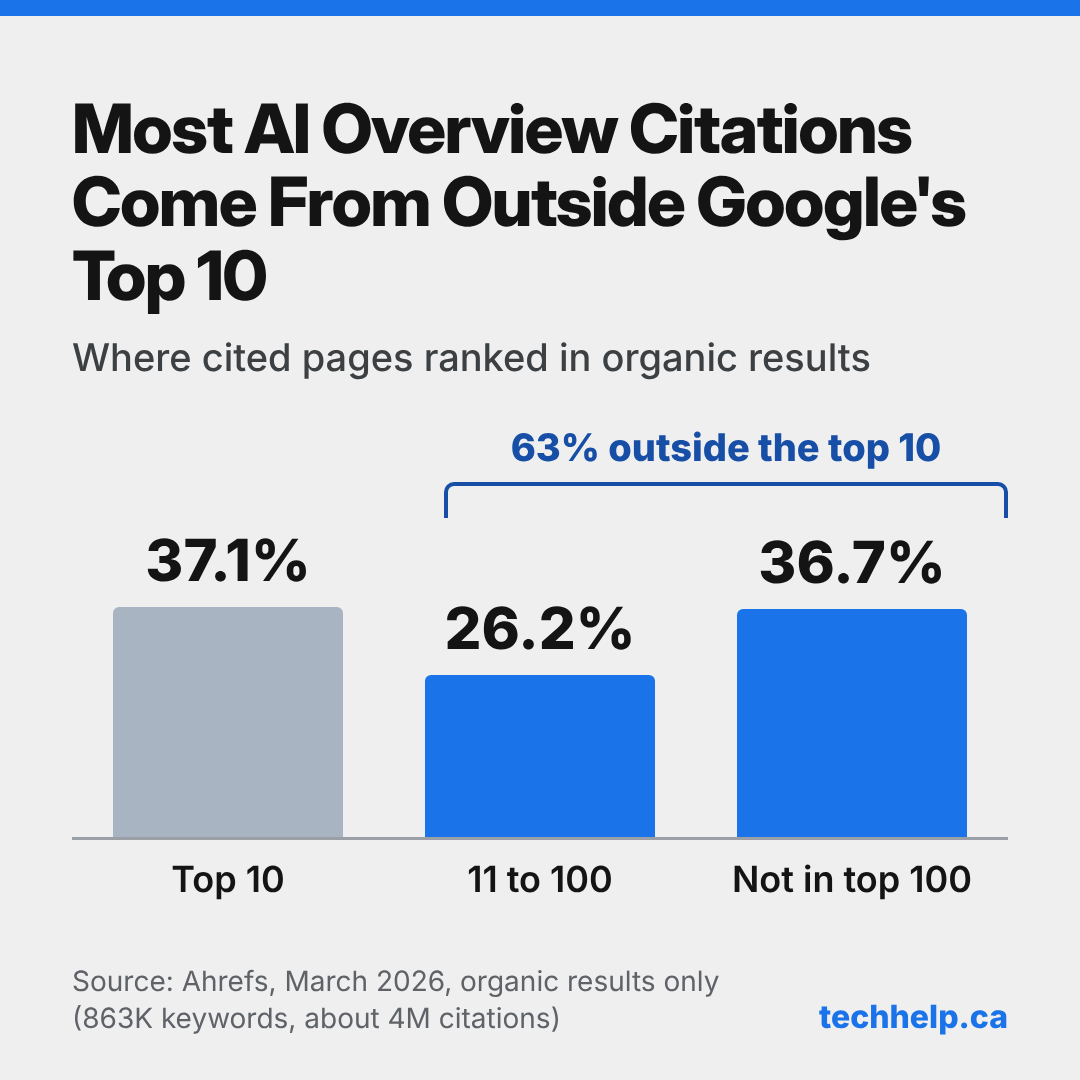
The twist is that ranking for the main question is only part of it. Ahrefs analyzed 863,000 keyword results pages and about 4 million AI Overview citations in March 2026. Of the cited pages, 37.1% ranked in Google’s top 10 organic results for the same keyword. Another 26.2% ranked between positions 11 and 100, while 36.7% didn’t appear in the top 100 at all.
An earlier Ahrefs analysis from July 2025 put the top-10 share near 76%. The two figures aren’t directly comparable, because Ahrefs changed how it reads search results in between, and Google moved AI Overviews to Gemini 3 in January 2026. Ahrefs’ best guess is that AI Overviews now lean more on pages that rank for fan-out searches. Google doesn’t show those searches, so that’s an informed theory rather than a confirmed one.
In practice, list the follow-up questions a buyer asks on the way to a decision, such as cost, timing, alternatives, risks and how to choose. Then make sure your site answers them where they naturally fit, either on the main page or on pages it links to.
Get talked about on sites you don’t own
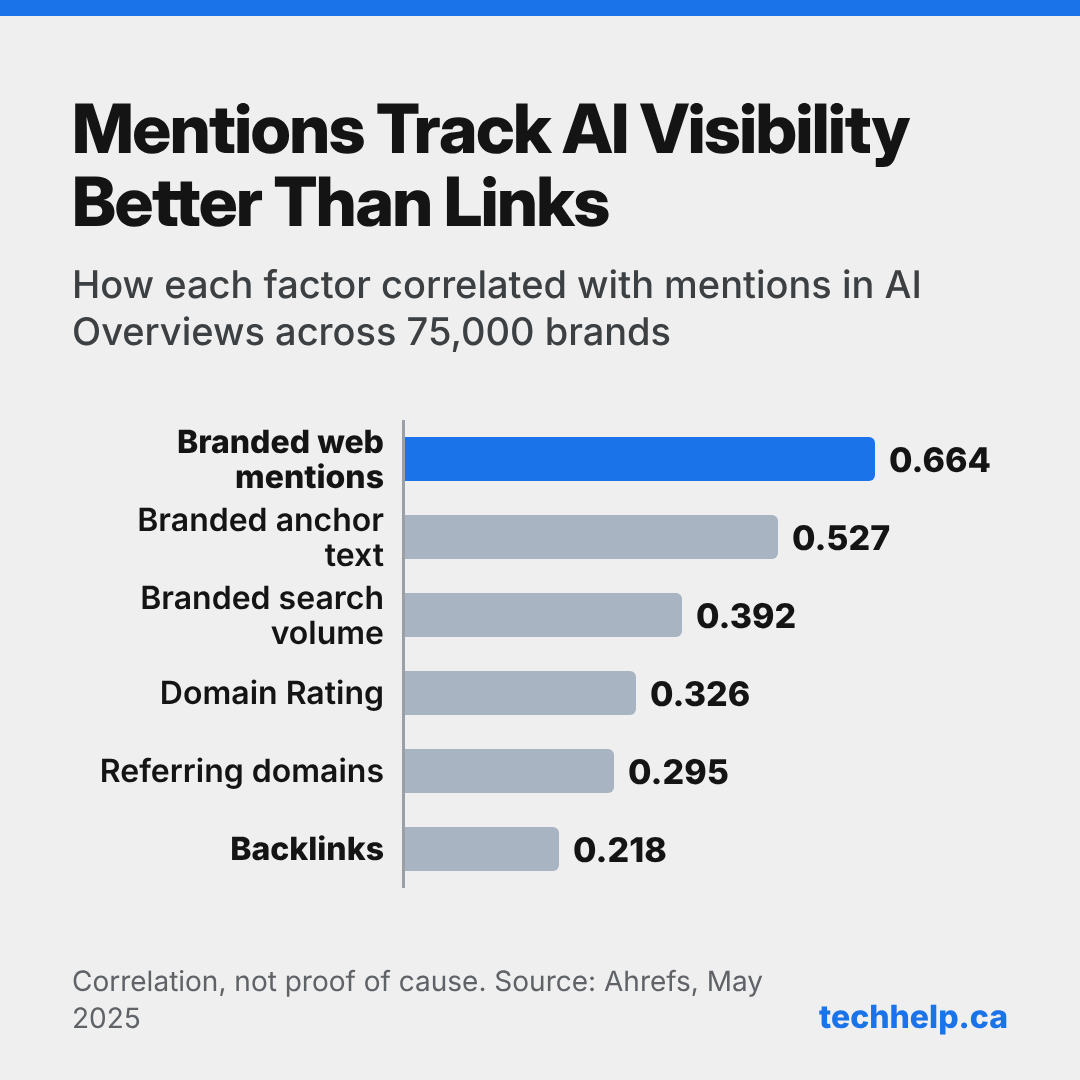
Promising. In a 2025 study of 75,000 brands, Ahrefs found that web mentions had the strongest correlation with appearing in AI Overviews. That included mentions with or without a link. The correlation for web mentions was 0.664, compared with 0.218 for backlinks.
Brands in the top quarter for web mentions appeared more than 10 times as often as those in the next quarter (169 versus 14 mentions). But correlation doesn’t prove that mentions caused those appearances. Well-known brands may simply get talked about more everywhere.
The University of Toronto paper points the same way. Compared with Google, the AI search services it tested showed a “systematic and overwhelming bias” toward earned media, meaning third-party sources such as reviews and independent publications, over content brands publish themselves and social posts.
Your own data can help, too. If you track pricing, job costs, customer trends or survey results others don’t have, publish findings that journalists or bloggers can quote with your name attached.
Publish specifics nobody else has, and lead with them
Promising. Google recommends it, and three very different studies point the same way. Google’s May 2026 guide to optimizing for its AI features tells site owners to offer a perspective others can’t, such as a review based on actually using the product, instead of repeating what’s already online or what an AI model could write on its own. It describes generic listicles as commodity content, the kind anyone could produce.
The best-known lab test supports that. Researchers from Princeton and IIT Delhi built a test engine using the top five Google results and GPT-3.5. Their paper introduced the term “generative engine optimization” and was presented at the KDD data science conference in 2024.
By the authors’ measure, adding quotations, statistics and source citations increased visibility in AI-generated answers by around 40%. Keyword stuffing didn’t help and sometimes performed worse. The gains were biggest for pages that ranked lower. Citing sources raised visibility for the fifth-ranked result by 115.1%, while the top-ranked result lost 30.3% on average. That was a 2023 setup and today’s systems work differently, so treat it as a direction, not a forecast.
Ahrefs ran a stranger test in late 2025. It built a website for a made-up luxury paperweight company, then published an official FAQ with specific denials alongside three conflicting fake stories about the brand on a blog, Reddit and Medium. It asked eight AI tools the same 56 questions before and after. Several tools treated the planted details as fact, and Gemini and Perplexity repeated misinformation in roughly 37% to 39% of answers. ChatGPT held up well, citing the official FAQ in 84% of its answers. The researcher’s takeaway: “in AI search, the most detailed story wins, even if it’s false.” That isn’t a reason to invent details. It’s a reason to make your own pages the most complete, accurate account of your business, including real prices or price ranges, service areas, timelines, policies, specifications and dates.
Where you put those details may matter too. Kevin Indig analyzed 18,012 verified ChatGPT citations drawn from 1.2 million responses and found that 44.2% came from the first 30% of a page’s text. That’s one analyst’s observational data on one platform. It also matches what human readers want, which is the answer first and the explanation after.
Keep facts current, but don’t fake freshness
Promising, with an exception. In a July 2025 study of about 17 million citations, Ahrefs found that pages cited by ChatGPT, Perplexity, Copilot and Gemini were, on average, 25.7% newer than pages in Google’s organic results. Google’s AI Overviews were the exception, citing slightly older pages than organic results. And the average AI-cited page was still 2.9 years old, so newness isn’t everything.
Update a page when something in it changes, such as a price, a rule, a product or a statistic, and say what changed. Nothing in this data suggests that changing a date without changing the content does anything.
What hasn’t been shown to work
llms.txt
Unproven. llms.txt is a proposed file that points language models to a site’s most useful pages, a bit like a sitemap written for AI. The same Google guide says you don’t need llms.txt or similar AI text files to appear, and that Google Search ignores them. Creating one for other services is fine, it adds.
The independent data matches. SE Ranking checked about 300,000 domains, found that only about 1 in 10 had an llms.txt file and found no measurable link between having one and how often AI tools cited the site. When SE Ranking removed llms.txt from its prediction model, the model actually got more accurate. If a tool you use asks for one, there’s no harm in Google’s eyes. Just don’t expect more citations from it.
Schema markup as a citation booster
Unproven for citations, though it’s still useful for rich results. Ahrefs ran one of the more careful tests so far. It tracked 1,885 pages that added JSON-LD schema between August 2025 and March 2026 and compared them with matched pages that never added it, measuring citations for 30 days before and after. Against those controls, AI Overview citations fell 4.6%, a small drop that was statistically significant. AI Mode and ChatGPT citations rose slightly, but neither increase was distinguishable from zero. Ahrefs’ summary was that adding schema produced no major uplift on any platform. The pages in the study were already heavily cited and the window was only 30 days, so a slow or small effect could still be hiding in there.
Tests of what AI tools do with the markup don’t fully agree. A test by searchVIU, which Ahrefs cites, found that ChatGPT, Claude, Perplexity, Gemini and Google AI Mode ignored schema when fetching a page live and pulled only the visible text. SEO consultant Mark Williams-Cook hid a made-up company’s address inside deliberately invalid JSON-LD, and ChatGPT and Perplexity still found it, which suggests they read the markup as ordinary page text. Neither result suggests the markup gets special treatment.
Microsoft is the exception on paper. At a conference in March 2025, Bing’s Fabrice Canel said schema markup helps Microsoft’s language models understand content, so it may matter more for Copilot. We haven’t seen a published test showing it earns more Copilot citations.
Keep schema where it earns rich results, and keep it accurate. If some AI tools read markup as plain text, outdated or wrong schema can end up in an answer about your business.
Chopping content up, or rewriting it for AI
Unproven, and Google says to skip it. Google’s guide includes a mythbusting list, and it’s direct on this point. There’s no requirement to break content into tiny pieces, no ideal page length and no need to write in a special way for generative AI search, because the systems understand synonyms and general meaning. That’s different from putting your answer near the top, which readers appreciate too. The trouble starts when a page is written for an imaginary parser instead of a person.
Buying mentions or mass-producing pages
Unproven, and risky. Since mentions correlate with AI visibility, the shortcuts are obvious: pay for placements, or churn out a page for every possible question. Google’s guide addresses both. It says chasing inauthentic mentions across the web isn’t as helpful as it might seem, and that creating pages mainly to manipulate rankings or AI answers falls under its scaled content abuse policy. A big pile of pages doesn’t make a site more useful, it adds. Earned coverage is slower, but it’s the kind both Google and the Toronto researchers point to.
How to test what works on your own site
Studies tell you what tends to happen across thousands of sites. They can’t tell you what’ll happen on yours. For that, you need your own test, and the setup matters more than you’d expect.
1. Pick prompts from real buying decisions
Use the questions customers ask before they hire you or buy from you, worded the way they’d type them. Mix unbranded prompts (“best accounting software for a three-person firm”) with branded ones (“[your company] vs. [competitor]”), and include the follow-ups. A set of 20 to 30 prompts is a manageable start. Our LLM prompt tracking guide covers how to build and group a prompt set in more detail.
2. Run a baseline more than once
AI answers change a lot from one run to the next. In a January 2026 study, SparkToro and Gumshoe.ai collected 2,961 responses from 600 volunteers testing 12 prompts across ChatGPT, Claude and Google’s AI tools.
Rand Fishkin estimated that two responses had less than a 1% chance of listing exactly the same brands, regardless of order. The chance of getting the same brands in the same order was closer to 0.1%. That’s why a brand’s appearance rate across repeated runs tells you more than its position in any one answer.
Run each prompt several times on each platform under the same conditions, with memory off or logged out and the same location. Log whether you were mentioned, whether your page was linked, which competitors appeared and which sources were cited. Three to five runs per important prompt, as suggested in our tracking guide, can give you an early baseline. Fishkin recommends 60 to 100 runs for a more reliable picture of which brands AI tools recommend. Treat smaller samples as directional, and report citation rates (for example, “cited in 6 of 20 runs”) instead of relying on one screenshot.
3. Change one thing, and leave a comparison group alone
This is the easiest step to skip and the one that keeps you honest. Pick a group of similar pages, change one thing on half of them and leave the other half as they are.
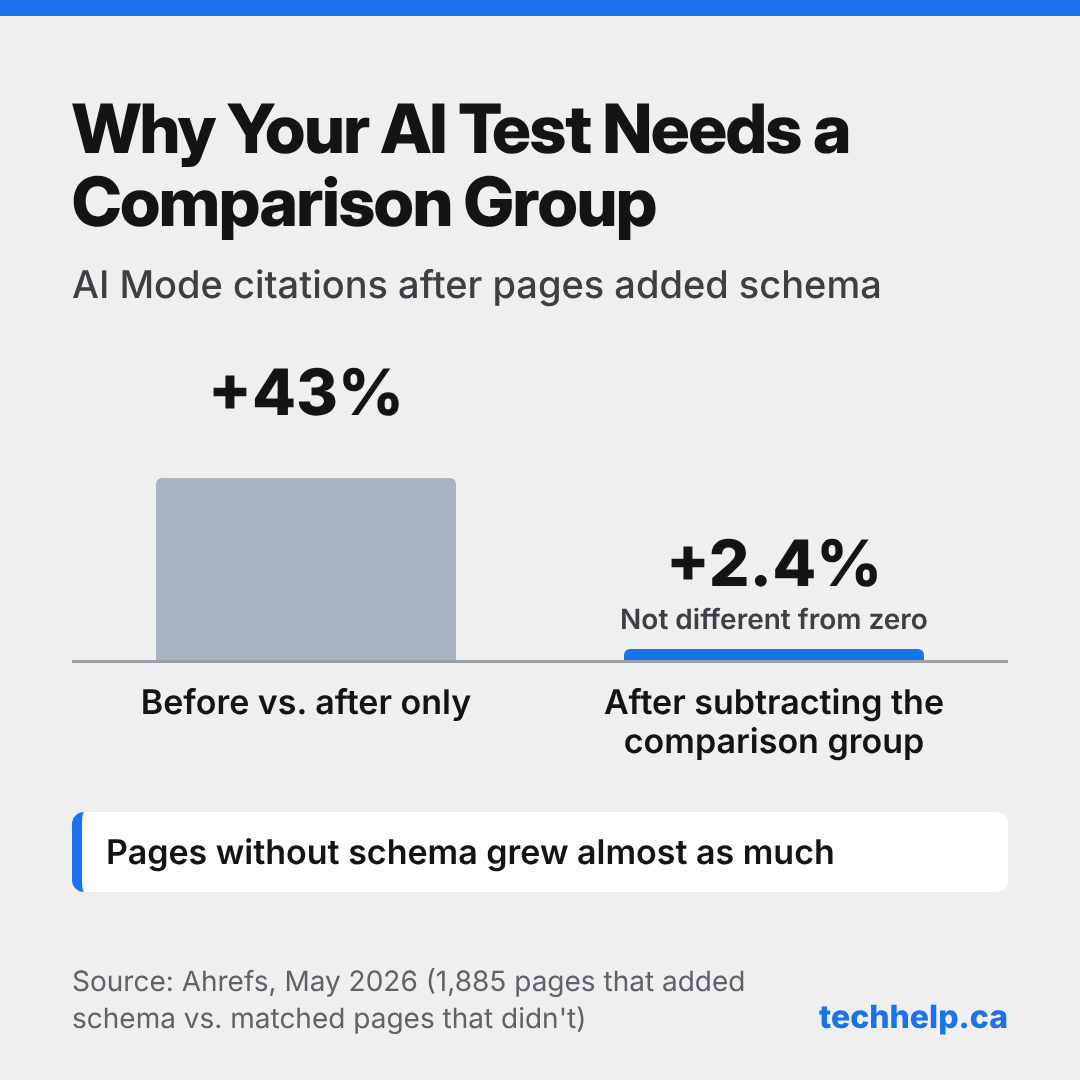
Ahrefs’ schema study shows why. Looking only at before-and-after numbers, pages that added schema gained 43% more AI Mode citations. But the comparison pages, which never added schema, gained almost as much, because AI Mode was growing for everyone during that period. Once Ahrefs subtracted that shared growth, the schema effect shrank to 2.4%, which wasn’t statistically different from zero. Without a comparison group, a site owner would have credited schema for growth that was mostly happening anyway.
4. Recheck the same way
Give crawlers time to pick up the change (you can ask Google to recrawl a page in Search Console), then rerun the same prompts on the same platforms under the same conditions. A month or more on each side of the change is a sensible minimum. Credit the change only if the pages you changed improved more than the pages you didn’t.
Say you rewrite the openings of six service pages to answer their main questions directly, while leaving six similar pages unchanged. Before the change, the pages you plan to edit get cited in 4 of 60 runs, compared with 5 of 60 for the unchanged pages.
Six weeks later, those figures rise to 13 of 60 and 7 of 60. Both groups improved, but the edited pages gained nine citations while the comparison group gained two. The seven-citation difference is a possible effect of the rewrite, not proof. Repeat the test before rolling it out more widely.
5. Read the sources that beat you
When a competitor gets cited and you don’t, look at what the AI tool linked to. If it’s the competitor’s own page, compare it with yours. Is it more specific, more current or easier to read without JavaScript? If it’s a review site, a directory or a comparison article, the fix probably isn’t on your website at all.
How to measure success without fooling yourself
Three different numbers get lumped together as “AI visibility,” and they don’t move together. A brand mention means your name appears in an answer. A linked citation means your page is one of the sources. An AI referral visit means someone clicked through.
Expect citations to send fewer visits than you’d hope. In Pew Research Center’s March 2025 browsing data from 900 U.S. adults, people clicked a link inside Google’s AI summary in just 1% of visits to pages that had one. A citation can be real visibility with very few clicks attached.
Google Search Console
Google added generative AI performance reports to Search Console in June 2026 and says they reached all websites worldwide as of August 31. The Search report counts impressions, meaning how often links to your site appeared in AI Overviews and AI Mode, and breaks them down by page, country, device and date. It doesn’t show clicks or the queries behind those impressions, and sites without enough AI impressions may not see it at all. Clicks from AI features still count in the main Performance report, mixed in with the rest of your search traffic.
Bing Webmaster Tools
Microsoft’s AI Performance report, launched as a public preview on February 10, 2026, counts how often your pages are cited as sources in Copilot, Bing’s AI-generated summaries and select partner integrations. It shows total citations, the average number of your pages cited per day, citations by page and a sample of the “grounding queries” the AI used to find your content. It doesn’t show clicks either, but that query sample is something Google’s report doesn’t offer.
Your analytics
AI referrals are still a small slice of traffic. Across the 74,752 websites in Ahrefs’ traffic tracker, all AI chatbots combined sent 0.28% of visits in March 2026. Google sent 28.12%, roughly 100 times as much.
To see your share, set up a channel group or filter in Google Analytics for referral sources such as chatgpt.com, perplexity.ai, gemini.google.com, copilot.microsoft.com and claude.ai. OpenAI says ChatGPT adds utm_source=chatgpt.com to links from its search results, but that tag isn’t bulletproof. For about a week in October 2026, after GPT-6 rolled out, many ChatGPT links arrived with neither the tag nor a referrer, so those visits landed in Direct until the tagging came back in mid-October. A sudden ChatGPT drop paired with a jump in Direct traffic can point to a tracking problem rather than lost visitors.
The visits you can’t see
Some AI influence never shows up as an AI referral. In a June 2026 study covering finance, travel and beauty, Similarweb tracked people who asked ChatGPT an industry question and got a brand recommendation. They were 2.5 times as likely to visit that brand’s site within seven days, and over half of those visits came through a branded search, not a ChatGPT link. Similarweb sells AI visibility tools and the study shows correlation, not proof. It’s still a good reason to watch branded search impressions in Search Console alongside your AI referral numbers.
Third-party tracking tools
Paid AI visibility tools can save hours of manual prompting, but read their numbers with that run-to-run variation in mind. Google’s guide tells site owners to be wary of tools that claim special insight, stating: “No third-party tool has access to our internal ranking or AI systems.” After the SparkToro study, Fishkin’s advice was to ignore any “ranking position in AI” and track how often you appear across many prompts and repeated runs instead. Before you pay for a tool, ask how many prompts it runs, how often it repeats each one, whether it runs them logged in or out and which locations it uses.
Where to put your effort first
Start with whatever is weakest on your site. If crawlers can’t read your pages, nothing else here gets a chance to work. If they can, the evidence points toward more specific pages and more people talking about you elsewhere, and both take longer than a technical fix. Whatever you change, test it against pages you leave alone, and rerun your baseline every few months. These systems change often enough that a result from last spring may not hold today.
Get new small business insights by email
Practical ideas and useful articles to help you make better business decisions.
Gabriel Nwatarali is the founder of Tech Help Canada and has worked in SEO, copywriting, and web strategy since the early 2000s. His work has helped drive more than 10 million app downloads and 2,900% organic traffic growth for startups, agencies, and brands across North America. He writes about SEO, marketing, AI, and the decisions that shape how businesses grow online, drawing on hands-on experience building websites, content systems, and digital strategies.