For a while, the conversation around Google’s AI Overviews has boiled down to one simple takeaway: less traffic.
That’s not wrong. It’s just incomplete. Clicks are getting harder to earn, but citations are becoming a real advantage.
CTR Study Shows Being Cited Correlates to Higher CTR
Seer Interactive’s latest CTR study makes the contrast between cited and non-cited hard to ignore. They analyzed 3,119 informational and educational queries across 42 client organizations from June 2024 to September 2025 (25.1M organic impressions; 1.1M paid).
They also split the analysis two ways: whether an AI Overview appeared, and whether a brand was cited or mentioned inside that overview.
At a high level, the “AI Overviews reduce clicks” story is real. In the dataset, organic CTR on queries with AI Overviews fell from 1.76% to 0.61%. Paid CTR on those same queries fell from 19.7% to 6.34%.
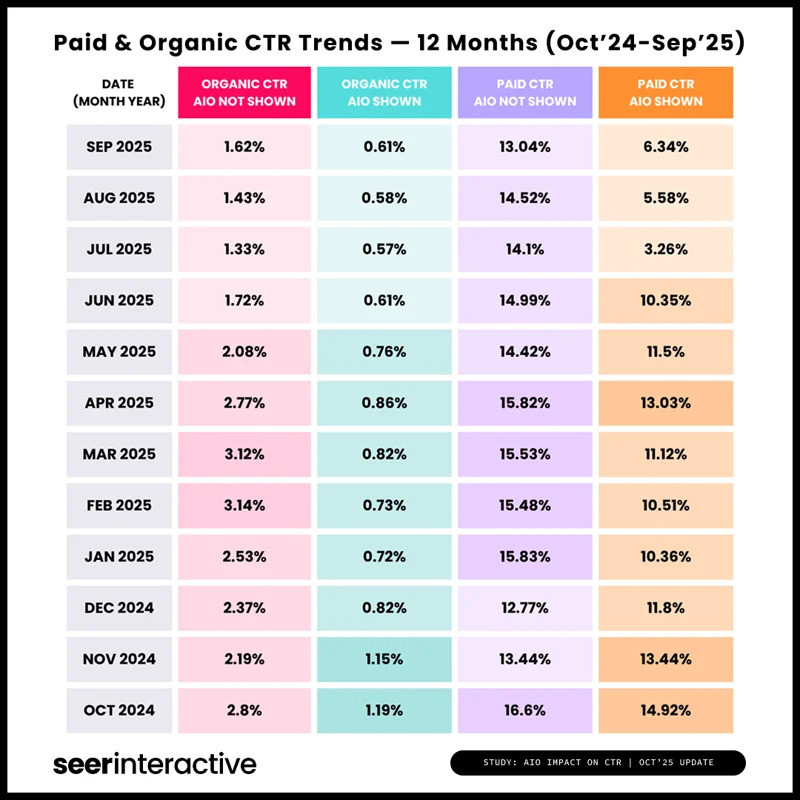
But the study also points to a more actionable truth. When you’re cited in an AI Overview, you tend to do better than when you’re not cited. In this dataset, cited brands saw 35% higher organic CTR and 91% higher paid CTR than brands that weren’t cited.
One important caveat is that this shows a strong relationship, not guaranteed cause-and-effect. Here are a few reasons that matter:
- The comparison is between queries where an AI Overview appeared and you were cited versus queries where an AI Overview appeared and you weren’t. It isn’t measuring “clicks on the citation link” specifically.
- Stronger brands may be more likely to be cited in the first place, and they may also earn more clicks due to rankings, familiarity, or better snippets.
- The query mix can skew results. The “cited” bucket may include queries where users are more likely to click for depth (or where the brand already has stronger visibility), which can raise CTR even within the lower-click AI Overview environment.
The best takeaway is this: being cited is associated with better performance in AI Overview environments, and it may help you capture more of the remaining clicks, but it doesn’t guarantee a lift on its own.
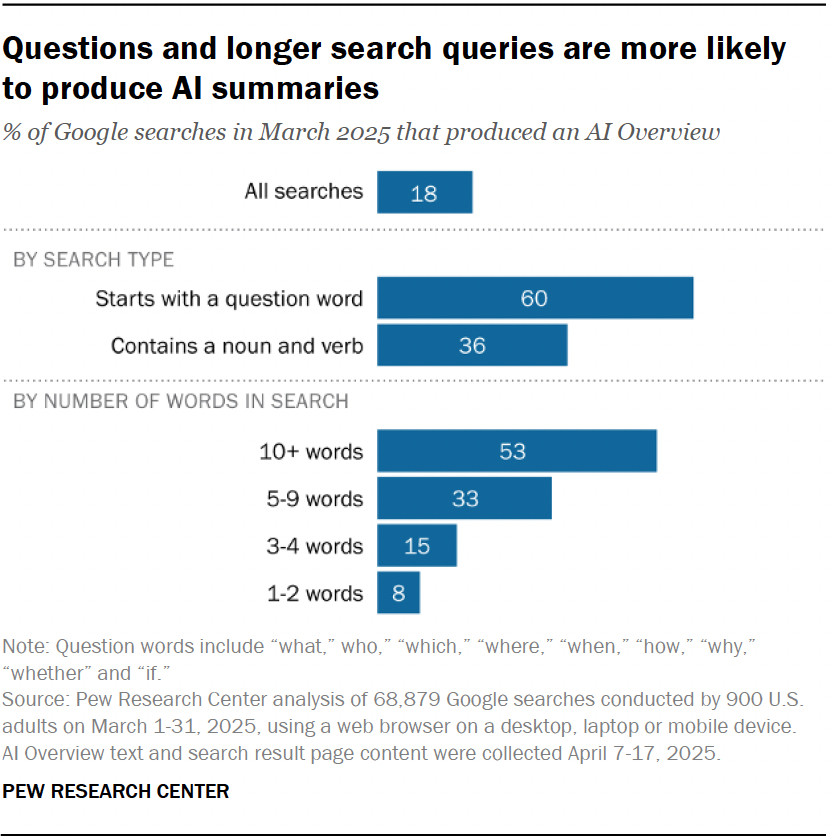
Seer’s data also aligns with what many marketers are seeing day-to-day. Pew Research Center found users clicked a traditional result 8% of the time on visits with an AI summary, compared to 15% on visits without one. Clicking a link within the summary occurred in only 1% of visits.
Do Rankings Still Matter?
Yes! The shift isn’t that rankings don’t matter. It’s that the interface is pulling attention into the answer layer, and rankings don’t translate to clicks like they used to.
To make sense of this, it helps to separate two questions.
- What happens to clicks when an AI Overview shows up?
- What happens when you’re one of the sources the overview cites?
You can maintain good rankings and still lose clicks, simply because the answer is being displayed higher on the page. Plenty of users will read the summary and move on. Still, being cited can tilt the distribution of the clicks that remain in your favor.
What This Does Not Mean
These findings don’t mean citations guarantee traffic. It also doesn’t mean every query behaves the same way. The dataset focused on informational and educational terms, which are the most vulnerable to AI Overviews.
It’s also one dataset drawn from 42 client organizations, so results can vary by industry, SERP layout, and site type. Transactional intent, branded searches, and local queries can behave differently, and AI Overview presence varies by topic and query format.
It also doesn’t mean these percentages are universal constants. The study is large, but it’s still a defined sample across a specific client set and time window. Pew’s analysis is similarly specific, based on observed behavior from a set of U.S. adults during a defined collection period. You can use both as directional signals, not guarantees.
What it does mean is that as AI Overviews expand, being the source becomes a measurable advantage, even in a lower-click environment.
Bottom Line
AI Overviews are pushing search toward a lower-click environment, and citations look like one of the few levers that can still shift outcomes. That doesn’t mean you should chase citations at all costs. It means citations are a useful signal that you’re showing up in the answer layer, not just the rankings layer.
In practice, that puts more weight on authoritative content that’s easy to quote and verify. The AI Overviews environment may also affect ad performance, as the data suggests. Even though paid CTR is lower on queries that trigger AI Overviews, the dataset shows a ‘cited vs not cited’ gap on paid results too (7.89% vs 4.14% in Q3 2025).
That suggests being cited is associated with capturing a larger share of the remaining ad clicks. (As with organic, this is correlation, not proof of causation.)
FAQ
Does Google change how it cites sources?
Pew found that 88% of AI summaries cited three or more sources, and 1% cited a single source. If Google changes how many sources it cites, how visible those sources are, or where they appear in the layout, the “citation advantage” could change quickly. That’s why it’s worth watching citations as a moving interface choice, not a permanent SEO reward.
Does “no-click” behavior intensify?
Pew also saw a wider behavior shift that goes beyond citation clicks. When an AI summary appeared, users clicked a traditional result less often than when it didn’t, and they ended their browsing session more often after visiting a search page with an AI summary (26% vs. 16%). If that gap keeps widening, it reinforces the same uncomfortable truth: visibility and traffic can drift further apart, even when rankings look stable.
Does Google Search Console show AI Overview performance separately?
Search Console reports your overall Search performance, but it doesn’t provide a simple AI Overview clicks bucket you can use to isolate in the same way you might filter other appearances. In practice, you typically infer impact by monitoring query and page trends as AI Overviews become more prevalent. Note that if your page appears both in an AI Overview and as a traditional result on the same SERP, Search Console generally counts that as a single impression for that page on that query.
If I’m cited in an AI Overview, why don’t I see a big traffic lift?
Because AI Overview citations are usually a share-of-a-smaller-pie win. AI summaries can satisfy immediate needs, reducing total clicks on many informational searches. A citation can still help you capture more of the clicks that remain, but it won’t automatically restore the older click environment—especially on queries where the overview answers the question well.
How should I interpret rankings and CTR when AI Overviews are on the page?
Treat rankings and CTR as context-dependent signals, not the whole story. AI Overviews can change the meaning of visibility, even when your average position appears stable. Use Search Console to spot directional trends, but anchor your conclusions to outcomes—engaged visits, leads, signups, or whatever matters for your business. That way, you don’t win the report while losing the real result.
Sources:
Seer Interactive CTR study (Sept 2025 update); Pew Research Center analysis (published July 2025; based on March 2025 browsing behavior).
- seerinteractive.com/insights/aio-impact-on-google-ctr-september-2025-update
- pewresearch.org/short-reads/2025/07/22/google-users-are-less-likely-to-click-on-links-when-an-ai-summary-appears-in-the-results/

I can suggest related Tech Help Canada articles based on the topic you’re reading now.

We empower people to succeed through practical business information and essential services. If you’re looking for help with SEO, copywriting, or getting your online presence set up properly, you’re in the right place. If this piece helped, feel free to share it with someone who’d get value from it. Do you need help with something? Contact Us