

A new consulting market has formed around getting businesses cited in AI-generated answers. Some of that work is legitimate: tracking AI visibility, correcting inconsistent business information, improving technical SEO, and publishing evidence that AI systems can verify.
The problem is the layer of invented requirements sold on top: special files, forced paragraph “chunking,” AI-only schema, pages for every possible query, and manufactured mentions across the web. Google has now said, in unusually direct terms, that those tactics aren’t needed for AI Overviews or AI Mode.
In May 2026, Google published official guidance for optimizing websites for its generative AI search features. Its message wasn’t that search has stayed the same. AI Overviews and AI Mode do change how Google assembles answers and how people reach websites. Google’s point was that its existing search index, ranking systems, quality systems, and spam policies still underpin those experiences.
That gives businesses a useful line to draw. Pay for work that makes your company easier to find, understand, verify, and trust. Don’t pay for unsupported tricks dressed up as technical requirements.
What Google actually said about AI search optimization
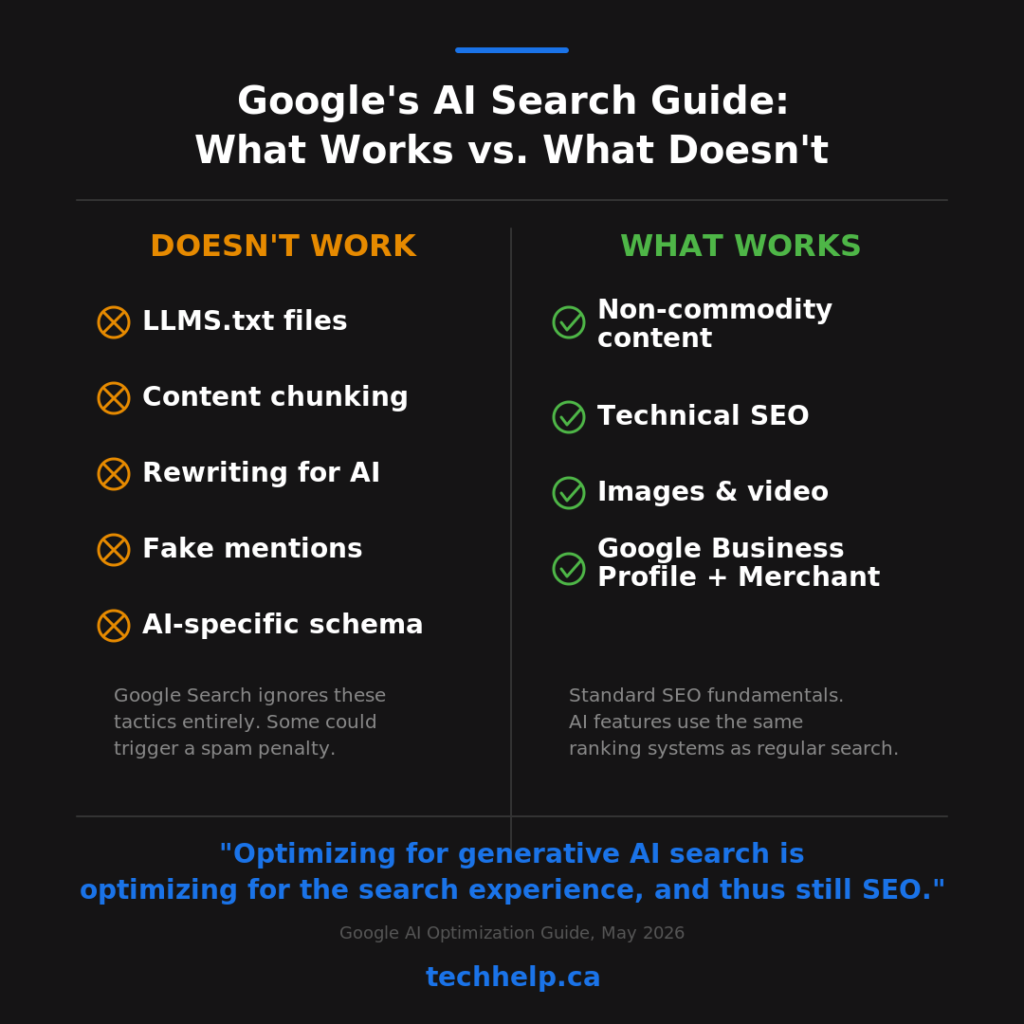
Google’s guide addresses answer engine optimization (AEO) and generative engine optimization (GEO) by name. Its position is concise: “optimizing for generative AI search is optimizing for the search experience, and thus still SEO.”
That statement applies to Google’s own search features. Google isn’t setting the rules for ChatGPT, Perplexity, Copilot, or every other AI product. It also isn’t saying that businesses should ignore how they appear in AI-generated answers. Monitoring citations, referral traffic, brand descriptions, and factual errors can still be worthwhile.
What Google is saying is narrower and more damaging to vendors selling shortcuts: AI Overviews and AI Mode don’t require a separate technical doorway. The same SEO foundations remain central to whether Google can discover, understand, and consider your content.
How Google finds material for AI Overviews and AI Mode
Google describes two mechanisms behind its generative search features. The first is retrieval-augmented generation, often called RAG or grounding. Google’s systems use its core Search ranking systems to retrieve relevant, current pages from the Search index. The AI then examines information from those pages and can generate an answer supported by clickable source links.
The second is query fan-out. For a complex question, Google’s model can issue several related searches at once to gather more information. A query about fixing a weed-filled lawn might trigger related searches about herbicides, chemical-free removal, and prevention. A page can therefore contribute to an answer because it’s relevant to one part of the problem, even if it doesn’t repeat the original query word for word.
This doesn’t mean the first organic result is guaranteed to appear in an AI answer. Google doesn’t describe AI Overviews as a copy of the blue-link rankings, and meeting every requirement doesn’t guarantee that a page will be crawled, indexed, or shown. A page must be indexed and eligible to appear with a search snippet, but Google still decides which sources fit a particular response.
The practical takeaway is that Google’s AI features share Search’s foundations. Google offers no AI-only schema, special file, or separate public submission process that a consultant can unlock for you.
Five “AI SEO” tactics Google says you can ignore
Google devoted part of its guide to myths because unsupported tactics have become common enough to confuse website owners. These are the ones most likely to waste your budget.
1. Creating an llms.txt file for Google
An llms.txt file is meant to give AI systems a simplified, machine-readable view of a website. Google Search doesn’t use it. Google may discover, crawl, or index the file as it can with many file types, but the file receives no special treatment and won’t improve Google visibility or rankings.
Maintaining one for another service that explicitly supports it is a separate decision. Just don’t let anyone sell it to you as a requirement for Google AI Overviews or AI Mode.
2. Forcing content into tiny chunks
You don’t have to split every page into short fragments so Google’s AI can understand it. Google says its systems can recognize the nuance of multiple topics on one page and retrieve the relevant part. It also says there’s no ideal page length.
Structure still matters for readers. Clear headings, focused sections, useful paragraphs, and logical progression make a page easier to use. The mistake is treating a rigid paragraph size as an AI ranking rule. Search Engine Roundtable’s coverage of Google’s June 2026 Search Central Live event in Milan captured the same message from attendees: forcing paragraph chunking for AI is useless when it works against human readability.
3. Rewriting every page in an “AI-friendly” style
Google’s systems understand synonyms and broader meaning. You don’t need a separate writing style for AI search or a page for every long-tail variation of a question.
Direct answers, clear definitions, and descriptive headings can still improve a page because they help people find and understand information. That’s ordinary editorial quality, not a secret syntax for language models.
4. Manufacturing mentions across the web
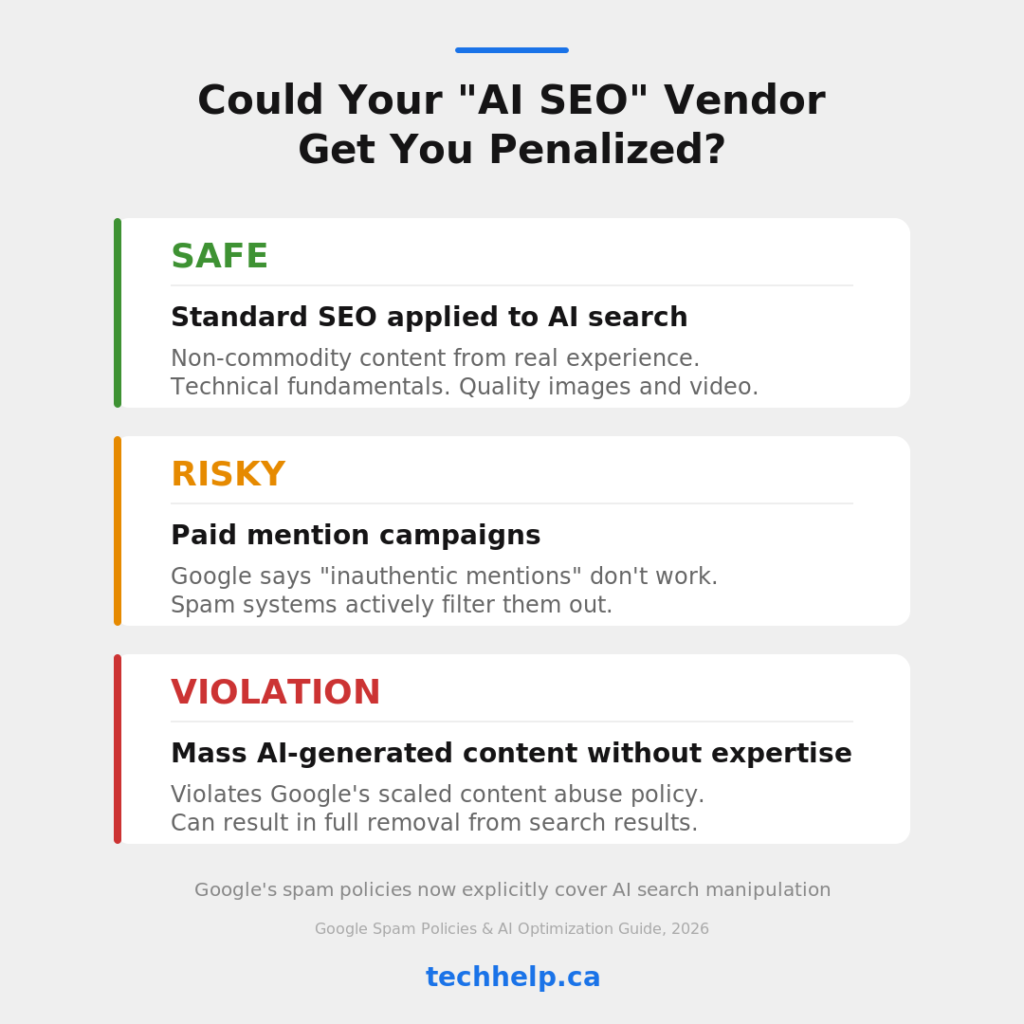
Google’s AI features may use information from blogs, videos, forums, and other third-party sources. That doesn’t make fake discussion, undisclosed paid praise, or low-quality mention campaigns a sound strategy. Google says seeking inauthentic mentions isn’t as useful as it may appear because its AI features rely on both core ranking systems and spam defenses.
Earned coverage and genuine customer discussion can still strengthen a company’s reputation. The distinction is authenticity. A credible review from a real customer isn’t the same thing as buying dozens of placements created only to make a brand look widely discussed.
5. Adding special schema for AI search
There is no AI-specific schema that makes a page eligible for Google’s generative search features. Standard structured data remains useful when it accurately describes visible page content and makes a page eligible for supported rich results. It simply doesn’t provide a separate AI-search advantage.
If a provider promises proprietary markup that “feeds” your site directly into Google AI, ask for the Google documentation supporting that claim. There isn’t any in Google’s current guidance.
Where AI SEO turns into search spam
Some tactics are merely useless. Others can put search visibility at risk. Google’s spam policies define spam to include attempts to manipulate generative AI responses in Search. The AI optimization guide connects that policy to a common tactic: creating separate pages for every possible search or fan-out variation to manipulate rankings or AI answers.
That can fall under scaled content abuse, which Google defines as generating many pages primarily to manipulate rankings rather than help users. The method doesn’t decide whether the content is abusive. Google explicitly includes using generative AI to produce many pages without adding value, but the same policy can apply to human-written, scraped, translated, or stitched content.
Using AI during research, outlining, drafting, or editing isn’t automatically a violation. The risk appears when scale replaces value: hundreds of thin pages, near-duplicate answers, recycled summaries, or location and query variations that contain no useful difference. Tech Help Canada’s analysis of AI-generated content and search spam risk explains that distinction in more detail.
Google says sites that violate its spam policies may rank lower or disappear from results altogether. So a vendor promising to expand your “AI footprint” with a large batch of low-value pages may be selling you both wasted content and search risk.
What improves visibility in Google’s AI search
Google’s recommendations are familiar, but they’re not easy. They require knowledge, evidence, sound website operations, and consistent publishing rather than a one-time technical trick.
Publish information competitors can’t easily reproduce
Google calls this non-commodity content. It comes from first-hand experience, original analysis, proprietary data, expert judgment, or a point of view that adds something new.
A generic article about common plumbing problems can be produced by almost anyone. A local plumber’s analysis of the most frequent pipe failures found across 300 service calls, including the neighbourhoods, building ages, warning signs, and repair outcomes, gives Google and readers something specific to work with.
The same principle applies across industries. Publish test results instead of rewriting product specifications. Show the reasoning behind a decision instead of repeating standard advice. Use real customer questions, anonymized operational data, before-and-after evidence, and lessons from work you’ve actually done.
Keep important pages technically eligible
Content can’t appear in Google’s AI features if Search can’t access or index it. Important pages should be crawlable, indexable, and eligible to appear with a snippet. JavaScript shouldn’t hide critical information from Google, and duplicate URLs shouldn’t waste crawling resources or split signals unnecessarily.
Semantic HTML is useful for accessibility and document structure, but Google doesn’t require perfect markup. Page experience also remains relevant: the site should work across devices, respond quickly, and make the main content easy to distinguish from ads, pop-ups, and navigation.
Use images and video when they add evidence
Google can surface relevant images and videos inside generative search experiences. Original photos, demonstrations, diagrams, comparisons, and short explanatory videos can give a page more ways to answer a question.
Media should add information, not decoration. A contractor’s photos of an actual repair, a software company’s annotated workflow, or a retailer’s product demonstration give the reader evidence that stock imagery can’t provide.
Keep product and business information current
For local and ecommerce businesses, website copy isn’t the only source Google uses. Accurate Google Business Profile details and Merchant Center data help Google understand locations, hours, products, pricing, availability, and services.
Google’s guide also points to Business Agent, a conversational Search experience that lets customers interact with participating brands. It’s a new surface worth evaluating, but it still depends on accurate business and product information rather than an AI-only content formula.
Measure qualified visits, leads, and sales
At its Milan event, Google reportedly showed a slide saying people who click from AI Overviews are more likely to spend more time on the destination site. Google didn’t provide percentages in the material reported by Search Engine Roundtable, so treat that as a claim to test, not a universal benchmark.
Separate AI referrals where your analytics allow it, compare engagement and conversion quality, and track whether AI visibility contributes to branded searches, leads, assisted conversions, or sales. A citation is encouraging. Business results tell you whether it was valuable.
What a legitimate AI visibility service should deliver
Google hasn’t declared every AEO or GEO service useless. A capable provider may combine SEO, content strategy, digital PR, analytics, reputation monitoring, and platform-specific research. The label matters less than the work.
Before paying, ask the provider to define the systems it covers and show its deliverables. A credible engagement should be able to:
- separate Google AI Overviews and AI Mode from other assistants with different data sources and controls;
- diagnose crawling, indexing, content, entity, and reputation gaps;
- identify where original evidence or subject-matter expertise is missing;
- monitor citations, referral traffic, factual accuracy, leads, and revenue where measurement is possible; and
- explain what it can influence without guaranteeing rankings or citations.
Be skeptical if the proposal revolves around secret schema, guaranteed citations, mass-produced fan-out pages, fake mentions, or a report full of visibility scores with no connection to business outcomes. Our LLM SEO guide covers the broader work of making a business understandable and citable across AI systems, not just Google.
What to do with your current SEO budget
Start by auditing what you’re already buying. Ask each provider to map its deliverables to documented platform behaviour. If the answer is simply llms.txt, forced chunking, AI schema, or hundreds of lightly varied pages, stop funding it.
Next, check the basics that affect eligibility. Confirm that priority pages are indexed, snippets aren’t blocked, important content is crawlable, and your Business Profile or Merchant Center feed is accurate where applicable. These tasks aren’t exciting, but a page Google can’t reliably process won’t become more visible because someone renamed the work GEO.
Then inspect your strongest content. Replace unsupported summaries with original evidence, clearer reasoning, current examples, expert commentary, and proof from your own operations. You don’t need to make every article longer. You need to make it harder to replace.
Finally, build a measurement baseline. Record where your brand appears, which pages receive AI referrals, what those visitors do, and whether the work produces qualified demand. Without a baseline, a vendor can take credit for normal fluctuation or report impressions that never produce value.
Agentic search is worth watching, not overbuying
Google’s guide identifies one emerging area that goes beyond conventional content discovery: AI agents that can interact with websites and complete tasks. It points website owners toward agent-friendly practices and notes that protocols such as the Universal Commerce Protocol are developing to support transactions.
This deserves attention from ecommerce and service businesses. An agent may eventually compare products, check availability, book an appointment, or complete a purchase for a user. Accurate structured product data, dependable interfaces, secure workflows, and clear policies will matter in that environment.
It’s still an emerging area. Treat agent readiness as a product and operations question, not proof that today’s Google rankings require a secret new optimization package.
The expensive part of AI SEO is still the real work
Google hasn’t said that AI visibility is irrelevant. It has said that its generative search features are rooted in the same Search systems and that several heavily promoted hacks aren’t needed.
For businesses, the distinction is useful. Don’t pay someone merely to rename SEO, generate a special file Google ignores, or manufacture content at a scale that could trigger spam enforcement. Pay for technical competence, original research, first-hand expertise, accurate business data, strong content, credible third-party recognition, and measurement tied to revenue.
There isn’t a shortcut hidden inside AI Overviews. The advantage still comes from publishing the source that deserves to be retrieved, cited, and visited.
Related
- AI in search: Future-proof your content now
- The only SEO ranking factors that matter today
- Answer engine optimization: Ultimate guide to SEO for AI search
References
- https://developers.google.com/search/docs/fundamentals/ai-optimization-guide
- https://developers.google.com/search/blog/2026/05/a-new-resource-for-optimizing
- https://developers.google.com/search/docs/essentials/spam-policies
- https://www.seroundtable.com/google-search-central-live-milan-41533.html

I can suggest related Tech Help Canada articles based on the topic you’re reading now.

Tech Help Canada Staff researches, writes, and reviews practical content for business owners and professionals. Our coverage spans business, marketing, SEO, technology, and the tools and systems people use to grow and operate online. We focus on clear, useful information backed by research, hands-on experience, and editorial review. Learn more about our team and editorial standards. Need help with something? Contact Us