

Digital marketing has money in it because businesses keep moving budget toward online discovery, trust-building, and sales. DemandSage cites Statista projections putting global digital advertising at $854.9 billion in 2026, with search, video, social, and influencer advertising all taking large shares of that spend.
That doesn’t make digital marketing easy money.
The noisy version of this topic makes it sound like you can pick a tactic, watch a few tutorials, and build income by next month. The useful version is less flashy and much more reliable: choose one path, learn the skill deeply enough to produce a measurable result, prove that result on a small project, then turn the proof into paid work or an asset you own.
Most ways to make money with digital marketing fall into two groups. Service work gets you paid faster because a business hires you to do something specific: SEO, email, ads, content, social media, consulting, or analytics. Asset-building takes longer because you’re creating something that can earn over time: a YouTube channel, affiliate site, newsletter, course, template, or e-commerce brand.
If you’re testing the waters, a digital marketing side hustle is usually the safest starting point. You can learn the skill, test whether you enjoy the work, and build proof before quitting a job or betting the month on one idea.
The key is specificity. “I help local clinics turn website traffic into booked consultations” is easier to sell than “I do digital marketing.” A clear outcome beats a broad skill every time.
Sell SEO services
SEO is one of the most approachable ways to make money with digital marketing because every business wants to be found when a customer searches. The work can start small, but it can grow into serious consulting once you understand search intent, technical issues, content quality, and local visibility.
Beginner SEO work usually includes keyword research, page title and meta description improvements, on-page content recommendations, basic site audits, Google Business Profile cleanup, internal link suggestions, and content briefs. As you improve, you can move into technical SEO, local SEO for multi-location businesses, e-commerce SEO, content strategy, and site migration support.
Google’s SEO Starter Guide is still one of the better places to learn the fundamentals because it focuses on helping search engines understand your content while making pages more useful for people. That’s the right base. You don’t need secret tactics. You need to understand how pages get discovered, crawled, organized, and chosen.
Backlinko’s 2026 SEO pricing guide, based on a survey of more than 300 SEO professionals, puts average monthly SEO costs at $1,000 to $2,500 and hourly SEO services at $50 to $100 per hour. Those numbers vary heavily by market, experience, scope, and competition, but they show why SEO can be a strong service path once you can connect your work to business outcomes.
The simplest way to start is to audit a small local business site and give them a short improvement plan. Don’t start with a 60-page report. Start with the five changes most likely to improve visibility or conversions. Then track what happens.
One warning: don’t sell instant rankings. SEO often takes weeks or months to show meaningful movement, and some changes may not produce visible gains at all. Sell SEO as a long-term improvement process, not a switch you flip.
Manage paid advertising campaigns
Paid advertising can pay well because the connection to revenue is immediate. A business spends money, the campaign produces leads or sales, and everyone can see whether the numbers work.
That immediacy is also what makes paid ads risky for beginners.
Client work can include campaign setup, keyword or audience research, ad copy, creative testing, landing page recommendations, tracking setup, budget pacing, and reporting. The most valuable paid ads specialists aren’t the ones who know where every button lives inside Google Ads or Meta Ads. They’re the ones who can tell whether a campaign is acquiring customers at a cost the business can afford.
Start with tracking before you start with creative. You need to understand conversion goals, pixels, events, UTMs, attribution limits, landing page performance, and cost per acquisition. A campaign with attractive click-through rates can still lose money if it attracts the wrong traffic or sends people to a weak offer.
For your first proof project, use a small budget on something you control. Promote your own service page, a simple lead magnet, a local event, or a test offer. Document the setup, the spend, the conversion result, and what you changed after the first round of data. That evidence is more persuasive than a certificate by itself.
Paid ads are a poor fit if you panic when results fluctuate. They are a strong fit if you like numbers, testing, fast feedback, and direct accountability.
Build email marketing systems
Email marketing is one of the best digital marketing services to sell because many businesses already have leads and customers but weak follow-up. You don’t always need to find new traffic. Sometimes the money is sitting inside a neglected list.
You can help with welcome sequences, abandoned-cart emails, post-purchase flows, reactivation campaigns, newsletters, launch emails, segmentation, list cleanup, deliverability basics, and campaign reporting. This work is valuable because it turns existing attention into repeat visits, booked calls, purchases, reviews, referrals, and renewals.
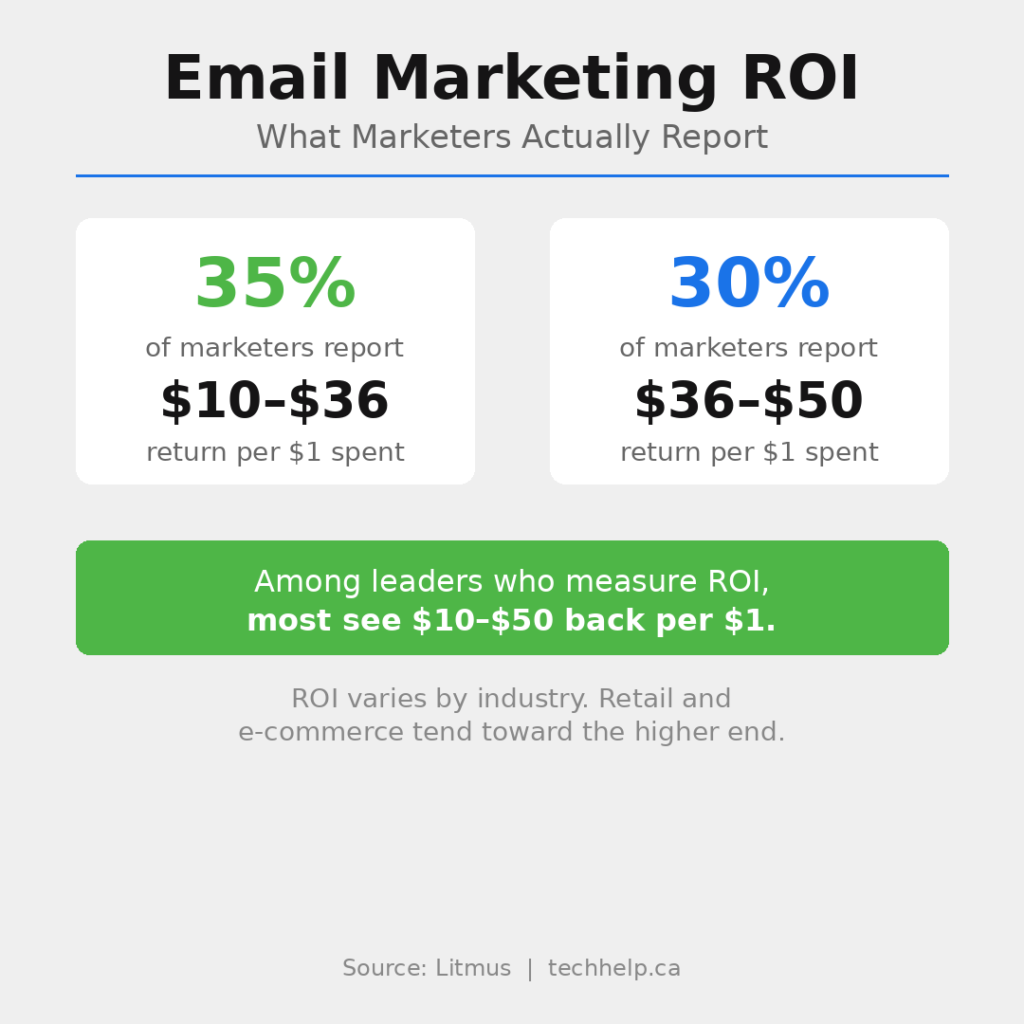
Litmus found that among marketing leaders who measure email ROI, 35% report $10 to $36 in return for every $1 spent, while 30% report $36 to $50. Older Litmus data also shows email ROI varies widely by industry, with retail and e-commerce on the higher end. Treat those numbers as benchmarks, not guarantees. A sloppy list and weak offer won’t magically perform because the channel is email.
If you’re working with Canadian businesses or sending to Canadian recipients, you also need to understand CASL. The CRTC says commercial electronic messages must have consent, identification information, and an unsubscribe mechanism. Consent can be express or implied depending on the relationship, but you need records and a process. “They gave me a business card once” isn’t a strategy.
The best first offer is often a simple email flow build. For example, you could build a five-email welcome sequence for a service business, a cart recovery flow for a small online store, or a win-back campaign for inactive customers. Define the before-and-after metric: revenue per recipient, booked calls, purchases, replies, or reactivation rate.
Good email marketing isn’t about sending more. It’s about sending the right message to people who gave permission and have a reason to care.
Create content for businesses
Businesses need content because customers need help understanding, comparing, trusting, and choosing. That creates work for writers, strategists, editors, designers, video producers, and content managers.
You can sell blog posts, service pages, case studies, email newsletters, product guides, lead magnets, video scripts, comparison pages, and content calendars. The most valuable content sits close to a buying decision. A service page, case study, landing page, sales email, or comparison guide usually matters more to revenue than a generic awareness article.
Evergreen content can hold value for months or years when it targets a durable question and gives the reader a complete answer. The mistake is treating every article as equal. A post answering “what is CRM?” serves a different buyer than a page comparing CRM options for a five-person sales team.
If you want to make money creating content, don’t sell word count. Sell a business function. Your content should help a company rank, convert, nurture, explain, support sales, reduce objections, or build authority.
Your first proof project can be a before-and-after page rewrite. Choose a weak service page, improve the headline, clarify the offer, add proof, tighten the call to action, and make the page easier to scan. Even if you do it for your own site, you’ll have a concrete sample that shows judgment, not just writing ability.
Manage social media for businesses
Social media management is popular because the barrier to entry looks low. Most people know how to post. Fewer know how to turn social media into a business asset.
The work can include content planning, post writing, short-form video ideas, scheduling, community replies, comment management, analytics, creative testing, and creator coordination. For some businesses, social media supports local awareness. For others, it builds authority, helps with hiring, drives product discovery, or keeps customers engaged between purchases.
The mistake is selling “three posts per week” as the entire service. That makes you easy to replace because you’re selling output, not thinking.
Better social media offers are tied to a business goal. A restaurant may need local reach and reservations. A consultant may need authority and inbound leads. An e-commerce brand may need product education, customer proof, and repeat purchase prompts. Your content plan should change with the goal.
To start, build a 30-day content plan for one type of business. Include the post ideas, why each post exists, what it should accomplish, and how you’d measure success. That kind of sample shows a potential client that you understand the work beyond posting.
Become a digital marketing consultant
Consulting is not the same as freelancing. A freelancer is often paid to execute tasks. A consultant is paid to diagnose problems, choose priorities, and guide decisions.
Digital marketing consulting can cover SEO, paid ads, content strategy, email, analytics, conversion improvement, positioning, marketing operations, or go-to-market planning. The work might include audits, workshops, roadmaps, reporting reviews, strategy sessions, and executive advising.
What you’re selling is judgment.
That is why consulting should usually come after experience. Clients are not paying for your availability. They’re paying for pattern recognition: the ability to look at a messy business, identify what is blocking growth, and recommend what to fix first.
If you’re early, start with service work and document outcomes. Once you’ve seen enough campaigns, websites, offers, and teams, you’ll begin to notice the same problems repeating. That’s when consulting becomes credible.
If you eventually want to build beyond solo consulting, the digital marketing agency route may make more sense. But don’t rush into an agency before you know how to sell, deliver, and retain clients yourself.
Grow and monetize a YouTube channel
YouTube can make money through ads, sponsorships, affiliate links, memberships, product sales, services, consulting, courses, and the trust you build with a specific audience. But YouTube is rarely quick money.
The official YouTube Partner Program threshold for full ad revenue sharing is 1,000 subscribers plus either 4,000 valid public watch hours in the past 12 months or 10 million valid public Shorts views in the past 90 days. YouTube has also expanded earlier access to some fan-funding and shopping features in eligible regions, with lower thresholds described in YouTube’s creator materials and third-party policy summaries.
Even when a channel qualifies, ad revenue alone is often the weakest business model for smaller creators. A smaller channel with the right audience can make more money from a service, affiliate offer, sponsor, newsletter, course, or product than from ads.
Think of YouTube as a trust engine. If people can watch you explain a problem clearly every week, they start to believe you can help them solve it. That trust can feed almost every other digital marketing income path.
The best first move is a narrow series. Don’t start a channel about “marketing.” Start with 10 videos for one audience with one problem. For example: “local SEO for dentists,” “email marketing for Shopify stores,” or “how freelancers can get clients without cold pitching.” Narrow topics are easier to search, easier to judge, and easier to monetize.
If you’re deciding whether to build around written content or video, this breakdown of blogging vs. vlogging can help you choose the format that fits your strengths.
Use affiliate marketing
Affiliate marketing means you recommend a product or service and earn a commission when someone buys through your tracking link. It can become a strong income stream, but it works best after you’ve built trust and distribution.
The model is simple. The execution isn’t.
FirstPromoter reports that more than 80% of brands use affiliate marketing to drive leads and sales, and many retailers attribute a meaningful share of revenue to affiliate programs. Affiliate earnings are uneven because attention, trust, search visibility, email lists, and buyer intent are uneven.
Affiliate marketing works best when you already have a useful asset: a blog with search traffic, a YouTube channel, a newsletter, a niche community, a review site, a comparison page, or a social audience that values your recommendations. If you don’t have an audience yet, start with high-intent content. Reviews, comparisons, tutorials, alternatives pages, and “best tools for X” guides tend to match the way people buy.
If you’re starting from scratch, this guide to affiliate marketing without a huge audience is a better path than chasing random products with high commissions.
You also need disclosure. The Competition Bureau says influencers and promoters should disclose material connections such as commissions, free products, discounts, free trips, tickets, or personal relationships. The disclosure should be visible, clear, and appropriate to the platform. A buried disclaimer or vague hashtag isn’t enough.
The healthiest affiliate strategy is simple: recommend products you have reason to trust, explain who they’re right for, explain who should skip them, and make the commercial relationship clear.
Sell digital products
Digital products can remove the time-for-money ceiling of service work. Templates, courses, ebooks, calculators, swipe files, spreadsheets, Notion systems, workshops, and niche training can be sold repeatedly after you create them.
The challenge is that generic digital products are hard to sell. Nobody needs another broad “marketing course” unless there’s a specific reason to trust the creator and a specific problem the course solves.
Ruzuku’s 2026 course report gives a useful snapshot of pricing and model differences. Its platform-wide median paid course price is $110, while business and marketing courses show a $247 median. Ruzuku also reports that courses with community features have a 65.5% completion rate versus 42.6% without community, and that creators offering community features earn roughly twice as much as those without them.
The lesson is practical: people don’t only buy information. They buy a better chance of finishing, applying, and getting a result.
A strong first product is usually small and specific. Build a pricing calculator for freelancers, a content brief template for agencies, a review request email pack for local businesses, or a launch checklist for solo consultants. Then sell it to the people who already have the problem.
Don’t build the product first and hunt for demand later. Talk to the buyer, find the repeated pain, create the smallest useful solution, and improve it after the first customers use it.
Build an e-commerce or dropshipping brand
Digital marketing skills can support a physical product business too. E-commerce forces you to learn positioning, paid ads, landing pages, conversion copy, email follow-up, customer retention, and analytics because the feedback is immediate. Someone clicks, buys, abandons the cart, asks a question, leaves a review, or disappears.
Dropshipping lowers the inventory burden because suppliers handle product storage and shipping, but it doesn’t remove business risk. You still own the customer experience. If the product is poor, shipping is late, refund policies are unclear, or support is weak, customers blame your brand.
TrueProfit’s 2026 dropshipping analysis puts the first-year profitability rate at about 10% and says only a small fraction of stores reach large monthly revenue milestones. Whether you accept those exact numbers or not, the direction is clear: dropshipping is not the easy button. It is a competitive e-commerce model with thinner margins and less control than many beginners expect.
If you choose this route, don’t start with “what product is trending?” Start with “what problem can I explain, support, and market with confidence?” The second question builds a business. The first question often builds a short-lived store competing against dozens of copycats.
How to choose the right path
You don’t need to try every path. You need one that fits your skills, timeline, risk tolerance, and preferred way of working.
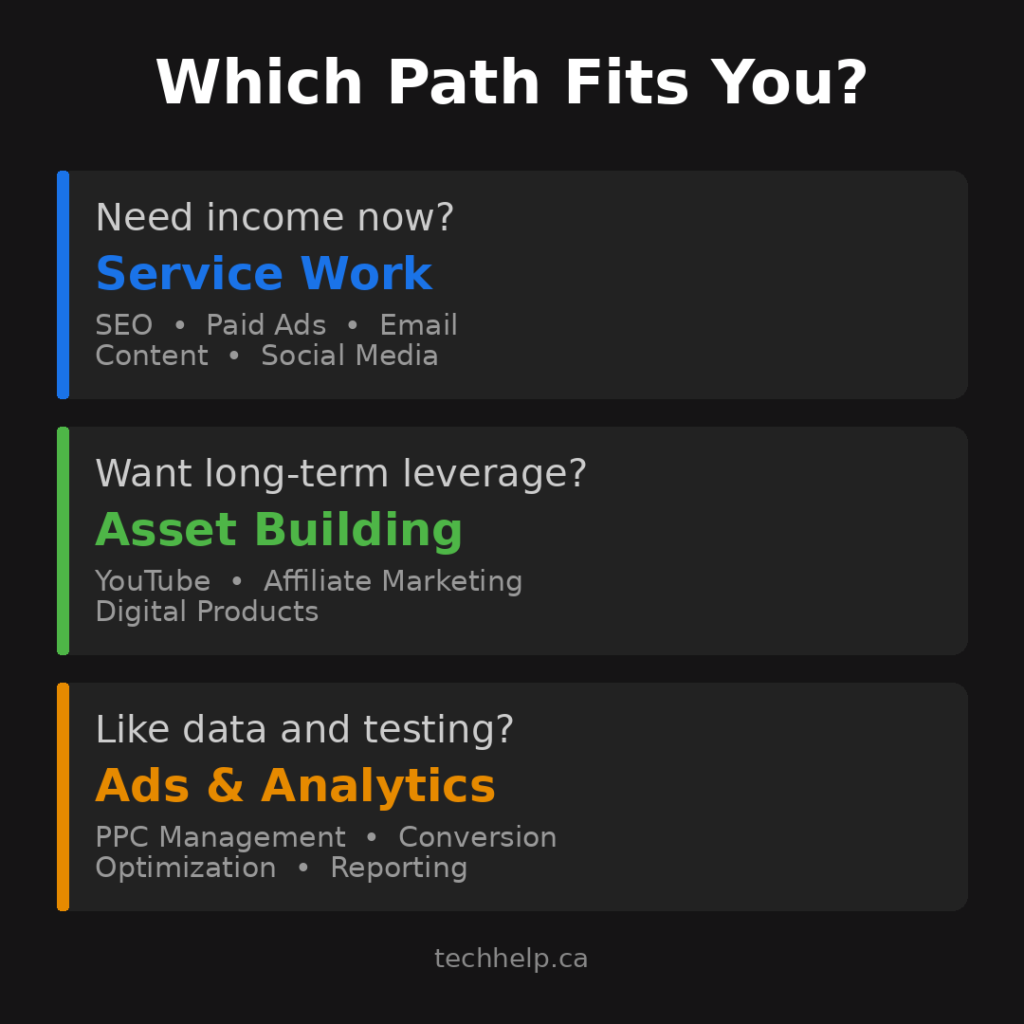
If you need income sooner, start with services. SEO, paid ads, email, content, and social media management can all produce client income faster than building an audience from zero. The trade-off is that service work depends on selling your time, at least at the beginning.
If you want leverage later, build an asset. YouTube, blogging, affiliate content, email newsletters, digital products, and e-commerce can keep earning after the first push, but they usually take longer to work. You may publish for months before the income feels meaningful.
If you like numbers and fast feedback, paid ads, analytics, conversion optimization, and email testing may suit you. If you prefer research and writing, SEO and content may fit better. If you like public teaching, YouTube, courses, and social media may be the stronger path.
Before you commit, answer five questions:
- What skill can I practice every week?
- Who already pays for this outcome?
- What proof can I build in 30 days?
- Can I explain my offer in one sentence?
- How will I get my first five clients, readers, subscribers, or customers?
If you can’t answer those questions, the idea is too vague. Narrow it until you can.
A simple 30-day plan to start
The fastest way to get unstuck is to build proof instead of collecting more advice.
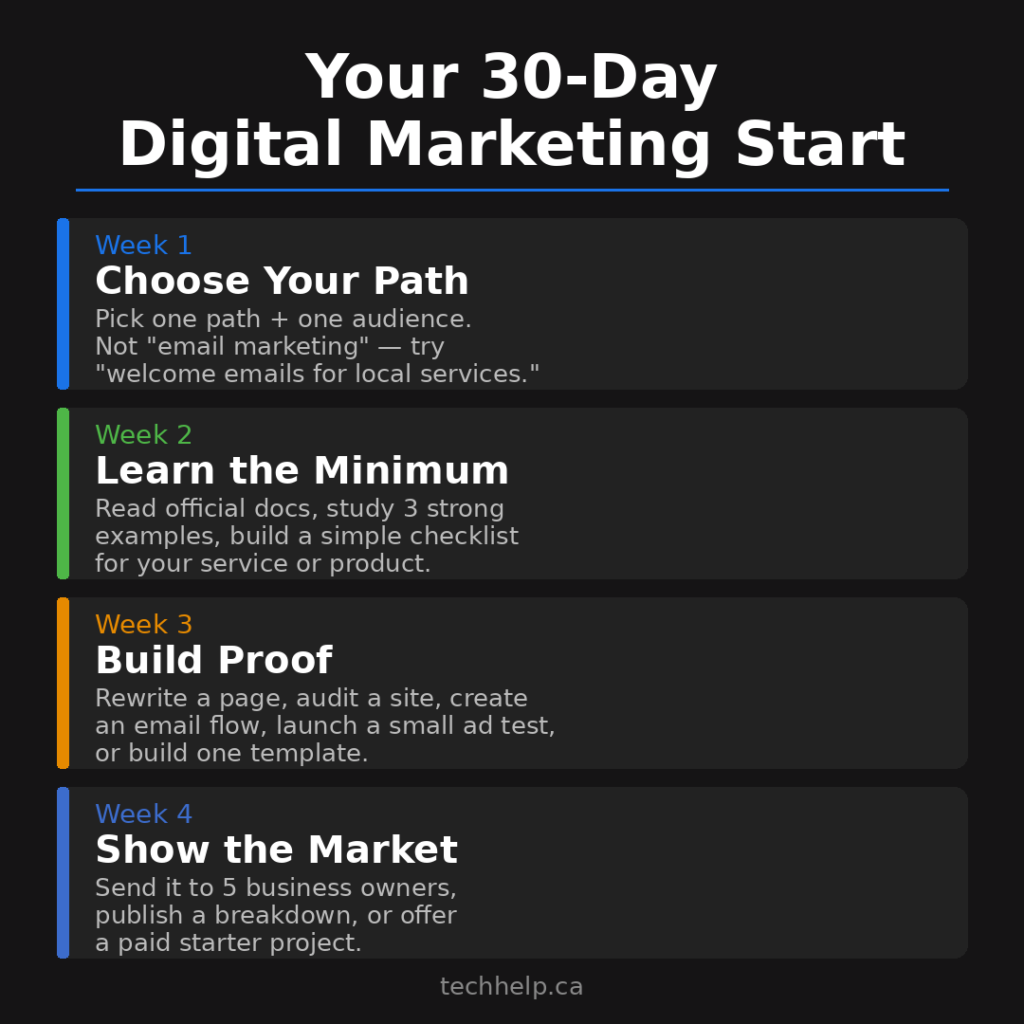
In week one, choose one path and one audience. Don’t choose “email marketing for everyone.” Choose “welcome emails for local service businesses” or “abandoned-cart flows for Shopify stores.”
In week two, learn the minimum needed to deliver a small result. Read official documentation, study three strong examples, and create a simple checklist for your service or product.
In week three, build a proof project. Rewrite one page, audit one site, create one email flow, launch one small ad test, publish three videos, or build one template. Make the work visible.
In week four, show it to the market. Send it to five business owners, publish a breakdown on LinkedIn, add it to a simple portfolio page, or offer a paid starter project with a clear scope.
You don’t need a full brand, a perfect website, or a 40-module course to begin. You need a specific problem, a small proof point, and a way for the next person to say yes.
Pick one path and build proof
Making money with digital marketing comes down to a simple sequence: learn a marketable skill, apply it to a specific problem, prove it works, and package that proof into an offer or asset.
Service work is usually the fastest route to income. Audience and asset-building create more leverage later. Digital products and affiliate marketing work best when you’ve already earned trust. E-commerce can sharpen your marketing fast, but it carries operational risk.
Pick one path this week. Build one proof project. Then use that proof to start a sales conversation with someone who has the problem you solve.
Momentum doesn’t come from planning every possible option. It comes from evidence.
Sources
- https://developers.google.com/search/docs/fundamentals/seo-starter-guide
- https://support.google.com/youtube/answer/72851
- https://competition-bureau.canada.ca/en/deceptive-marketing-practices/types-deceptive-marketing-practices/influencer-marketing-and-competition-act
- https://crtc.gc.ca/eng/com500/guide.htm
- https://backlinko.com/seo-pricing
- https://www.litmus.com/blog/infographic-the-roi-of-email-marketing
- https://www.demandsage.com/digital-marketing-statistics/
- https://firstpromoter.com/blog/affiliate-marketing-statistics
- https://www.ruzuku.com/learn/articles/state-of-online-courses-2026
- https://trueprofit.io/blog/dropshipping-success-rate
- https://milx.app/en/trends/youtube-monetization-requirements-for-2026
Frequently Asked Questions
What is the fastest way to make money with digital marketing?
Service work is usually the fastest path because a business can pay you directly for a specific result. SEO audits, email sequences, content rewrites, paid ad setup, and social media packages are easier to sell early than passive income assets because the buyer already has a problem and a budget.
Can beginners make money with digital marketing?
Yes, but beginners usually need to start small. A first project might be a local SEO cleanup, a welcome email sequence, a content refresh, or a simple social media plan. The goal is to build proof before charging higher rates or selling strategy.
Which digital marketing skill pays the most?
The highest-paying skills are usually the ones closest to revenue: paid advertising, conversion optimization, email marketing, SEO strategy, analytics, and consulting. Pay depends less on the channel and more on whether you can tie your work to leads, sales, retention, or cost savings.
Is digital marketing passive income?
Some digital marketing paths can create semi-passive income, such as affiliate content, digital products, online courses, and YouTube videos. They still require upfront work, promotion, updates, and trust-building. Service work is usually active income, but it can fund the assets you build later.
Do you need a degree to make money with digital marketing?
No. A degree can help in some roles, but clients and employers usually care more about proof. A portfolio, case study, campaign result, strong writing sample, or working project can do more for you than a credential with no evidence behind it.

I can suggest related Tech Help Canada articles based on the topic you’re reading now.

Tech Help Canada Staff researches, writes, and reviews practical content for business owners and professionals. Our coverage spans business, marketing, SEO, technology, and the tools and systems people use to grow and operate online. We focus on clear, useful information backed by research, hands-on experience, and editorial review. Learn more about our team and editorial standards. Need help with something? Contact Us