

Copywriting formulas: 200+ templates for pages, emails, ads and posts
Every piece of copy starts with a blank page and too many ways to begin. Copywriting formulas take care of the second problem. They give your ideas an order, so you can spend your energy on what to say instead of where to put it.
You'll find more than 200 formulas and templates here, grouped by what you're writing. Start with the two selection tables below, then go to the formula that fits your reader and offer. Most include an example you can adapt.
No matches in this selection
How to choose the right copywriting formula
A formula only helps when it fits the job. Three questions will get you to the right one.
What are you writing? A whole page, email or script needs a structure formula. A single headline, bullet or button needs an element formula. A finished draft needs a checklist.
Where will it run? A Google search ad gives you 30 characters per headline. A sales page can run for thousands of words. Some formulas squeeze into tight spaces and some need room to breathe.
How much does your reader already know? This is the one people skip, and it decides how you should open.
These five stages of awareness help you decide how much ground the copy has to cover before you introduce your offer.
| Awareness stage | What the reader knows | Formulas to start with |
|---|---|---|
| Unaware | They don't know they have a problem yet | Star, Story, Solution · ABT · Hook, Story, Offer |
| Problem aware | They feel the pain but don't know what fixes it | PAS · BAB · PASTOR |
| Solution aware | They know fixes exist but haven't picked one | The 4 Ps · QUEST · FAB |
| Product aware | They know you but aren't convinced | AAPPA · Star, Chain, Hook · testimonial formulas |
| Most aware | They want it and need a reason to act now | Elements-of-the-offer close · scarcity subject lines · verb + offer + urgency CTAs |
Treat that table as a starting point. Plenty of PAS emails go to people who already know the brand, and that's fine. What the table protects you from is a common mismatch: opening with your product's features for a reader who doesn't yet know why they'd need it.
If you already know what you're writing, this shortcut points you to a few formulas to start with.
| If you're writing | Start with |
|---|---|
| A homepage | The homepage formula · the 4 Ps |
| A landing page people reach from an ad or email | IDCA · the five questions |
| A long sales page | The seven-step sales letter · PASTOR · the 21-step sales letter |
| A cold email | Star, Chain, Hook · BAB · the 1-2-3-4 formula |
| A welcome email series | The Soap Opera Sequence · the five-day mini course |
| A search ad | The three-line ad · AIU |
| A social media ad | Emotional-rational-social proof · Loud, Relevant, Engaging |
| A blog post | APP · the six-part blog post · HIPASI |
| A pitch, proposal or update for a decision-maker | SCQA · ABT |
| A product page | FAB · the product description template |
| A video script | The 10-step VSL · the short-form video script |
Formulas that structure a whole message
These are the workhorses. Each one lays out an entire page, email, ad or script from the first line to the call to action, and most of them work at any length.
Unless a real campaign is named, the examples below are fictional. Replace their numbers, results and promises with claims you can support.
AIDA (Attention, Interest, Desire, Action)
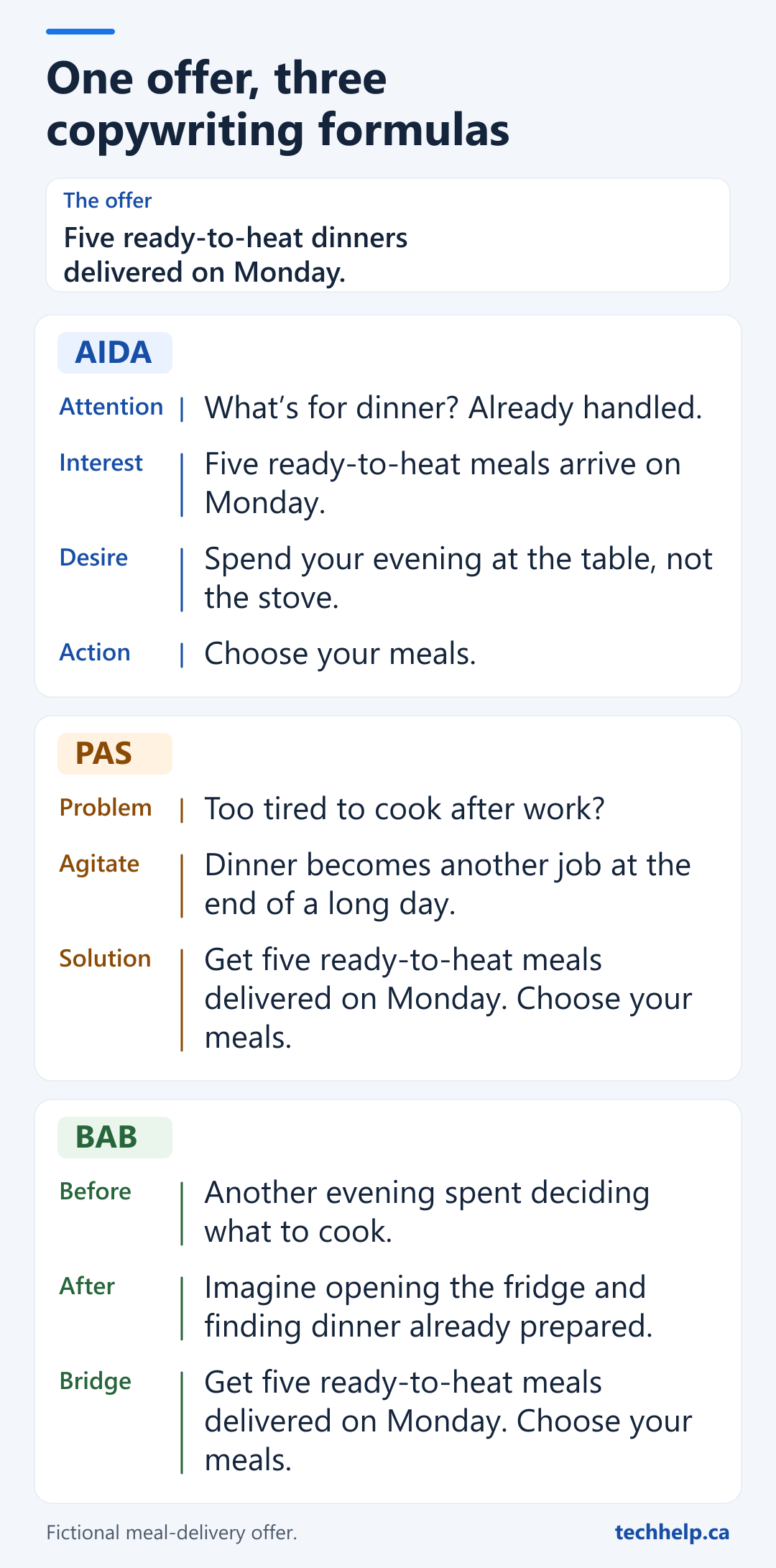
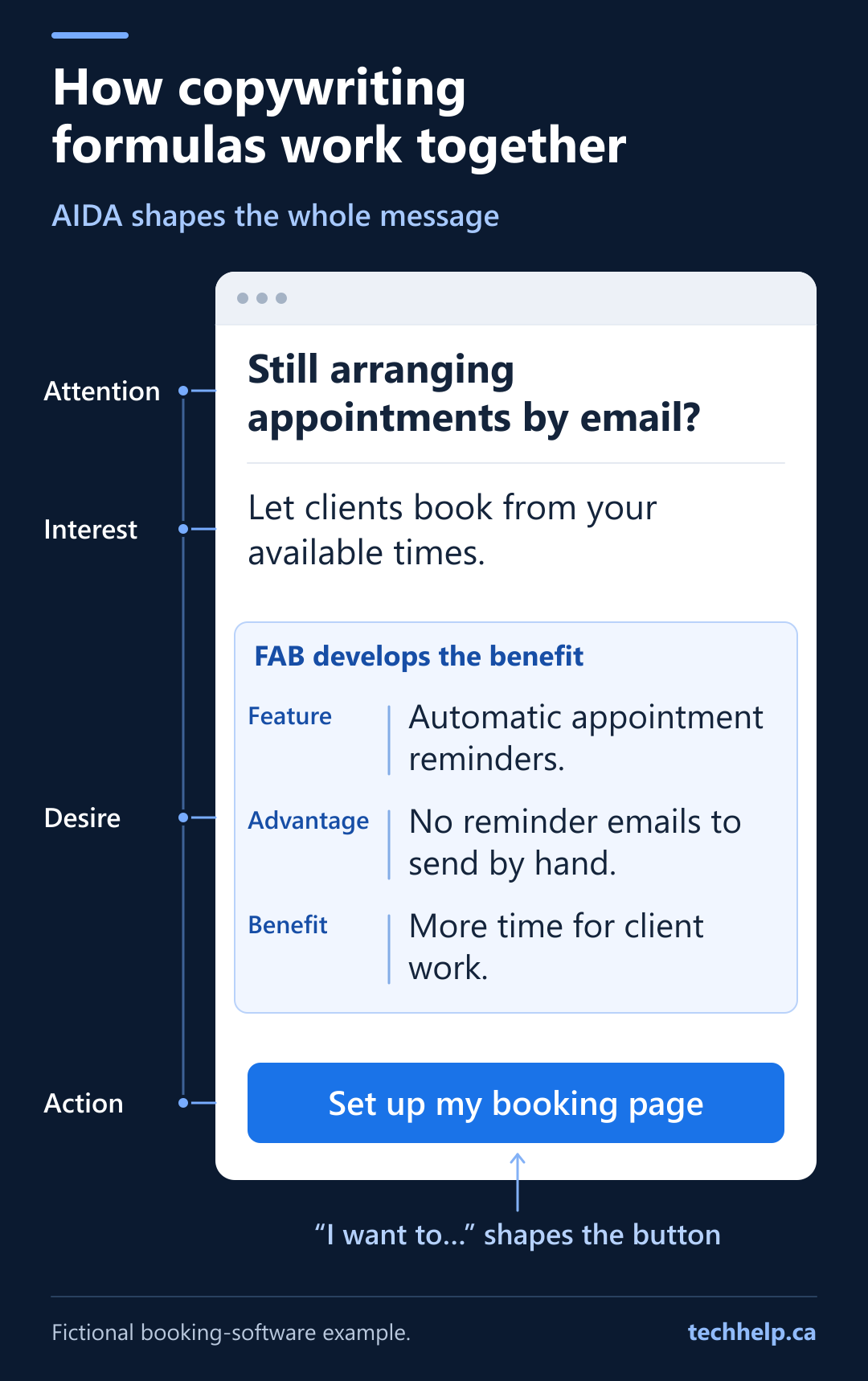
Many of the formulas on this list build on AIDA. It gives attention, interest and desire separate jobs before the ask.
- Attention: stop the reader with a headline or opening line about something they want or fear.
- Interest: give them a fresh fact, angle or detail that makes them keep reading.
- Desire: move from "interesting" to "I want that." Show what their day or business looks like with your offer in it.
- Action: ask for one specific next step.
Desire is the step that gets shortchanged. You've seen the pattern: a bold headline, one line of copy, and a "Start your free trial" button. The button asks for a decision the page hasn't earned yet.
Example (meal-prep delivery): "Dinner is handled before you leave work. Each Sunday you pick five meals from a rotating menu of 30, and they arrive chilled on Monday, portioned and ready in 10 minutes. No more 6 p.m. scramble, no more takeout guilt, and your weeknights belong to you again. Choose your first week's meals."
Two variations are worth knowing. AIDCA adds Conviction before Action, using testimonials, data, demos and guarantees to reassure a skeptical reader.
IDCA drops Attention. Use it on landing pages people reach from an email or ad, where you've already earned the click. The page can start building interest right away, provided it delivers on the message that brought them there.
PAS (Problem, Agitate, Solution)
If you only learn one formula, make it this one. PAS works in a two-line ad and in a long sales page.
- Problem: name the problem in your reader's own words.
- Agitate: make it sting. Spell out what it costs them, how it spreads and what happens if they ignore it.
- Solution: present your offer as the way out.
Agitation is where PAS goes wrong. Push too hard and you sound like a late-night infomercial. Keep it specific and true: the missed invoice, the client who walked, the Sunday spent fixing spreadsheets.
Example (booking software): "Clients keep booking the same time slot twice. Every double booking means an awkward phone call, a refund or a no-show that wipes out half your afternoon. Our calendar syncs in real time, so each slot can only be booked once."
Variation: PADS adds a Discredit step before the solution. You explain why the usual fixes (a shared spreadsheet, a part-time assistant, a sticky note on the monitor) don't hold up, so your solution doesn't get lumped in with them. A softer related sequence is CSI (Challenge, Solution, Invitation), which moves from the problem to the solution without a separate agitation step.
BAB (Before, After, Bridge)
Describe the reader's world before, problem included, then show what life looks like after that problem is solved. Your product is the bridge between the two.
BAB is PAS without the agitation, which makes it a good fit for cold emails, social posts and short ads, where a long build-up wastes space. A landscaping company might write: "Right now your backyard is the thing you apologize for when friends come over. Imagine hosting this summer's barbecue on a patio you're proud of. We design and build it in three weeks, permits included."
The 4 Ps (two versions)
The first version leads with imagery. It works best when your reader can easily picture the result.
- Picture: paint a scene the reader can step into, either the pain they live with or the result they want.
- Promise: say how your offer delivers that result.
- Prove: back it up with testimonials, data, demos or a track record.
- Push: ask for the action.
The second version swaps in Problem, Promise, Proof, Proposal. Opening with the problem suits homepages and lead-gen pages, where a dramatic scene can feel like a stretch. "Proposal" also reads softer than "push," which helps when you're asking someone to book a consultation rather than buy on the spot.
PASTOR
PASTOR is especially handy for sales pages and launch emails. Each letter covers a cluster of ideas.
- P: Person, problem and pain. Name your reader and what's hurting them.
- A: Amplify. Show what doing nothing will cost them and what they could have instead.
- S: Story, solution and system. Tell the story of someone who solved this, and introduce your method.
- T: Transformation and testimony. Show the change your offer creates, backed by people who've been through it.
- O: Offer. Lay out exactly what they get.
- R: Response. Tell them what to do next.
One tip that travels with PASTOR: keep the list of deliverables short and spend most of the offer section on what changes for the buyer. Nobody gets excited about "six modules and a workbook." They get excited about finally understanding their numbers.
QUEST (Qualify, Understand, Educate, Stimulate, Transition)
Reach for QUEST when your offer only suits a specific group. Its opening step helps the right readers recognize themselves before you explain the solution.
- Qualify: call out the right reader fast so they feel the page was written for them. ("If you run a two-chair salon and still book appointments by text…")
- Understand: show that you get their situation.
- Educate: introduce a better way of doing things, before you introduce the offer.
- Stimulate: build desire and value.
- Transition: move them from prospect to customer.
Qualifying up front turns away the wrong readers early, and that's the whole point. The people who stay are the ones worth selling to.
ACCA (Awareness, Comprehension, Conviction, Action)
Start with awareness of the problem, then build comprehension by explaining why it happens, who it affects and what it costs. Build conviction that it's worth solving, then point the reader toward action.
ACCA suits causes, nonprofits and any offer where the reader doesn't know the problem exists yet. A food bank's donation page fits. So does an IT company explaining a new phishing scam to owners who've never heard of it.
AAPPA (Attention, Advantage, Proof, Persuasion, Action)
AAPPA gives proof a step of its own, so you build the case for your offer before asking the reader to act.
Grab attention, show the reader an advantage, then give them proof that you can deliver it. Follow with persuasion, often by showing what they lose by waiting, and ask for action.
A lot of formulas leave proof implied, which is risky with a skeptical, product-aware reader. AAPPA won't let you skip it.
PAPA (Problem, Advantages, Proof, Action)
Start with the problem, explain the advantages of solving it with your offer, provide proof you can deliver, and ask for action. PAPA works when the reader needs the problem stated before the benefits will mean anything to them.
A bookkeeping service could write: "Your invoices are scattered across three inboxes. We put them in one place and follow up before payments become overdue. See how the process worked for a business like yours, then book a walkthrough."
PAPPA keeps a separate Persuasion step between Proof and Action. Use that space to answer a remaining objection or explain a genuine cost of waiting. If the evidence has already answered the doubt, move to the ask.
SLAP (Stop, Look, Act, Purchase)
SLAP moves quickly from attention to purchase. Try it for an offer readers already understand, like a daily deal on a familiar product or a template pack with a clear use.
Make readers stop with a bold headline or image, then look with a quick benefit and a few details. Give them a reason to act and make the purchase easy.
On a lot of pages, act and purchase happen in the same click. SLAP suits offers readers can understand quickly. Price alone doesn't determine copy length; an unfamiliar offer may still need explanation even when it's inexpensive.
The six-part sales letter
Use this when a sales letter needs a conversational opening and a firm close. It gives you room to explain the offer before working through the reader's reasons to buy.
- The opening: hook the reader with something already on their mind.
- The description or explanation: introduce the offer and its main features.
- The motive or reason why: shift from logic to emotion by spelling out the benefits.
- The proof or guarantee: back up your claims and take away the risk.
- The snapper or penalty: show what putting it off will cost them.
- The close: tell them exactly what to do and make it easy.
The order is flexible. Keep the opening connected to what the reader already cares about, and let that lead into the offer.
AIDPPC (Attention, Interest, Description, Persuasion, Proof, Close)
AIDPPC expands the middle of AIDA when you need more room to build desire. After earning attention and interest, describe the offer and how it works. Use persuasion to connect it to the reader's motives, supply proof, then close with the next step.
Use it when readers need to understand the solution before they can appreciate its benefits. A service with an unfamiliar process, for instance, may need that description before testimonials will carry much weight.
Star, Story, Solution
Introduce the star, tell their story, struggle included, then reveal the solution that turned things around.
The star doesn't have to be a person. A product, a feature or even a neighborhood can play the lead, as long as its story pulls readers in. A well-known example is the subscription letter Martin Conroy wrote for The Wall Street Journal. It opens with two young men who graduate from the same college, alike in almost every way. Twenty-five years later, both work for the same company. One manages a small department. The other is its president. The difference, the letter explains, comes down to what each man knew and how he used it.
Star, Chain, Hook
The star is a bold promise or claim. Build a chain of proof through case studies, numbers or testimonials, then finish with the hook, one clear call to action.
Star, Chain, Hook is strong for cold emails and short promotions, where you need to make a big claim and justify it before the reader loses interest. A hypothetical bookkeeping firm could write: "We closed the books for 40 restaurants last month in under five days each. Two of them found tax deductions their last bookkeeper had missed for three years. Want me to send over how we'd handle your first month?"
Hook, Story, Offer
This is a go-to structure for webinars, launch emails and social videos, anywhere you have a personal story worth telling.
The hook earns attention through a headline, thumbnail or opening line. The story follows a relatable change, often yours or a customer's, and the offer invites the reader to make that change too.
SCQA (Situation, Complication, Question, Answer)
For proposals and emails to decision-makers, SCQA is hard to beat. It presents your recommendation as the answer to a problem the reader recognizes.
- Situation: the context your reader already agrees with.
- Complication: what changed or went wrong.
- Question: the question the complication raises.
- Answer: your recommendation.
It also suits case studies and B2B landing pages, where readers want the argument in a logical order. Here's how it reads in practice: "You've grown from two locations to six (situation). Your booking system still runs on one shared inbox (complication). So how do you stop losing appointments as you grow (question)? Move each location onto its own calendar with central reporting (answer)."
ABT (And, But, Therefore)
ABT turns a message into a story in one sentence: "{Fact} and {fact}, but {problem}, therefore {what you're doing about it}." A local marketing agency might put it this way: "You've got great reviews and steady foot traffic, but almost nobody finds you on Google, so we start by fixing your local listings."
ABT works for elevator pitches, About page intros and the first line of a cold email. If you can't get it into one sentence, clarify the problem you're solving before expanding the pitch.
The 1-2-3-4 formula
This is about as short as a complete formula gets.
- What I've got for you
- What it's going to do for you
- Who I am
- What you need to do next
Use it for one-page offers, product announcements and short promotional emails, when you need to get from hello to the ask without a detour. Each step can be a single sentence.
The 6+1 formula
The 6+1 formula adds context and continuing credibility to a persuasive sequence. Its fourth step is the reason to learn it.
- Context: establish who you are, why you're contacting the reader and why the message is relevant to them.
- Attention: grab it.
- Desire: make them want a solution to their problem.
- The gap: show the consequence of doing nothing.
- Solution: present it, sharing only as much as they need to take the next step.
- Call to action: ask.
+1. Credibility: earn it the whole way through.
AIDA never asks you to show what inaction will cost. For a lot of readers, that cost is the most persuasive part of the page.
Sales page and sales letter formulas
These formulas assume you've got room: a long-form sales page, a sales letter or a launch email that runs for several screens. Most build toward a closing call to action after answering the reader's doubts. You can still give ready buyers an earlier button; readers who need more convincing can keep reading.
The seven-step sales letter
Lead with a strong, specific benefit. The rest of the letter develops and supports that promise, and the same sequence works on a sales page.
- Promise your most important benefit in the headline or first paragraph.
- Expand on that benefit right away, before you lose momentum.
- Tell readers exactly what they're going to get.
- Back up your claims with proof and endorsements.
- Tell readers what they could lose if they don't act.
- Restate your biggest benefits as you close.
- Ask for action now.
Step 3 gets better when you split it in two. List the tangible things they receive, like 12 video lessons or two coaching calls, then describe the change they'll feel, like knowing exactly what to post each week instead of guessing.
The 12-step sales letter
This template works through a reader's objections one at a time.
- Get attention
- Identify the problem
- Provide the solution
- Present your credentials
- Show the benefits
- Give social proof
- Make your offer
- Give a guarantee
- Add scarcity
- Call to action
- Give a warning
- Close with a reminder
The nine-point sales letter
This is a tighter structure for sales pages that need to move fast. It skips the long build-up and gets to proof early.
- Grab attention with the headline.
- Follow with an opening that inspires.
- Define the product clearly.
- Tell a success story or share a case study.
- Add testimonials and endorsements.
- List special features and extras.
- State your value proposition.
- Ask for action with specifics and urgency.
- Finish with a P.S.
That last step isn't decoration. Readers who skim often jump from the headline to the bottom of the page, so your P.S. can get read before the body copy does. Use it to restate the main benefit or the deadline.
The 21-step sales letter
This template leaves almost nothing to chance, from identifying the audience to making the final ask.
- Call out your audience by name ("For freelance designers who…").
- Grab attention with a big-promise headline.
- Back up that promise with a quick explanation.
- Identify the biggest, most painful problem they have.
- Present the solution.
- Show what it cost you (in time, money or failures) to develop that solution.
- Explain how easy it is to use.
- Show how fast it gets results.
- Help them picture life after the problem is solved.
- Share your credentials.
- Detail the benefits.
- Add social proof.
- Make your offer.
- Add bonuses.
- Build up the total value of the offer and bonuses.
- Reveal the price.
- Add scarcity, if it's real.
- Remove the risk with a guarantee.
- Call to action.
- Give a warning about what happens if they don't act.
- Close with a reminder.
Notice that the price doesn't show up until step 16, after the offer, the bonuses and the total value are already on the table. By the time readers see the number, they've got something to measure it against.
The Power Copywriting Formula
This is the long one. It starts with four prerequisites you need before writing a word: a quality product, a clear customer profile, credibility and an offer. Then work through these 32 steps.
- Research the customer, product, alternatives and objections.
- Step away long enough for the research to settle.
- Gather the product's features, facts and figures.
- Translate those details into benefits.
- Build an offer the reader has a good reason to accept.
- Define a guarantee you can deliver.
- Write the headline.
- Use color to draw attention to important points.
- Keep graphics focused on the message.
- Write an opening that starts delivering on the headline.
- Address objections that could stop someone reading.
- Add subheadings that carry the argument for skimmers.
- Show the problem's consequences.
- Explain how the offer addresses them.
- Establish why the reader should believe you.
- Reinforce that credibility with a useful insight from your experience.
- Show evidence that the solution delivers.
- Divide the copy into readable sections.
- Explain the benefits of using the product.
- Summarize the most important benefits.
- State the features readers need to evaluate.
- Make the package worth its price through relevant extras or support.
- Present the price.
- Ask for the next action.
- Offer a relevant add-on where it helps the buyer.
- Address the buyer's remaining risk.
- Restate the main benefits at the close.
- Add a P.S. that reinforces the offer.
- Make the buying process easy to follow.
- Remove links that distract from the page's purpose.
- Leave the draft alone before editing it.
- Revise for clarity, evidence and persuasion.
Even if you never follow the whole process, two steps are worth stealing. Let your research rest before you write, and let your draft rest before you edit. Both breaks catch problems you can't see when you're too close to the work.
HELLYEAH
HELLYEAH suits long-form pages with a bold, personality-driven voice. Expect to call out a villain and take sides.
- Holler: grab attention.
- Empathize: connect with their pain, usually by sharing your own.
- Lambast: call out what caused the problem in the first place.
- Legwork: prove you know what you're talking about.
- Yes: you have the solution.
- Educate: explain why your solution beats the others.
- Action: give one clear next step.
- Handle: answer lingering doubts and objections.
The elements-of-the-offer close
Every sales page eventually has to present the deal. This formula covers the close in eight beats.
- Here's what you're going to get
- Here's what it's worth
- A bonus, ideally tied to a condition (order by Friday, sign up for the annual plan)
- The price
- A comparison that makes the price feel small ("less than one client lunch a month")
- The guarantee
- Risk reversal, such as "keep the bonuses even if you ask for a refund"
- Scarcity, but only if it's true
If the countdown timer resets every time someone reloads the page, the deadline is hard to believe. Only use scarcity your business can explain and honor.
Video script formulas
Video isn't a sales letter read out loud. Viewers can leave in a second, and skimming a video is far clumsier than skimming a page. These formulas account for that.
The 10-step video sales letter (VSL)
- Open with a shocking or surprising statement.
- State the problem and why it's a big deal.
- Agitate the problem.
- Push the agitation further, to the emotional level.
- Introduce the solution.
- Show your credibility so viewers know why to listen.
- Prove what you're saying is true.
- List the biggest things they'll get, features and benefits both.
- Give specific reasons to act now rather than later.
- Close by asking for the purchase and restating the benefits.
The three-CTA video sales letter
This version asks for the sale three times, each with a different appeal. It's aggressive, but it catches viewers at different points of readiness.
- Open with a greeting that grabs attention.
- Name the problem and promise to solve it.
- Establish scarcity.
- Agitate the problem.
- Position your offer as the answer.
- Walk through features and benefits.
- First call to action, appealing to desire.
- Share credentials, proof, results and testimonials.
- Explain the guarantee.
- Second call to action, appealing to logic.
- Warn about the deadline and scarcity.
- Final call to action, appealing to the fear of missing out.
The short-form video script
Use this one for Reels, TikTok, YouTube Shorts and any clip under a minute.
- Hook: the first second or two. Show the result, name the problem or start mid-action.
- Promise: tell viewers what they'll get if they keep watching.
- Payoff: deliver it. One tip, one demo, one before-and-after.
- Call to action: one next step, like follow for part two, grab the template or visit the link in the bio.
Keep it to one idea per video. Three closely related tips can support that idea; three separate topics usually need separate videos.
Headline formulas
Headlines aren't just the line at the top of the page. Every subhead, crosshead, email subject, video title and bolded opening line works like one, because readers use it to decide whether to keep going.
Fill in the braces with your own details. Any template with a number in it only works if you can support that number. The same applies to comparisons, guarantees and claims that something is the first or only one of its kind.
Benefit and promise headlines
- Who else wants {desirable result}?
Who else wants a website that books appointments while they sleep? - Now you can {desirable result} {without the usual downside}
Now you can run payroll without an accountant on speed dial - Now you can {desirable result} {and get a bonus result}
Now you can grow your email list and keep your unsubscribe rate low - We promise you this: {result}, or {consequence for you}
We promise you this: your new kitchen in 30 days, or we pay for the takeout - Here's the {unexpected adjective} way to {solve a problem}
Here's the lazy way to keep your books up to date - Get rid of {problem} once and for all
Get rid of late invoices once and for all - {Do something hard} in {short period of time}
Set up your online store in a single afternoon - Land your first {result} in {time}
Land your first wholesale account in 60 days - {Have/Build} a {desirable thing} you can be proud of
Build a portfolio you can be proud of - Get the {surprising adjective} power of {category} without {pain}
Get the unfair advantage of a full marketing team without the payroll - Let {product} work on your {problem area} for just {time}
Let our bookkeepers work on your receipts for just one month - Is it worth {small price} to you to {big result}?
Is it worth $9 a month to never miss a client call again? - How to {get result} and {unexpected bonus}
How to spend less on ads and get more leads - The only {category} made specifically for {audience or outcome}
The only scheduling app built specifically for mobile dog groomers
Unexpected-angle headlines
- {Remove a pain} {in an unexpected way}
File your expenses from the grocery checkout line - {Get a desirable result} {in an unexpected way}
Close more sales by talking less - Overcome the {unexpected culprit} that keeps you {stuck}
Overcome the one setting that keeps your emails out of the inbox - How I found out that {unexpected thing} is the best {fix}
How I found out that saying no is the best growth plan - What {unexpected group} can teach you about {topic}
What wedding DJs can teach you about reading a room on sales calls - Break all the rules and {result}
Break every pricing rule and still sell out your workshop
Curiosity and secret headlines
- The secret of {desirable thing}
The secret of a booked-solid calendar - Let me show you the secrets of {admired group}
Let me show you the secrets of top-earning Etsy sellers - Little-known ways to {result}
Little-known ways to lower your hosting bill - {Number} little-known factors that could affect your {thing they care about}
7 little-known factors that could affect your Google rankings - What everybody ought to know about {topic}
What everybody ought to know about sales tax on digital products - Why haven't {people like the reader} been told these facts?
Why haven't first-time landlords been told these facts? - How {people from a place} {get a desirable result}
How small Italian towns keep their main streets busy - Behind the scenes of {interesting thing}
Behind the scenes of a 48-hour product launch - Is this the world's first {surprising thing}?
Is this the world's first invoice that chases itself?
Pain and problem headlines
- Are you still wasting money on {thing}, without anything to show for it?
Are you still paying for ads that don't bring in a single lead? - How to permanently stop {painful thing}, even if you've tried everything
How to stop chasing late payments for good, even if you've tried everything - You're tired of {pain}, but you still want {outcome}, so it's time you met {product}
You're tired of clunky site builders, but you still want a site that looks custom, so it's time you met {your builder} - How your {service provider} is overcharging you, and what to do about it today
How your payment processor is overcharging you, and what to do about it today - {Most / number of} {group} can't {thing}, are you one of them?
Most freelancers can't name their real hourly rate, are you one of them? - See why {problem} happens in {short time}
See why customers abandon your booking form in this two-minute walkthrough
Proof and authority headlines
- {Expert} shows you how to {do what they do}
A 20-year restaurant owner shows you how to cut food waste in half - {Do something} like {admired example}
Answer support emails like a five-star hotel concierge - {Number} lessons I learned from {person or unusual experience}
11 lessons I learned from my first failed product launch - People pay me {price} for this, but you can have it free
Clients pay me $500 for this audit, but you can have the checklist free - Here's a {method or system} that's helping {audience} {result}
Here's a system that's helping solo accountants take Fridays off - Former {insider} reveals {what gets the outcome}
Former loan officer reveals what gets small business loans approved - I found a {surprising adjective} way to {result}
I found a boring way to double my newsletter replies
Challenge and question headlines
- Can your {current solution} pass the {named} test?
Can your homepage pass the five-second test? - Do you have the courage to {bold action}?
Do you have the courage to raise your prices this year? - Would you {surprising action}? I just did
Would you delete half your product line? We just did - Who doesn't like {mild vice}? {Unexpected answer}
Who doesn't love free shipping? Your profit margin - {Most / number of} {group} are {right/wrong/confused} about {topic}
Most store owners are wrong about abandoned carts - Is {trending topic} a scam? Find out if your {resource} is at risk
Is "AI SEO" a scam? Find out if your marketing budget is at risk - Is it wrong to {get desirable outcome}?
Is it wrong to charge friends full price? - You're {comparative} than you think
You're closer to profitable than you think
Contrast and comparison headlines
- {Common option} {does weak thing}, {your brand} {does strong thing}
Most hosts charge extra for backups, but ours run every night for free - They all {reacted badly} when {I did something unexpected}, but when {result}!
My accountant laughed when I said I'd do my own books, but then he saw my year-end report! - {Underdog} takes on {giant} and {result}
One-van bakery takes on the grocery chains and wins the neighborhood - {Big player does X}, {small player responds with Y}
Coffee chain raises prices, corner café answers with free refills for regulars
Story and confession headlines
- I stopped {common practice} today, and you should too
I stopped posting on Facebook every day, and you should too - I spent {time} {working toward a goal}, then I quit, and here's why
I spent two years building an app, then I shut it down, and here's why - I don't regret {decision}, but here's what I'd do differently
I don't regret quitting my job, but here's what I'd do differently - {Bad thing} just happened, and here's {what to do}
Your biggest client just left, and here's your 30-day plan - {Person did small thing}, {big reaction}, result: priceless
She mailed a handwritten thank-you card, the client renewed for three years, result: priceless - To the {role} who won't settle for less than {outcome}
To the contractor who won't settle for anything less than five-star reviews - {Recognizable person} {emotional reaction} to {familiar issue}
A veteran shop owner is furious about the fees on a single refund - {Bad event} just happened, and {result or response} is {description}
The shop's booking system went down, and its handwritten waiting list filled the window
Guide and resource headlines
- The ultimate guide to {topic}
The ultimate guide to pricing your first service - The complete library of {number} free and low-cost {resources}
The complete library of 150 free and low-cost marketing templates - How to make money with your {asset}, step by step
How to make money with your spare room, step by step - How to survive your first {challenging thing}
How to survive your first tax season as a freelancer - How to learn {technical skill} before {expert} has to explain it
How to read a profit-and-loss statement before your accountant has to explain it
Short and punchy headlines
- {One word}
Tiny (for a pocket-sized speaker) or Done (for a task app) - {Objection}, but it works
Ugly, but it works or Expensive, but it pays for itself
Value proposition formulas
A value proposition tells someone what you do, who it's for and why they should pick you over everything else they could do, including nothing. Each formula below frames the same imaginary business, a meal-prep delivery service for busy families called Prepped, so you can see how each one changes the emphasis.
For {target}, {name} is a {category} that {benefit}
This is the classic positioning statement, and it comes in three lengths.
- Long: For {target} who {need}, {name} is a {category} that {benefit}.
For working parents who dread the 6 p.m. dinner scramble, Prepped is a meal-prep delivery service that puts healthy dinners on the table in 10 minutes. - Short: {Name} is a {category} that {what it does best}.
Prepped is a meal delivery service that cooks like your favorite aunt. - With an objection removed: {Name} is a {category} that {outcome}, without {objection}.
Prepped is a family meal service that gets picky kids eating vegetables, without a dinner-table standoff.
The only {category} that doesn't {objection}
Name the frustration people have with your whole category, then promise to remove it. The only meal kit that doesn't leave you chopping for an hour.
VAD (Verb, Application, Differentiator)
Start with an action, say where it applies and finish with what makes you different. Serve family dinners in 10 minutes, made from local farm ingredients.
Differentiator statements
- We do X, but the difference is {differentiator}.
We deliver family meals, but the difference is that every menu is built around your kids' picky-eater list. - We're the ones that {differentiator}.
We're the ones that let you swap any meal up until Sunday night.
The {adjective} way for {audience} to {result}, {benefit}
Pick an adjective that flips a common complaint. The no-chopping way for busy families to eat well, without spending Sunday in the kitchen.
{Proven example} for {new audience}
Borrow a concept people already understand. A personal chef for families on a grocery budget. You can also combine two familiar ideas with {known concept} meets {known concept}, for {audience}. A family recipe book meets a meal delivery service for busy parents.
We help {audience} {result} by {method}
Lead with the audience, then the result, then how you deliver it. We help busy families eat home-cooked dinners by doing the shopping, chopping and cooking for them.
{Superlative} {category} {qualifiers}
The fastest family dinner in town, ready in 10 minutes. Only use a superlative you can back up, because readers and regulators both expect proof.
Customer, Problem, Solution
Name the customer, describe the problem and show how you solve it. Working parents want to feed their kids well, but by 6 p.m. there's no time or energy left to cook. Prepped delivers chef-made family meals each week, ready to heat and serve.
Problem, Solution, Differentiator, Credibility
Lead with the size or cost of the problem, introduce the solution, show what makes it different, and establish credibility. This gives a longer pitch room to answer both "Why this?" and "Why you?"
For Prepped, that might read: "Cooking separate dinners for picky eaters takes over the evening. Prepped delivers meals you can heat and serve, with portions and ingredients tailored to each family member. See the sample menus and feedback from families who've tried them."
What, How, Why
Answer all three questions in a single sentence. Prepped is a family meal delivery service (what) that plans, shops and cooks for you every week (how), so you get your weeknights back (why).
Bullet formulas (fascinations)
Direct-response copywriters call their best bullets "fascinations." A regular bullet states a feature. A fascination makes the reader curious enough that they have to know more, and the only way to find out is to buy, sign up or keep reading.
BGNGo (Best, Good, Necessary, Good with Outcome)
Put your best bullet first, follow it with good supporting points, then cover the necessary details readers need but won't get excited about. Finish with a good bullet tied to an outcome.
People tend to remember the first and last items in a list best, something psychologists call the serial position effect. BGNGo puts that to work by bookending your list with the two strongest bullets.
The seven deadly fascinations
Rewrite each bullet so it taps into one of the seven deadly sins. Here's what that looks like for an online bookkeeping course.
- Lust: The 15-minute weekly routine that makes tax season something you almost look forward to
- Sloth: How to automate 80% of your data entry and never type a receipt again
- Envy: The reports your more successful competitors are already reading every Monday
- Pride: How to walk into your accountant's office and be the most organized client they have
- Wrath: The bank fee you're paying every month that nobody told you about (page 34)
- Gluttony: Every template, checklist and spreadsheet from the course, yours to keep
- Greed: How to find the deductions that could put thousands back in your pocket
You don't need all seven, and they don't need to run in that order. Choose the motives that fit your reader and offer.
Headlines as bullets
Every headline formula above works as a bullet. Add a page number, timestamp or module number to make it a tease: "The one-line email that gets late clients to pay (page 12)." This works especially well for course, book and training sales pages.
Two more patterns suit a fascination because they promise a specific insight.
- How {person or role} showed me {unexpected lesson}
How a delivery driver showed me why customers miss our collection entrance (lesson 3) - Why some {people} get {advantage} in {setting}, and what you can learn from it
Why some proposals reach the shortlist before the buyer opens the pricing page (page 18)
Body copy formulas
Almost any structure formula can lay out a single section of body copy. These two are built for it.
FAB (Features, Advantages, Benefits)
- Feature: what it is or does.
- Advantage: why that's better than the alternative, whether that's the old version, a competitor or doing it by hand.
- Benefit: what it means for the reader.
Example: "Prepped meals arrive in oven-safe trays (feature). There's no transferring to pans or extra dishes (advantage). So dinner cleanup takes two minutes, and you get your evening back (benefit)."
The quickest way to write FAB is to finish this sentence: "You get {feature}, which means {advantage}, so you {benefit}." FAB works best deeper in a page, where readers are comparing options and have a checklist of features in mind.
Feel, Felt, Found
Salespeople use this objection-handling formula on the phone, and it works just as well in writing. It acknowledges the doubt before answering it, so the reader doesn't feel argued with.
- Feel: acknowledge the worry. "You might feel a meal service is too expensive for a family of five."
- Felt: show others had the same worry. "A lot of our customers felt the same way before they tried it."
- Found: share what they discovered. "Then they found they were spending more on takeout and wasted groceries than on Prepped."
Drop it into the body copy right where the objection usually comes up. Tucked away in a separate section at the bottom, it'll miss the readers who already left.
CTA and button formulas
A button is where your visitor finally says yes. Treat its copy like a headline, not an afterthought.
The "I want" button
Finish one of these two sentences from your visitor's point of view, then use the ending as your button copy.
- "I want to ____" → Get my meal plan
- "I want you to ____" → Show me this week's menu
Notice the second one keeps the first person ("me," "my"). That's the point: the button reads like the visitor's own words.
"Get ____"
Start the button with "Get," then name what the visitor receives: Get the free template, Get my quote, Get started in 2 minutes. "Get" suggests the visitor is receiving something rather than doing work.
RAD (Require, Acquire, Desire)
RAD is less a template and more a test of whether your button is ready.
- Require: does the visitor have all the information they need to click?
- Acquire: is the button easy to find and click?
- Desire: do they actually want what the button promises?
If the answer to the first question is no, the problem isn't your button copy. It's the page above it.
Verb + offer + urgency
Also called Hook, Line and Sinker, this works for buttons, text links and ad calls to action: Book your free tour today, Download the checklist now, Claim your discount before Friday. Put the verb first so the reader knows exactly what happens when they click.
Testimonial formulas
A testimonial is there for your prospect, not your ego. Each formula below helps you ask better questions or guide what customers tell you. Only edit for length and clarity, and get the customer's approval on the final version before you publish it. Never invent or embellish one.
Before, After, Experience
Ask what hesitations the customer had before buying, what they discovered after going ahead, and how the experience felt.
This structure turns a testimonial into a small story, giving prospects more to evaluate than "Great service, highly recommend!" Ask these three questions in a short email or call, then turn the answers into a paragraph for the customer to approve.
TEASE
Use TEASE as a checklist for shorter testimonials. They're great to scatter between longer ones, but don't trade away specifics just to make one shorter.
- Tactful: is it respectful and appropriate?
- Emphasizes: does it highlight a specific strength?
- Authentic: does it share a real part of the experience?
- Short and sweet: is it easy to read in a few seconds?
- Engaging: does it hold the reader's interest?
The 4 Ss (and the 4 Ls)
Good testimonials are specific, short, sizzling and signed with a real name, and ideally a photo, role or business. Weak testimonials are long, lame, lazily written and lacking a point.
The fill-in-the-blanks testimonial
Send this to happy customers and ask them to fill in the blanks in their own words:
I came to {business} because ____. {Person or team} helped me by ____. The result was ____. What I liked most was ____. I found the experience ____. I'd recommend {business} to anyone who needs ____.
The prompts give customers a way to describe the problem, the result and who they'd recommend you to. Keep their meaning and wording when you edit their answers.
Website page formulas
Your website's pages each have a different job, and the formula should match it. A homepage introduces you to strangers. A pricing page helps people who already like you pick a plan.
The homepage formula (AICPBSAWN)
As an acronym, AICPBSAWN is ridiculous. As a page plan, it's surprisingly practical: Attention, Interest, Credibility, Proof, Benefits, Scarcity, Action, Warn, Now. Here's how it maps onto a typical homepage.
In the hero section, earn attention with your biggest benefit, the problem you solve or what makes you different. Build interest with a subhead and a short explanation, then establish credibility with a testimonial and client logos.
Use feature blocks for proof and benefits. A subheading, a short paragraph and a screenshot or photo can show the product doing what you claim. Explain what that feature means for the reader, then repeat the pattern for the next important feature.
In the closing section, mention genuine scarcity, such as limited spots or a seasonal deadline, and ask for action with a clear button. A brief warning can explain what the problem keeps costing them. Give them a reason to act now, supported by evidence such as a testimonial from someone glad they did.
Plenty of homepages put a button in the hero, and that's fine when visitors arrive ready to act. This formula saves it for the end. If you're getting lots of signups from people who never use the product, check what the page promises and how you qualify visitors before changing the button's position.
The landing page formula (the five questions)
A landing page has one job. These five questions help you answer what a skeptical visitor wants to know.
- What will you do for me if I listen?
- How are you going to do it?
- Who's responsible for the promises you're making?
- Who else have you done this for?
- What will it cost me?
Answer them in order and you've got a complete lead-gen or sales page. It also works as a plan for a one-page website.
The pricing page formula
Pricing pages get read by people who are already interested. Your job is to help them choose, not to sell them from scratch.
- Headline that frames the value, not the cost. Plans that pay for themselves in saved hours.
- Who each plan is for, in one line per plan. For solo owners. For growing teams. For multi-location businesses.
- A recommended plan, visually highlighted, so undecided visitors have a default.
- What's included, written as outcomes where you can, with the details in a comparison table below.
- Answers to the pricing objections people actually raise: contracts, cancellation, hidden fees, what happens when they outgrow a plan.
- Risk reversal, such as a free trial, a money-back guarantee or "cancel anytime."
- One call to action per plan, plus a fallback for people who aren't ready, like "Talk to us" or "See a demo."
The About page formula
An About page is still about the reader. They want to know whether you can help them and whether they can trust you.
- Who you help and what you help them do. Lead with this, not your founding date.
- The problem you saw. What frustrated you or your customers enough to start this?
- What you do differently. Your approach, your values in practice, your process.
- Proof. Results, customer numbers, credentials or press, whatever's true and relevant.
- The people. Real names and faces do more for trust than "our team of experts."
- A next step. Book a call, browse services or read customer stories.
The product description formula
- Who it's for and the main benefit, in one sentence.
- Three to five features, each tied to a buyer benefit. FAB works well here.
- Proof: reviews, ratings, awards or a short testimonial.
- The specifics: sizes, materials, compatibility, shipping and returns.
- A reason to buy now, like low stock or a delivery cut-off date.
The FAQ answer formula
- Phrase the question the way customers ask it, using their words, not yours. "Can I cancel anytime?" beats "Cancellation policy."
- Answer in the first sentence. Yes, no or the number.
- Add the proof or detail that makes the answer believable.
- Point to the next step if there is one.
A good FAQ section handles the objections that would otherwise stop a sale. Pull the questions from sales calls, support tickets and the emails people send before they buy.
The case study formula (Challenge, Solution, Results)
- Challenge: who the customer is and what wasn't working, with specifics.
- Solution: what you did, step by step, including anything that didn't go to plan.
- Results: the measurable outcome, the timeframe and a quote from the customer.
Lead the case study with the result in the headline. How a three-person accounting firm cut month-end close from 10 days to four gets read. Client success story: Smith & Co. gets skipped.
Email sequence formulas
These formulas plot a whole series of emails rather than a single message. Set one up in your email platform's automation tool and every new subscriber or customer gets the same sequence.
The five-day mini course
- Day 0 (on signup): welcome them, preview what the course covers and ask them to reply with an answer to one question.
- Day 1: teach one useful thing and finish with an action to take.
- Day 2: share a bigger idea through a story, with a call to action in the P.S.
- Day 3: a batch of practical tips.
- Day 4: a case study with real numbers and a call to action to try your solution.
The five-email lead nurture
- A warm hello
- A transparent case study or finding
- A personal business story that shows your honesty and humanity
- A second case study
- A free trial offer or soft sell
The Soap Opera Sequence
This five-email welcome series builds toward an offer through a continuing story. The early emails end on a cliffhanger so readers look forward to the next one.
- Set the stage: introduce yourself and hint at a story or secret you'll share soon.
- High drama: tell your backstory, starting with the moment things got hard.
- Epiphany: reveal what you discovered that changed everything.
- Hidden benefits: share the benefits of your solution that people don't expect.
- Urgency and call to action: set a deadline and make the offer.
The String of Pearls
Instead of a fixed structure, the String of Pearls is a principle. Each email delivers one valuable or intriguing detail, a "pearl" that's useful on its own. Strung together over a series, the pearls add up to a persuasive case for your offer. Where do the pearls come from? Customer research, support tickets, reviews and the questions people ask before they buy.
The new-customer welcome sequence
This sequence runs six emails over about two weeks. It's aimed at helping new customers get value fast and stick around. Adjust the timing to how quickly customers can use what they've bought.
- Welcome, plus a real person's name and contact details for support
- A free extra, like a template, a guide or a bonus session
- A case study showing how another customer uses the product
- Real examples of the return customers get
- A customer testimonial, ideally on video
- Answers to frequently asked questions
PASOP (Problem, Agitation, Solution, Outcome, Problem)
PASOP links a series of useful emails by ending each one with the next problem the reader will face. Solve the current problem first, show the outcome, then open the next question. The final email uses PAS to lead into your offer.
For a proposal-writing course, the sequence could work like this.
- Email 1: explain why a vague project scope leads to rework, show how to define it, and describe the result. End with the next problem: how to price that scope.
- Email 2: explain the cost of underpricing, give a pricing exercise and show what it clarifies. End with the next problem: getting the client to approve the proposal.
- Email 3: address stalled approvals, explain what's at stake and introduce the course as the next step.
Each email should be useful on its own. The open question gives the next email a purpose without withholding the answer you already promised.
Email subject line formulas
Your subject line has one job: get the email opened. Then the email has to deliver what the subject line promised. Every formula here falls apart if the body doesn't pay off.
The report formula
- New {approved/certified} {process or tool} + {benefit}
- Introducing {technique or system} + {benefit or mystery}
- A new way to {result} + {benefit}
Introducing the Friday review: how to plan next week in 15 minutes
The data formula
- {Percentage} + {unexpected thing}
- {Known name} rated {rating} for {thing}
- {Trend} {percentage change}
Pair the number with a "why" or "how" so it doesn't read like a summary that makes opening unnecessary. Why 3 in 10 of our customers switched plans last month
The how-to formula
- {Attention-grabber}: how to {avoid or get something}
- How {person or company} {did something impressive}
- How to {result}
- How to {result} without {pain}
Tax deadline next week? How to file without the panic
The question formula
- Who / What / When / Where / Why / How {question}?
- {Short statement}?
Still using the free plan? or Ready?
The quote formula
Quotation marks catch the eye in a crowded inbox.
- "{Quote}" by {person}
- "{Quote}," know who said that?
- "{Quote}," agree?
- {Person} said this about {topic}
- {Event or group}: "{Quote}"
- "{Unattributed quote}"
That last one is the sneaky one. Put a customer's real words in quotes, with their permission, like "I didn't think it would work for my industry," and readers open it to find out what happened next.
The open loop
Give away just enough of the story that readers need the rest. Then close the loop in the email itself.
- I messed up
- {Person} said it was the {right/wrong/scary} thing to do
- FYI, you should be {doing/reading/watching} this
- FYI, stop wasting time {doing something unhelpful}
- {Valuable thing} for you
- The best thing to happen to {industry} since…
- In case you missed it
The empty suitcase
An "empty suitcase" leaves a word such as "this" unexplained. In body copy, that can make the meaning unclear. In a subject line, it can create curiosity if the reader has enough context to care.
- {Name}, this is for you
- This is how you {do something}
- I learned this from watching {person or thing}
- I {did} this, and everything changed
What {group} needs to {verb}
Swap in an industry, a role or, if your email tool supports it, a first name or company name.
What landlords need to know before January or What Sarah needs to fix first
The announcement formula
- Introducing {name}
- Introducing {name}: {short value proposition}
- New: {name}
- New: {benefit, without naming the product}
- Now open: {registration, enrollment, booking}
The scarcity and urgency formula
- Only {number} {days/hours} left to {action}
- Just {number} {items or spots} left
- Last chance to {action}
- Get {bonus} if you {action} in the next {timeframe}
The punctuation formula
Use punctuation to break up the subject line and make it look different from everything around it in the inbox.
- How we email busy people (and get replies)
- You + this deal = a free weekend?
- Psst… your cart misses you
The short formula
One to three words. Short subject lines stand out in an inbox full of long ones.
One question · Tomorrow? · 60 minutes · Unsolicited advice
The introduction formula
{First name} <> {First name} works for connecting two people, and it reads like a personal message. You can borrow it for marketing, such as when announcing a webinar with a guest expert: {Subscriber's first name} <> Maria. It feels very personal, so save it for when you have a genuine introduction to make.
Search ad formulas
Google stopped allowing advertisers to create or edit expanded text ads on June 30, 2022. Its responsive search ads accept up to 15 headlines of 30 characters each and up to four descriptions of 90 characters each. Because Google combines those assets in different orders, each line needs to work on its own and alongside the others.
The formulas below still work. You just apply them across a set of headlines and descriptions instead of one fixed ad.
AIU (Attention, Interest, Urgency)
- Attention: a headline that matches what the searcher typed.
- Interest: a description that gives them a reason to choose you.
- Urgency: a reason to click now.
The order is flexible. Sometimes the urgency is the attention grabber: Same-Day Furnace Repair.
Device + Keyword + Persona + Brand
The formula is Device + Keyword + Persona + Brand = Converting Copy. Write for the device the searcher is likely using, include their keyword, speak to the specific type of customer and sound like your brand. For an urgent repair search on a phone, "Call now" may fit better than "Download the guide."
The three-line ad
- Headline: attract attention by being relevant to the search.
- First description: generate interest by being useful.
- Second description: ask for the click by showing the value.
Responsive search ad templates
Write a mix of headline types so Google has good combinations to test.
- Keyword headlines: {Service} in {City} · {Product} for {Audience}
- Benefit headlines: Get {Result} in {Timeframe} · {Outcome} Without {Pain}
- Proof headlines: {Number} 5-Star Reviews · Trusted Since {Year}
- Offer headlines: {Discount} Off Your First Order · Free {Quote/Trial/Shipping}
- CTA headlines: Book Your Free Consult Today · Get Your Quote in 2 Minutes
For descriptions, pair a benefit with a call to action, such as Same-day repairs, upfront pricing and a 1-year guarantee. Book online in 60 seconds. Count your characters as you go, since headlines cap at 30 and descriptions at 90.
USP + CTA + display path
Give the searcher a reason to choose you, an action to take and a display path that helps them recognize the destination. This structure was used in fixed-line search ads, but the parts also work across responsive ad assets. Fit the copy to today's limits rather than the old 35-character description lines.
For the unique selling proposition, start with one of these patterns.
- {Memorable benefit} and {price advantage}
- Your search for {solution} ends here
- {Choice or range} + {price} + {service advantage}
- Get {offer} for {price}
For the call to action, use the next step the searcher can actually take.
- Start searching {selection} now
- Get your free quote online
- Order the {useful guide} today
- {Speed or price advantage}. Call today
Then use a relevant display path, such as /furnace-repair, alongside the site's domain. The ad and destination page should describe the same offer.
Attention, interest, ask
This editing formula is expressed as ea = 2at + i + as. Here, ea means ad effectiveness, at means attract attention, i means generate interest, and as means ask for the click.
The extra weight on attention reminds you that the rest of the ad cannot do its job if nobody notices it. Use the expression as a review sequence, not a numerical prediction. Check whether the ad earns attention, gives a relevant reason to care and makes the next step clear.
Social media ad formulas
Loud, Relevant, Engaging
- Be loud: stand out in the feed with a bold image, an unexpected color or a striking first line.
- Be relevant: speak to a specific audience about something they care about right now.
- Be engaging: give them a reason to stop, read and click.
ERERS (Emotional, Rational, Emotional, Rational, Social proof)
This sequence alternates emotional triggers and rational reasons, then closes with proof. Here's how it plays out in a single ad for a bookkeeping app.
- Emotional: the benefit. Stop losing Sunday nights to receipts.
- Rational: the features. Snap a photo and the app logs, sorts and matches every expense.
- Emotional: the feeling, often carried by the image. A relaxed owner closing a laptop at 5 p.m.
- Rational: the risk remover. Free for 30 days, no card required.
- Social proof: the crowd. Join {number} small business owners who've made the switch.
The four-step social ad formula
Use this as a plan for an ad and a check before publishing it. Be objective by choosing the outcome you want, highlight benefits the audience cares about, be persuasive with a specific reason to believe the offer, and follow the rules of the platform and promotion.
For a local workshop, that could mean one registration goal, a headline about what attendees will learn, a sample of the work they'll produce and an invitation to book. Keep the price, date and any conditions clear.
Social ad hook templates
Use these hooks as the first line of an ad, the headline or the line just above the button:
- See why {credible person} said {intriguing thing}
See why our longest-serving client called us "the only agency that answers the phone" - Free {valuable freebie}
Free 30-day social media content calendar - Want {desirable thing}? {Actionable solution}
Want more Google reviews? Try our two-text follow-up script - Enter to win {desirable thing}
Enter to win a free year of web hosting - Sick of {thing your audience is definitely sick of}?
Sick of explaining your prices on every sales call? - Stop {unpleasant thing}
Stop rewriting the same product descriptions
Social media post formulas
Most of the structure formulas earlier in this list, especially PAS, BAB and the headline formulas, work for organic posts too. These templates are built for engagement and sharing, and they fit Facebook, LinkedIn, X, Threads and Instagram captions with small tweaks.
Skip posts that beg for likes, shares or tags. Facebook announced in December 2017 that it would demote what it calls engagement bait, including posts like "LIKE this if you're an Aries!" Use the question templates below to invite a relevant discussion, rather than asking for reactions to inflate your numbers.
- One little-known way to {do something}: {how}
One little-known way to get more Google reviews: ask in person, then text the link within the hour - Unpopular opinion: {your take}
Unpopular opinion: most small businesses don't need a new logo, they need a clearer homepage - Remember when {nostalgic thing}?
Remember when a business card was all the marketing you needed? - Fill in the blank: "{partial sentence} ____"
Fill in the blank: "The best business advice I ever ignored was ____" - {Number} reasons I'm stopping {common activity}
5 reasons I'm stopping free consultations - If/When {scenario}, I ____
If I could only use one marketing channel for a year, I'd pick ____ - {Question}? 1) {Answer} 2) {Answer} 3) {Answer}
Biggest time-waster in your week? 1) Email 2) Meetings 3) Social media - We {impressive result} by {unusual method}, here's how
We doubled our repeat orders by adding a handwritten note to every box, here's how - Don't let your {asset} {bad outcome}, here's how to {good outcome}
Don't let your old blog posts gather dust, here's how to turn them into a month of content - {Pain before}, {joy after}, here's what changed
Writing proposals used to take me a full day, now it takes an hour, here's what changed - {Benefit}, {benefit}, {benefit}, how {your reader} gets all three
Lower bills, warmer rooms, no furnace noise, here's how your home gets all three - {Statistic}, {source}, {what to do about it}
About 70% of online shopping carts get abandoned, according to Baymard Institute's average of 50 studies, so here's how to win some of yours back - "{Quote}," {person}
A short quote from a customer, a book or someone your audience admires, paired with an image of the quote. - {Your take} + {someone else's post}
Share a useful post from someone else and add one line of your own opinion above it. - I loved this {article/video} by {person} about {topic}
Credit someone else's work and tag them. It's generous, and it's an easy way to start a conversation. - {Question your audience can answer from experience}?
Which part of sending a proposal takes you the longest? - {Specific discussion} is happening on our {post}. Add your experience
Shop owners are comparing their busiest collection times on our latest post. How does yours compare? - {Article or video title} by {creator}, with {reason to read or watch}
A three-email welcome sequence, with the reasoning behind each message - "{Useful excerpt}" + {source} + {reason to read on}
Choose a short passage that earns interest in the full piece, credit it and add a reason to read on. - How {person or business} and {collaborator} achieved {result}
How a neighborhood bakery and a local grocer built a shared collection route
Any of these patterns can accompany a photo or video that demonstrates the point. You can also repost someone else's material with your own useful commentary, while preserving their credit.
Older prompts such as "Like if you {agree with something}" and "Please RT: {message}" ask directly for engagement. Give people a reason to participate or pass the information on. For a changed collection schedule, "Share this with anyone collecting an order on Saturday" serves a purpose; a generic request for reactions does little for the reader.
Blog post formulas
Star, Story, Solution also works for a blog post built around a person or business making a change. The narrative carries the practical point. The structures below give you other ways to organize an introduction or a whole post.
APP (Agree, Promise, Preview)
APP is built to get readers past the blog introduction by connecting a familiar problem with a reason to keep reading.
- Agree: open with something the reader already believes or feels. Writing a blog post every week is exhausting.
- Promise: tell them what the post will do for them. But it gets a lot easier once you stop starting from scratch.
- Preview: show what's coming. Below, you'll find the five templates I use to get every post drafted in under two hours.
The six-part blog post
Use this structure when personal experience helps explain the point.
- A compelling title
- A lead paragraph that hooks the reader
- A relevant image
- A personal experience
- The main body, written to be scannable
- A discussion question to invite comments
HIPASI (Headline, Image, Problem, Agitate, Solution, Invitation)
HIPASI is PAS adapted for a blog post: a headline and image up top, the PAS sequence through the body, and an invitation to comment, subscribe or try your product at the end.
The nine-part blog post
This structure connects a problem the reader cares about with practical help, then gives them a next step.
- Earn attention with the headline.
- Open with a reason to keep reading.
- Pair the opening with a relevant image, beside the text where the layout allows.
- Use the first subheading to promise a useful benefit.
- Explain the problem in a way readers recognize from their own experience.
- Pull out one memorable point readers can share.
- Introduce the method with a second benefit-led subheading.
- Explain how to put the advice into practice.
- Close with an invitation to buy, subscribe or take another relevant step.
The original layout places a half-width image next to the opening. On a narrow screen, stack it above or below the text so neither gets squeezed. The image should help explain the point.
The inverted pyramid
Journalists put the most important information first, then supporting details, then background. It's the right structure for news posts, announcements and any article where readers might stop after two paragraphs. If they do, they've still got the point.
Checklists to run before you publish
The formulas above help you write a first draft. These help you improve it before anyone else sees it.
So what? Prove it
Read every claim on the page and ask two questions. "So what?" forces you to turn features into benefits. "Prove it" forces you to back the benefit with evidence: a number, a testimonial, a demo, a screenshot. If a claim can't survive both questions, cut it or fix it.
The 4 Cs
Is it clear? Is it concise? Is it compelling? Is it credible?
Be careful with concise. It means no wasted words, not as few words as possible. Cutting the detail that makes a claim believable to hit a word count is a classic mistake.
The 4 Us
Use this test on headlines or any line that needs to earn attention.
- Useful: does it give the reader something of value?
- Urgent: is there a reason to read or act now?
- Unique: does it say something they haven't heard a hundred times?
- Ultra-specific: does it use concrete details and numbers?
A line that misses on all four needs a rewrite, not a polish.
The Rule of One
One big idea, one core emotion, one story, one desirable benefit and one response you're asking for. If your draft is trying to sell three ideas at once, pick the strongest and save the others for another day.
SCAMPER
SCAMPER is a creativity tool for reworking an existing idea. Use it when a draft feels flat and you need another way to approach the message.
- Substitute a tired phrase with something fresh.
- Combine two ideas or elements that work elsewhere.
- Adapt a headline, offer or angle from a different industry.
- Modify one element, making it bigger, smaller or more specific.
- Put it to another use by aiming the message at an audience you haven't tried.
- Eliminate something that isn't pulling its weight.
- Reverse or rearrange the order, the angle or the offer.
A FOREST
Use A FOREST to review the persuasive techniques in a draft: alliteration, facts, opinions, repetition, examples, statistics and threes (the rule of three). Choose what strengthens the message. A draft doesn't need all seven.
From formula to finished copy
A formula gets you a structure. You still have to fill it with the right words for your reader, and that's where most of the time goes. Pick the formula, write a rough version of each step, then run it through the checklists above.
For help drafting it yourself, try CopyHub, Tech Help Canada's copywriting tool. Give it the formula and the details, then write, direct and refine each section in one workspace. Save your tone of voice and writing rules, then enable default instructions to use them with your prompts.
Want us to write the copy? Tell us about your project. We'll help you turn your offer into a message your customers can understand and act on.