

Most guest post outreach fails before the pitch is written.
The sender thinks the problem is the email template. The editor sees something else: a weak site match, a topic their readers do not need, a vague ask, a generic contact address, and no proof that the contributor understands the publication.
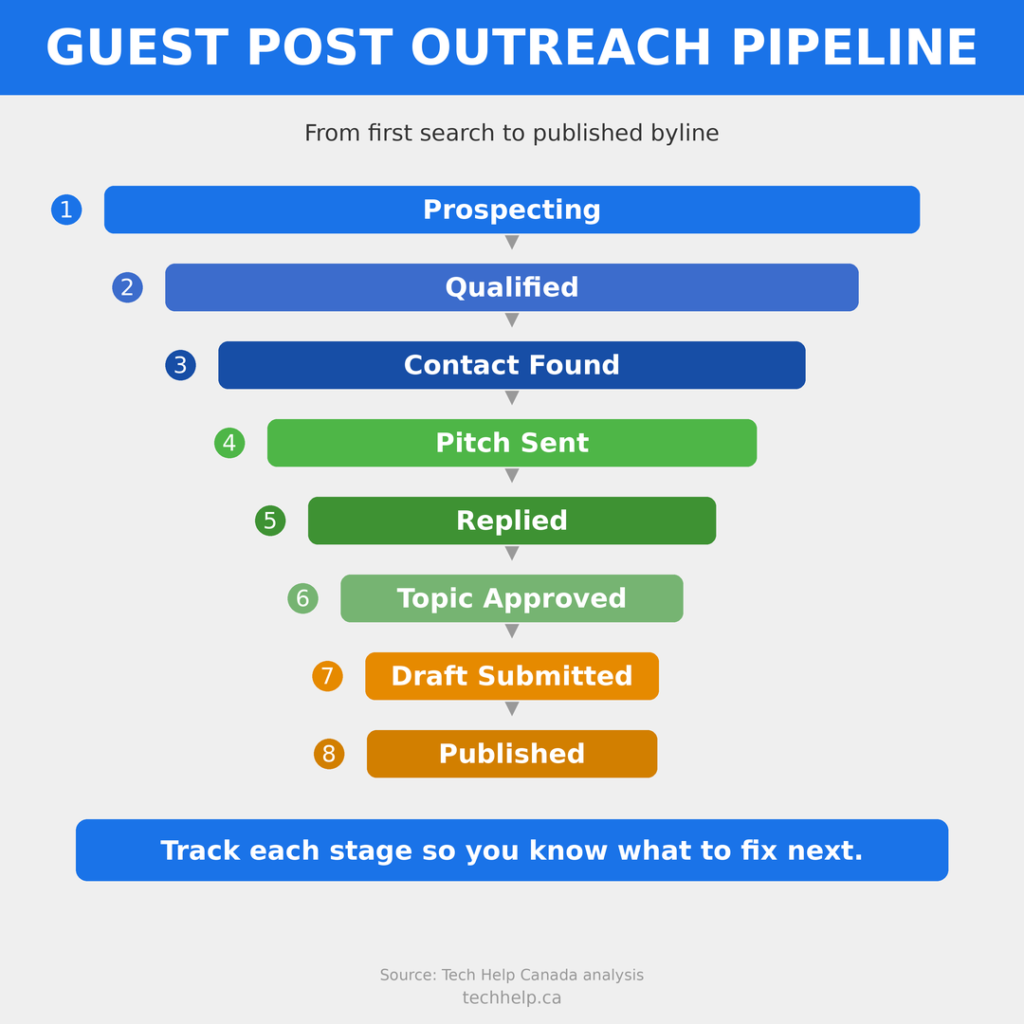
Guest post outreach is the process of finding the right sites, qualifying them, reaching the right person, pitching a useful idea, following up, and tracking the path from first contact to accepted guest post. The email matters, but it only works when the system behind it is strong.
If you need the full strategy for finding, writing, publishing, and measuring guest articles, start with our guest posting guide. If your main goal is backlink value, our guide to guest blogging for backlinks covers the link quality side in more detail.
This page goes deeper on the outreach work itself: the part where most guest posting campaigns win or get ignored.
Guest post outreach starts with the list
A better pitch cannot fix the wrong prospect list.
If a site does not publish outside contributors, does not cover your topic, has no reason to care about your expertise, or exists mainly to sell placements, the outreach email is already fighting a losing battle.
Start with fewer prospects and more intent. A list of 75 sites you can defend will usually outperform 750 scraped domains you barely recognize.
Good guest posting outreach starts with four prospecting paths:
| Prospecting path | How to use it | What it finds |
|---|---|---|
| Search operators | Search your topic plus phrases like write for us, guest post, contribute, submission guidelines, or become a contributor | Sites openly accepting contributions |
| Competitor backlink research | Review referring domains for competitors and look for bylines, contributor pages, and guest article patterns | Sites that have published similar contributors |
| Author trail research | Find people who publish guest posts in your niche, then trace where else they have written | Publications already open to your type of expertise |
| Community signals | Watch LinkedIn, niche communities, newsletters, podcasts, and founder/editor posts | Opportunities that do not always show up in search tools |
Do not stop at “they accept guest posts.” That is only the first filter.
The better question is whether your article would make sense on that site even if there were no backlink involved. If the answer is no, the site probably should not be on the list.
Qualify every site before you hunt for emails
Guest post outreach gets expensive when you qualify too late.
You do not want to spend 20 minutes finding a direct editor email, warming up the relationship, and writing a tailored pitch only to realize the site publishes thin content, links to unrelated industries, or has not posted anything new in eight months.
Run every prospect through a simple scorecard first.
| Qualification signal | Strong sign | Weak sign |
|---|---|---|
| Topical fit | The site already publishes for the audience you want to reach | Your topic would feel bolted on |
| Editorial standards | Articles have clear structure, real editing, author details, and useful sources | Posts feel rushed, generic, or barely reviewed |
| Audience quality | The site has signs of real readers, such as comments, newsletter activity, social shares, branded searches, or relevant traffic | The site exists, but no one seems to engage with it |
| Freshness | New articles are published consistently | The blog looks abandoned |
| Link behavior | Outbound links support the reader and point to credible sources | Every article is packed with commercial anchors |
| Contributor fit | Outside experts appear naturally in the content mix | Guest posts look like a separate low-quality section |
| Contact path | A real editor, content lead, or site owner can be found | Only a generic form or paid-placement page exists |
Metrics can help, but they should not make the decision for you.
Domain Rating, Domain Authority, traffic estimates, and backlink counts are research signals. They do not tell you whether the audience is relevant, whether the publisher has standards, or whether a placement would build trust with the people you actually want to reach.
A smaller industry blog with a real audience can be more useful than a larger-looking site with weak engagement and no editorial care.
Find the person who can say yes
A good pitch sent to the wrong inbox is still a bad send.
Generic addresses like info@, contact@, and editor@ can work, but they often sit behind crowded inboxes. For higher-value prospects, look for the person who actually owns the decision.
Start with the site itself. Check recent bylines, author pages, the masthead, the about page, the contact page, newsletter footers, and contributor guidelines. If the site has an editor, content manager, founder, marketing lead, or managing partner tied to the blog, that person is usually a stronger target than a general mailbox.
Then check public profiles. LinkedIn, X/Twitter bios, podcast pages, speaking pages, and author profiles can reveal the right contact path.
Email finder and verification tools can help here. Hunter, Voila Norbert, NeverBounce, BuzzStream, and Pitchbox all support parts of the contact-finding, verification, or outreach management process. Use tools to reduce manual work, not to excuse sloppy targeting.
Verify addresses before sending. High bounce rates hurt deliverability, and deliverability problems make every future email work harder.
For most publications, start with one relevant person. If you do not hear back after a full follow-up sequence, you can try a different relevant contact later with a fresh, respectful approach. What you want to avoid is sending the same pitch to three people at the same publication on the same day.
That feels less like outreach and more like pressure.
Warm up the prospects that deserve the effort
Cold outreach can work. Warm outreach gives your best prospects a reason to recognize your name.
This does not mean fake compliments or weeks of performative engagement. It means becoming lightly familiar before you ask for a guest post.
For Tier 1 prospects, spend a little time with the publication before you pitch. Read recent articles. Share one with a thoughtful comment. Reply to a newsletter. Leave a useful comment where the editor is active. Connect on LinkedIn with a short note that references their work.
The goal is not to create obligation. The goal is to make your eventual email feel less random.
Save this effort for sites where one placement would matter. You do not need a four-week warm-up for every small blog on your list. Tier the work so your time matches the opportunity.
| Prospect tier | Example | Warm-up level |
|---|---|---|
| Tier 1 | High-trust publication, strong audience fit, meaningful brand value | Read deeply, engage lightly, pitch with a tailored angle |
| Tier 2 | Good niche site with relevant readers and steady publishing | Read a few posts, reference a specific fit, send a focused pitch |
| Tier 3 | Smaller or newer site with a relevant audience | Confirm fit, send a concise pitch, keep follow-up light |
This is the same relationship-first mindset that makes influencer outreach work: people respond better when the message clearly belongs in their world.
Write the first email around the editor’s readers
Editors do not wake up hoping to help strangers build links.
They care about protecting their audience, publishing useful content, saving time, and avoiding contributors who create more work than the article is worth.
Your first email has to speak to that reality.
A 2019 Backlinko and Pitchbox study of 12 million outreach emails found that only 8.5% received a response. The same study found that personalization improved reply rates, and follow-ups made a meaningful difference. Treat those numbers as a public benchmark, not a promise. Response rates move with niche, reputation, list quality, timing, deliverability, and the strength of the offer.
Pitchbox’s newer outreach guidance frames 15% to 25% as a realistic target for healthier campaigns, with lower rates common for new senders, weak domains, or cold lists. If your campaign is sitting below 5%, the email copy may not be the only problem. The list, contact choice, subject line, offer, and sender reputation all need a look.
The first email should do five things quickly:
| Email part | Job |
|---|---|
| Subject line | Make the topic feel specific to the publication |
| Opening line | Show you know where you are sending the pitch |
| Topic angle | Offer an idea their readers could use |
| Proof | Show you can write the piece well |
| Close | Make the next step easy |
Here is a simple guest post outreach email you can adapt:
Subject: Guest post idea for [Site Name]: [Specific Topic]

Hi [Name],

I read your recent piece on [topic], especially the section about [specific detail].

I work with [audience or niche], and I noticed you have covered [related topic] but not [specific angle]. I think your readers would get value from a practical guest article on one of these:

1. [Topic idea 1]
2. [Topic idea 2]
3. [Topic idea 3]

Here is one relevant sample of my work: [sample link].

Would you like me to send a short outline for the strongest fit?

Best,
[Name]
The template works because it is not really about the template. It forces you to prove fit before asking for anything.
Keep the first email short. One sample link is enough. Do not attach a draft, include five portfolio links, or explain your entire link building strategy. The editor needs a reason to reply, not a dossier.
Personalization should be specific, not theatrical
Personalization is not a mail merge field.
“I loved your amazing blog” does not help. Neither does mentioning the site’s name in the subject line if the pitch itself could go to any publication in the industry.
Useful personalization shows that you understand the site, the audience, and the missing article idea.
Good personalization sounds like this:
I saw your recent article on onboarding remote employees. You covered the manager’s checklist well, but I did not see anything on how small teams can document role knowledge before a contractor leaves. That could be useful for your operations readers.
Weak personalization sounds like this:
I came across your great website and thought your readers would enjoy my article.
You do not need to write a custom essay for every prospect. You need enough specificity to prove the pitch belongs there.
Use a tiered personalization system:
| Tier | Research time | Personalization standard |
|---|---|---|
| Tier 1 | 15 to 25 minutes | Reference recent coverage, propose a tailored topic, connect it to the site’s audience, and include your strongest proof |
| Tier 2 | 8 to 12 minutes | Reference one relevant article or category and offer a topic that fits the site |
| Tier 3 | 3 to 5 minutes | Confirm topical fit, avoid generic language, and pitch one useful idea |
This keeps guest blogging outreach practical. You can respect the editor without turning every send into a research project.
Follow up without becoming easy to ignore
Many replies happen after the first email.
Backlinko’s outreach study found that sending at least one follow-up can lift replies. That makes sense. Editors are busy, inboxes move fast, and a good pitch can get buried for reasons that have nothing to do with quality.
Follow-up only works when it adds a useful nudge instead of guilt.
Use a simple sequence:
| Step | Timing | What to send |
|---|---|---|
| First pitch | Day 0 | Specific topic ideas and one relevant sample |
| Follow-up 1 | 5 to 7 days later | Short reminder plus the strongest topic angle |
| Follow-up 2 | 12 to 14 days after the first pitch | Add one new angle, outline, or timely reason the topic fits |
| Final follow-up | 21 to 28 days after the first pitch | Polite close-out and permission to reconnect later |
Keep every follow-up shorter than the first email. Do not send “just checking in” by itself. Add something small: a tighter headline, a more useful angle, a recent article tie-in, or a sentence that reduces the editor’s workload.
A good follow-up can be as simple as:
Hi [Name],

Just wanted to follow up on the guest article idea below.

The angle I think fits best is [topic], because it would give your readers [specific payoff] without repeating the usual advice on [overcovered topic].

Happy to send a short outline if useful.

Best,
[Name]
Stop after two or three follow-ups. Silence is a signal. You can revisit the site months later with a new idea, but do not keep pushing the same thread.
Track outreach like a pipeline
If you are doing guest post outreach from memory, you are going to lose track of promises, duplicate sends, missed follow-ups, and replies that needed a faster answer.
At small scale, a spreadsheet is enough. Once you have more active prospects, an outreach CRM such as BuzzStream or Pitchbox can help with scheduling, status tracking, templates, and reporting.
Track the fields that affect decisions:
- Site name
- URL
- Prospect tier
- Contact name
- Contact role
- Email address or contact path
- Qualification notes
- Topic ideas pitched
- Date of first send
- Follow-up dates
- Status
- Reply type
- Accepted topic
- Draft due date
- Published URL
- Link policy
- Relationship notes
Then watch the metrics that show where the process is breaking:
| Metric | Formula | What it tells you |
|---|---|---|
| Response rate | Replies divided by contacted prospects | Whether your targeting, offer, timing, and deliverability are working |
| Positive reply rate | Interested replies divided by contacted prospects | Whether replies are turning into real opportunities |
| Acceptance rate | Accepted topics divided by replies | Whether your topics fit the publications that respond |
| Publication rate | Live posts divided by accepted topics | Whether execution after the pitch is working |
| Placement rate | Live posts divided by contacted prospects | Whether the whole outreach system is paying off |
Pitchbox defines response rate around replies from outreached opportunities. That is a useful way to think about it because the unit is not raw emails. It is qualified opportunities.
Benchmarks are directional:
| Response rate | How to read it |
|---|---|
| Under 5% | Usually a sign of weak targeting, weak offer, poor contact choice, poor deliverability, or too much automation |
| 5% to 10% | Workable, especially for cold lists or new senders |
| 10% to 20% | Strong for many guest post outreach campaigns |
| Above 20% | Excellent, usually tied to narrow lists, strong credibility, warm relationships, or a very relevant offer |
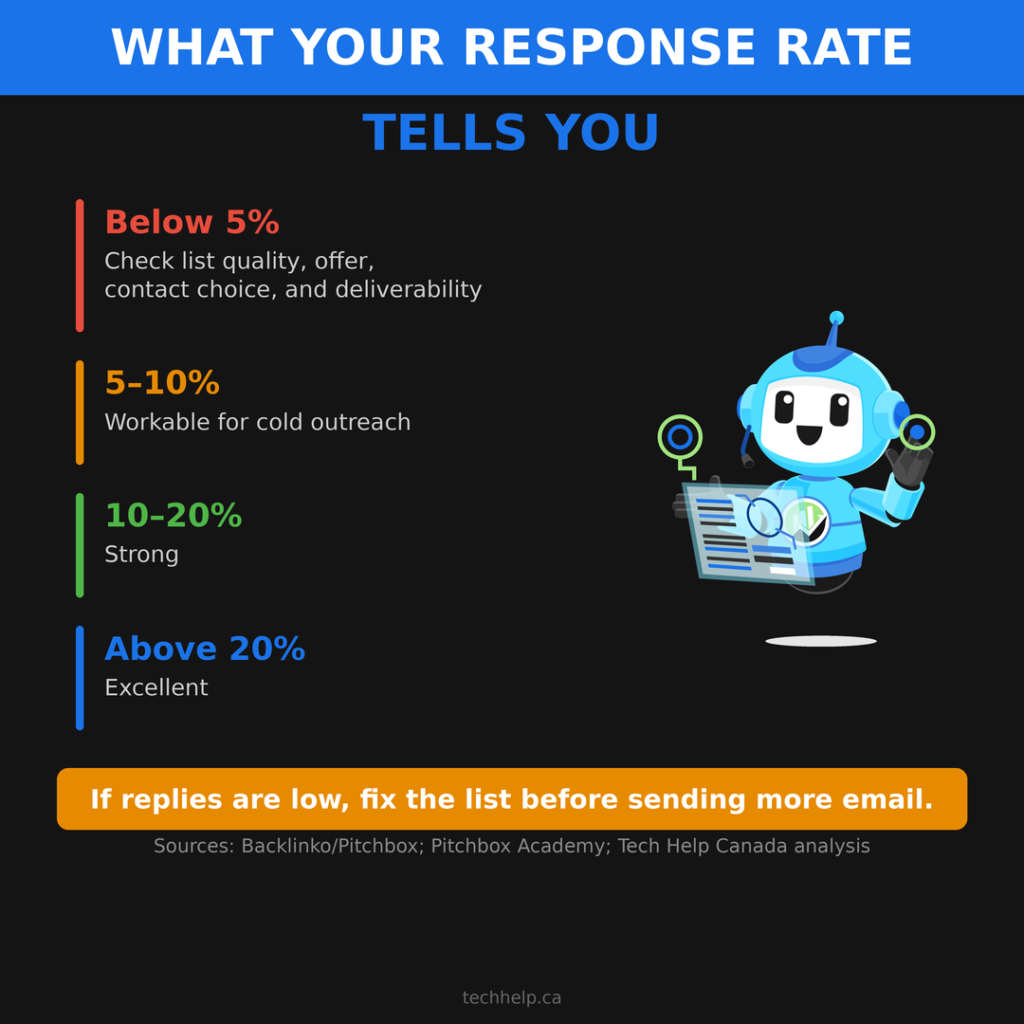
Do not worship the response rate by itself. A 25% reply rate from weak sites is not better than a 10% reply rate from sites your customers actually read.
Scale the system without making editors feel processed
Scaling guest post outreach is not the same as sending more email.
If volume rises while list quality, personalization, follow-up, and writing quality fall, the campaign gets bigger and worse at the same time.
Scale the repeatable parts first:
- Save search operators and prospecting sources that find good sites.
- Use a qualification scorecard so weaker prospects get filtered early.
- Keep a reusable pitch structure, but rewrite the topic angle for each site.
- Create follow-up reminders before the first email goes out.
- Save topic ideas by niche so you are not inventing from zero every time.
- Keep notes on editor preferences, formatting rules, and link policies.
Templates should give you structure. They should not make the email feel copied.
Protect sender reputation as volume grows. Use a domain-based email address, verify contacts, keep bounce rates low, avoid attachments in cold emails, honor opt-out requests, and increase sending volume gradually if you are using a newer domain or mailbox.
Most of all, protect the relationship. Do not pitch the same exact article to competing publications at the same time. Do not pressure editors after they pass. Do not act like the backlink is the only reason the publication exists.
The best outreach programs become easier over time because past placements create proof. Each accepted guest post becomes a better sample for the next editor. Each good editor relationship can become another assignment later.
That is a better growth path than starting every month with another scraped list.
Keep the SEO value without turning the pitch into link spam
Guest post outreach can be a legitimate marketing activity. It can also become low-quality link building if the behavior is wrong.
The distinction is not the label. It is the pattern.
Healthy guest post outreach looks like this:
- The site is relevant to the topic.
- The article is useful for the publication’s readers.
- The editor can accept, reject, or request revisions.
- Links support the article instead of hijacking it.
- Anchor text sounds natural in the sentence.
- Any sponsored or paid relationship is handled transparently.
Risky outreach looks like this:
- The same thin article is pushed to many unrelated sites.
- The pitch is mainly about getting a followed backlink.
- The sender demands exact-match commercial anchor text.
- The site publishes anything for a fee with no real review.
- Links point to pages that do not help the reader.
- The contributor ignores the publisher’s link policy.
Google’s spam policies warn against links created mainly to manipulate rankings, including paid or exchanged links that pass ranking credit. Google also says advertising or sponsorship links can be handled with attributes such as rel="sponsored" or rel="nofollow".
Do not make Google the only lens, though. Publishers, readers, referral traffic, brand mentions, and long-term reputation matter too. A guest post that earns trust with the right audience can have value even when the link is nofollowed or the main win is visibility.
If you want the wider link building context, our link building strategies guide covers how guest posting fits with other earning, outreach, and promotion methods.
Common guest post outreach mistakes
Most outreach mistakes are not mysterious. They are simple shortcuts that tell the editor you did not do the work.
Pitching unrelated sites is the first one. If the publication’s audience would not care about your topic, the pitch should not be sent.
The second is asking before offering value. “I want to contribute to your site” is not much of an offer. A useful topic for a specific audience is.
The third is using fake personalization. Editors can spot “I loved your recent post” when the rest of the email proves you did not read it.
The fourth is sending too much. Long biographies, multiple attachments, five sample links, and a full draft create more work before the editor has even said yes.
The fifth is measuring the wrong thing. Sending 1,000 emails is not success. Getting 12 relevant replies from 80 well-qualified prospects may be.
The sixth is disappearing after acceptance. Outreach does not end when the editor says yes. Fast replies, on-time drafts, careful revisions, and polite follow-through are what turn one placement into a relationship.
Guest post outreach checklist
Use this checklist before you send the first pitch:
- The site publishes content for the audience you want to reach.
- Your topic fits the publication without feeling forced.
- The site has signs of editorial standards and real readers.
- The site is active and maintained.
- You reviewed outbound links and guest contributor quality.
- You found the best available editorial contact.
- The email address or contact path has been checked.
- You have one to three topic ideas tailored to the site.
- Your email references something specific and relevant.
- You include one strong writing sample, not a pile of links.
- Follow-up dates are scheduled before you send.
- The prospect is logged in your tracker.
- Your link expectations match the publisher’s policy.
- You have a plan for what happens if the pitch is accepted.
The strongest guest post outreach is usually quiet, organized, and respectful. It does not feel like a campaign to the editor. It feels like a useful contributor reaching out with a topic their readers might actually want.
Start with 25 prospects you can defend. Qualify each one, find the person who can say yes, write one specific pitch, schedule the follow-ups, and track every reply.
Once that process works, scale the parts that deserve more volume. The replies get easier when the system earns them.
Frequently asked questions
What is guest post outreach?
Guest post outreach is the process of finding relevant websites, qualifying them, contacting the right editor or site owner, pitching a useful article idea, following up, and tracking whether the pitch turns into a published guest post.
How do you find sites for guest post outreach?
You can find sites through search operators, competitor backlink research, author trail research, niche communities, newsletters, and social posts from editors or site owners. The strongest prospects are relevant to your audience, actively publishing, and already open to expert contributions.
What should a guest post outreach email include?
A guest post outreach email should include a specific subject line, a brief sign that you understand the publication, one to three relevant topic ideas, a short credibility line, one strong writing sample, and a low-friction next step such as offering to send an outline.
How many follow-ups should you send for guest post outreach?
One or two follow-ups are usually reasonable, and a third can be appropriate for high-value prospects if each message stays polite and useful. Space them several days apart, add a small new reason to respond, and stop if the editor stays silent.
What is a good guest post outreach response rate?
Response rates vary by niche, list quality, sender reputation, topic fit, and personalization. Under 5% usually signals a problem in the list, offer, contact choice, or deliverability. A 10% to 20% response rate is strong for many qualified guest post outreach campaigns.
Is guest post outreach safe for SEO?
Guest post outreach can be legitimate when the site is relevant, the article serves the publication’s readers, the editor has real review standards, and links are natural. It becomes risky when the campaign is mainly about manipulating rankings with thin content, unrelated sites, paid followed links, or exact-match commercial anchors.

I can suggest related Tech Help Canada articles based on the topic you’re reading now.

Tech Help Canada Staff researches, writes, and reviews practical content for business owners and professionals. Our coverage spans business, marketing, SEO, technology, and the tools and systems people use to grow and operate online. We focus on clear, useful information backed by research, hands-on experience, and editorial review. Learn more about our team and editorial standards. Need help with something? Contact Us