

YouTube spent more than two years asking creators to disclose realistic AI-generated or meaningfully altered content themselves. On May 27, 2026, the platform added enforcement behind that request.
YouTube can now apply an AI label when a creator leaves the disclosure question unanswered and its systems detect significant photorealistic AI use. It has also moved labels for realistic AI content into places viewers are far more likely to notice.
This doesn’t mean every AI-assisted script, thumbnail, or edit needs a warning. YouTube says the underlying disclosure policy hasn’t changed. What changed is the visibility of the labels and the platform’s ability to act without waiting for a creator to volunteer the information.
The two YouTube updates creators need to understand
The first update changes where viewers see the label. On long-form videos, labels for photorealistic and meaningfully AI-altered or generated content now appear below the video player and above the description. On Shorts, the label appears as an overlay on the video. Labels for unrealistic, animated, or slightly altered content can still appear in the expanded description.
The second update changes how labels get applied. If a creator doesn’t say whether AI was used and YouTube’s internal systems detect significant photorealistic AI, the platform can add the label automatically.
Creators can correct most mistaken labels in YouTube Studio by changing the AI disclosure setting. There are exceptions. Labels can’t be changed when the content was made with YouTube’s own AI tools, contains C2PA metadata showing it was fully generated by AI, or was labelled after a manual review.
Creator disclosure remains required, but a creator’s answer is no longer the only way a label can appear. Automatic detection now backs up self-reporting.
What YouTube requires you to disclose
YouTube requires disclosure when AI generates or meaningfully alters realistic content in a way that could change what viewers believe happened. The rule applies whether AI created the entire asset or changed only part of it.
You need to disclose content that:
- Makes a real person appear to say or do something they didn’t
- Alters footage of a real event or place
- Generates a realistic event or scene that never happened
- Uses a synthetic version of someone else’s voice
- Includes AI-generated music
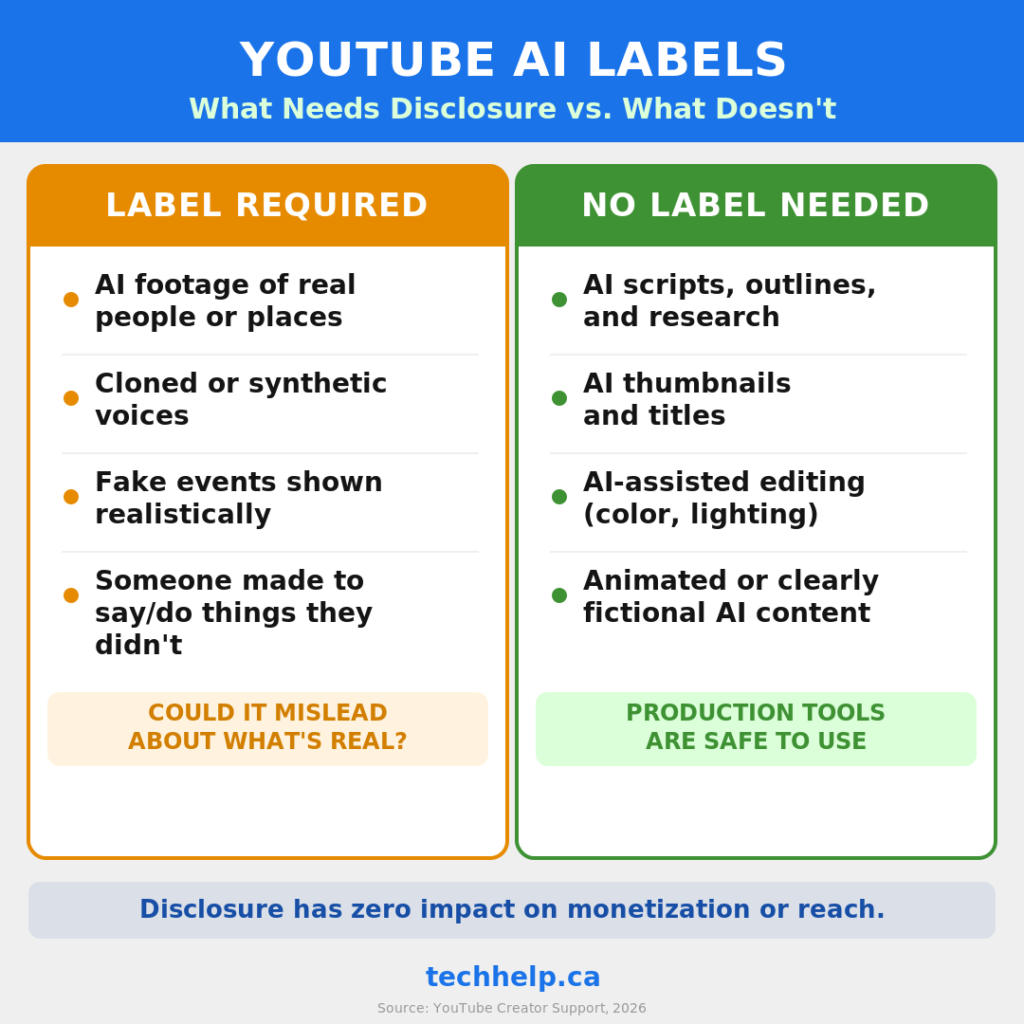
You generally don’t need to disclose AI used for production assistance or minor changes that don’t mislead viewers about what happened. YouTube’s examples include scripts, outlines, titles, thumbnails, infographics, captions, and idea generation. Minor work such as colour correction, background blur, sharpening, upscaling, audio repair, and cloning your own voice for a voice-over or dub is also exempt.
Clearly unrealistic or animated material also falls outside the main disclosure requirement. An animated unicorn doesn’t create the same risk of confusion as a fabricated video of a real executive endorsing a product.
A useful first question is whether AI changed what the audience could reasonably believe is real. If it only helped plan or polish the video, disclosure usually isn’t required. If it fabricated a realistic person, statement, place, event, or performance, disclose it. YouTube’s specific examples still control, so creators should check the current policy when a use case sits near the line.
What happens if you don’t disclose AI use
YouTube says an AI disclosure label by itself doesn’t change how a video is recommended or whether it can earn money. Disclosure alone isn’t a recommendation or monetization penalty.
Repeatedly withholding required disclosures can create real consequences, however. YouTube’s support documentation says it may apply labels itself and penalize creators who consistently fail to disclose. Those penalties can include content removal or suspension from the YouTube Partner Program.
The platform’s privacy process creates another risk when synthetic content depicts an identifiable person’s face or imitates their voice. That person can ask YouTube to remove the content. YouTube reviews those requests rather than guaranteeing an immediate takedown, but a disclosure label doesn’t make deceptive impersonation acceptable.
If the content requires disclosure, checking the box preserves more control than waiting for YouTube or the person depicted to respond after publication.
What YouTube has revealed about AI detection
YouTube hasn’t published a complete technical description of its new internal detection signals. The company hasn’t said that one watermark or classifier powers the whole system.
The platform has identified C2PA metadata as one automatic labelling signal. C2PA Content Credentials can attach signed provenance information to a file, including information about how it was created or edited. When that metadata tells YouTube a video was fully generated by AI, the resulting label is permanent.
Google’s SynthID is related but distinct. It embeds imperceptible watermarks in content produced by supported AI models, including Gemini, Imagen, Lyria, and Veo. Google says SynthID can survive a range of transformations and can be detected across text, images, audio, and video. However, YouTube’s May announcement didn’t identify SynthID as one of its internal detection signals.
Neither provenance metadata nor watermarking can identify every AI-generated file on the internet. Coverage depends on which tool created the content, whether that tool supports the standard, and what happened to the file before upload. That helps explain why YouTube still requires creator disclosure while adding its own detection systems.
YouTube isn’t acting alone
Major platforms were already moving toward machine-readable provenance before YouTube announced this change. TikTok began automatically labelling some AI-generated content carrying C2PA Content Credentials in 2024. Meta also built systems to read common AI-generation signals and paired them with disclosure requirements for realistic AI video and audio.
Regulators are moving in the same direction. The European Union’s June 2026 Code of Practice on AI-generated content provides a framework for marking synthetic outputs in a machine-readable form and labelling deepfakes and certain AI-generated text under Article 50 of the AI Act.
The rules aren’t identical across every service or jurisdiction. Across platforms and regulatory systems, however, realistic synthetic media increasingly carries provenance or disclosure requirements.
The label doesn’t solve the trust problem
YouTube’s systems are only half the story. The company says the label doesn’t reduce distribution or monetization, but viewers still decide whether to trust what they’re watching.
Research from the Nuremberg Institute for Market Decisions shows why disclosure can be uncomfortable for marketers. In a survey of 1,000 people in each of the United States, the United Kingdom, and Germany, only 20% said they trusted AI itself, while 21% trusted AI companies and their promises.
The researchers also showed people identical advertisements described either as human-made or AI-generated. Participants evaluated the AI-labelled versions more critically and showed less willingness to learn more about or buy the advertised products. The effect varied with the product and the participant’s existing trust in AI.
That research examined advertising rather than YouTube videos, so it doesn’t prove that an AI label will cause a specific drop in views or engagement on the platform. It does show that transparency and trust aren’t the same thing. A label tells viewers how content was made; it doesn’t give them a reason to value it.
Trying to hide AI use isn’t a solution to that tension. If viewers discover the omission later, the creator has both the original skepticism and a credibility problem. The stronger response is to make the human contribution unmistakable through expertise, reporting, judgment, humour, access, or a point of view worth following.
A practical AI disclosure workflow
Creators and marketing teams shouldn’t decide whether to disclose five minutes before publication. Make the disclosure decision part of production, not a last-minute upload choice.
Separate production assistance from viewer-facing synthetic media
Track whether AI only helped with planning and post-production or changed what viewers will perceive as real. That distinction resolves many cases before upload.
Keep a simple record of generated assets
Note the tool used, the date, the prompt or source material, any consent obtained, and whether disclosure is required. Save original files when realistic people, places, voices, or events are involved.
Get permission before recreating a person’s likeness or voice
A label doesn’t replace consent, licensing, privacy rights, or other legal obligations.
Answer YouTube’s disclosure question deliberately
In YouTube Studio, the setting appears under Attributes > AI use during upload. Don’t leave it blank because the team is unsure. Resolve uncertain cases before the video goes live, and use YouTube’s current examples to make the call.
Check the published video
Confirm that the expected label appears and that YouTube hasn’t applied one incorrectly. If the system made a mistake and the label isn’t locked, correct the disclosure status in YouTube Studio.
Make the content worth watching with the label visible
AI can accelerate production, but the video’s value still needs to come from something the audience trusts. Generic synthetic content doesn’t become distinctive because it was produced efficiently.
YouTube has ended the pure honour system
This isn’t an AI ban, and YouTube isn’t requiring a label for every AI-assisted task. The change ends the platform’s reliance on self-reporting when realistic AI-generated or meaningfully altered content is involved.
Before your next upload, decide whether AI changed what viewers may understand as real, document how the asset was made, and disclose it when the policy requires it. YouTube can now add the label without your help. What it can’t add is the trust your content still has to earn.

I can suggest related Tech Help Canada articles based on the topic you’re reading now.

Tech Help Canada Staff researches, writes, and reviews practical content for business owners and professionals. Our coverage spans business, marketing, SEO, technology, and the tools and systems people use to grow and operate online. We focus on clear, useful information backed by research, hands-on experience, and editorial review. Learn more about our team and editorial standards. Need help with something? Contact Us