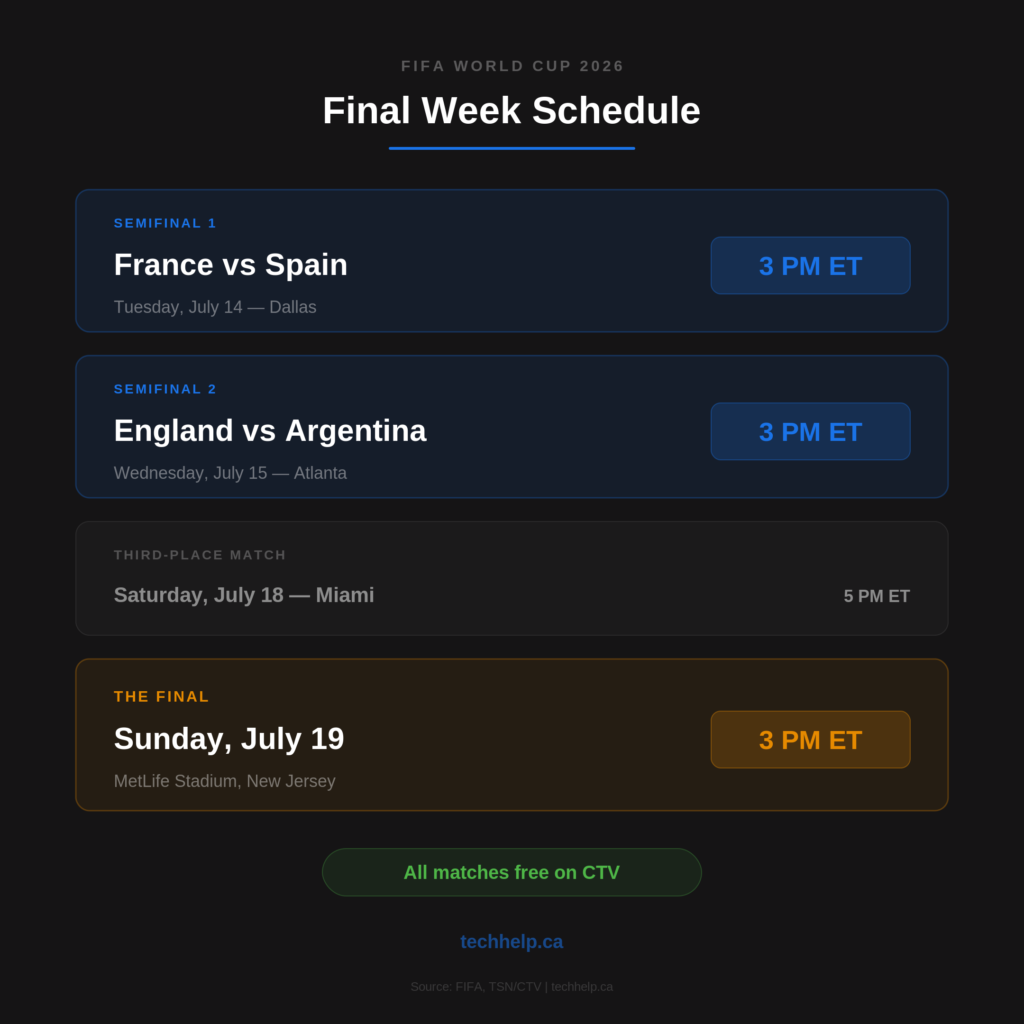
France plays Spain on Tuesday, July 14. England plays Argentina on Wednesday, July 15. Both World Cup semifinals kick off at 3 p.m. Eastern time, placing both matches inside the workday for many Canadians.
Before Tuesday’s kickoff, decide who must cover customers and critical work, whether employees may watch, how that time will be handled, and who can approve schedule changes. A short policy sent in advance gives employees and managers a common answer before the match begins.
Customer-facing businesses have a second decision to make. The final week may create demand, but early host-city reports suggest the gains have been concentrated around fan activity and visitors. Run a promotion only when it fits your customers, location and capacity, then measure whether it produced profit.
The final-week schedule
FIFA’s current schedule has France playing Spain in Dallas on Tuesday, July 14 at 3 p.m. Eastern time. England meets Argentina in Atlanta on Wednesday, July 15 at the same time. Both matches begin at noon Pacific time.
The bronze final starts at 5 p.m. Eastern time on Saturday, July 18 in Miami. The final begins at 3 p.m. Eastern time on Sunday, July 19 in New Jersey.
Canada’s run ended with a 3-0 loss to Morocco in the round of 16, but the tournament has already shown its ability to attract a large Canadian audience. Bell Media reported that 11.7 million unique Canadians watched at least part of the Canada-Qatar match across its English- and French-language television and streaming services. The average audience was 5.3 million.
The 11.7 million figure is reach, not average viewership. Its reported 34% increase was also a comparison with Canada’s second match of the 2022 tournament, not with the entire previous tournament. Those numbers show the size of the audience without providing a reliable forecast for this week’s matches.
Official fan festivals also continue in both Canadian host cities. Toronto’s current schedule includes both semifinals and the bronze final at Fort York and The Bentway, and the venue remains open for the July 19 final. Vancouver’s festival at Hastings Park also runs through July 19. Anyone planning to attend should check the current schedule, entry rules and capacity before leaving.
Treat the matches as a scheduling issue, not a crisis
Before the tournament, UKG projected at least $17 billion in lost workplace productivity worldwide. The figure was based on wage data and stated employee intentions, not a measured loss.
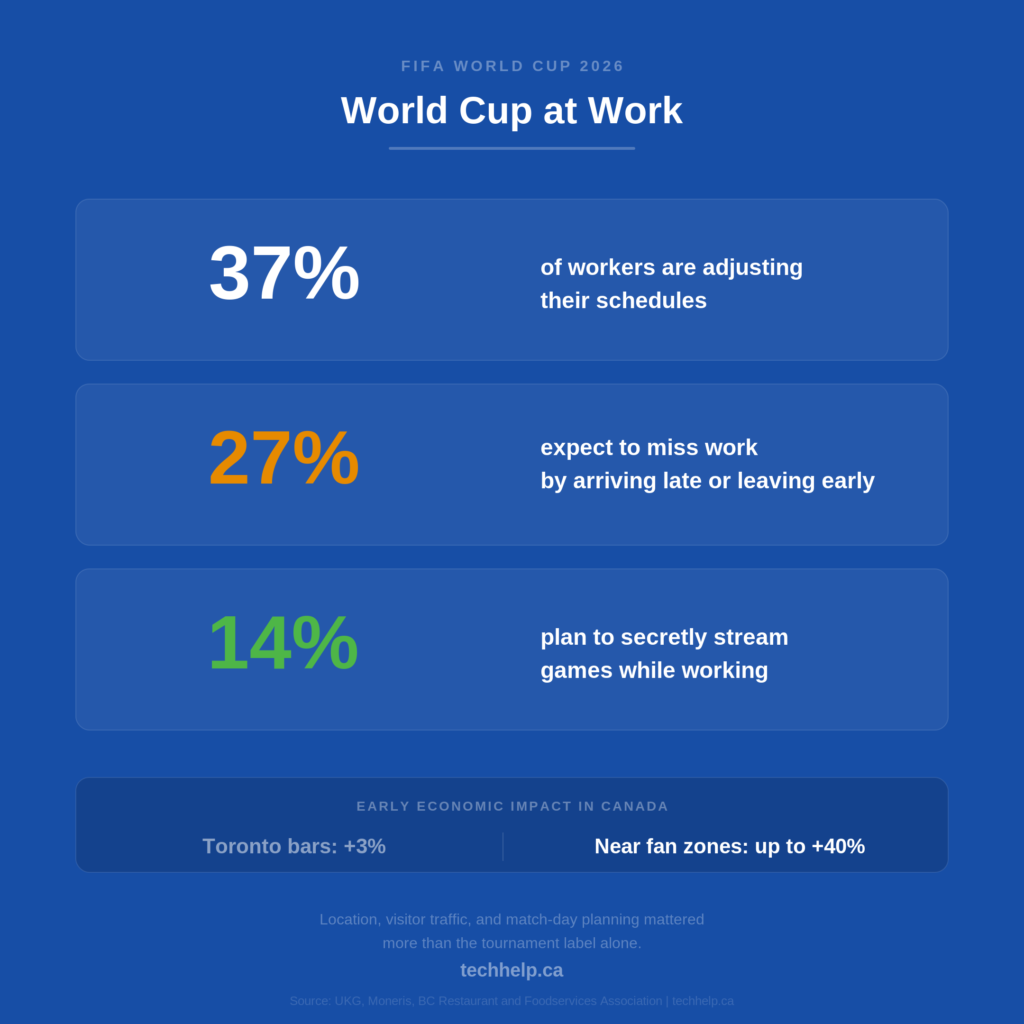
A UKG survey behind the estimate still offers a useful planning signal. Among 8,000 employees in Canada and seven other countries, 37% said they planned to adjust their schedules during the tournament. Twenty-seven per cent expected to miss work by arriving late, leaving early or taking a day off, while 14% said they intended to stream matches secretly at work.
Those were multinational survey responses, not documented behaviour inside Canadian workplaces.
Employers can respond to the predictable demand without assuming every employee will be distracted or treating fans as a problem.
For office and remote teams
Start with the work that can’t slip. Identify customer coverage, safety responsibilities, deadlines and decisions that need someone available from 3 p.m. through the end of the match. Allow enough time for halftime, stoppages and possible extra time or penalties rather than assuming everyone will be back at 5 p.m.
Move flexible meetings or routine work only when doing so won’t create a new problem earlier in the day.
Then state the viewing arrangement. A business might allow an optional shared screening, let employees use an approved break or paid time off, or permit an adjusted schedule where the role and employment rules allow it. Apply the same time-reporting, break, overtime and approval rules you would use for another personal request.
Participation should be optional. Employees who don’t follow the tournament shouldn’t have to attend a viewing or absorb extra work without a fair schedule. If fans receive special flexibility, consider an equivalent option for colleagues who prefer to use that flexibility differently.
For teams spread across Canada, the same kickoff lands at 4 p.m. Atlantic, 4:30 p.m. in Newfoundland, 2 p.m. Central, 1 p.m. in most of Saskatchewan, 1 p.m. Mountain and noon Pacific. A rule written only for an Eastern head office may create confusion elsewhere.
For shift and frontline teams
Customer service, production, health and safety requirements still set the minimum coverage. Estimate demand for the match window and the period immediately afterward, then publish the required positions and any available flexibility.
Use voluntary shift swaps where practical, with manager approval and enough lead time to check qualifications and overtime. Record schedule changes through the normal system. An informal promise to “make up the time later” can create payroll, coverage and fairness problems.
Don’t assume traffic will fall during the match or surge after it. Review reservations, advance orders, local event schedules and your own tournament sales before changing staffing. A restaurant beside a fan festival and a suburban service business face very different demand.
For managers
Managers need to follow the same process as everyone else. The workforce survey found that managers were especially likely to seek schedule changes, even though they’re often responsible for maintaining coverage.
Name the person who can approve swaps and handle an absence during each match. Employees shouldn’t have to guess whether their direct manager is watching, working or available to make a decision.
Early numbers don’t guarantee a sales lift
Moneris card-spending data reported for June 12 to 26 showed a 3% year-over-year increase on domestic credit cards at Toronto restaurants and bars. Spending on foreign-issued cards at those businesses rose 34%. Those figures point to stronger visitor activity, but they don’t show that every restaurant benefited or that a tournament promotion caused the increase.
British Columbia’s figures came from a different method. The B.C. Restaurant and Foodservices Association said operator surveys, site visits and supplier discussions indicated a 5% to 10% increase in food purchasing across the province, with restaurants near fan zones reporting increases of up to 40%. A provincial news release also cited individual Vancouver businesses with stronger match-day sales.
Food purchasing isn’t the same as revenue, and operator reports aren’t directly comparable with payment-card data. The two snapshots suggest that location, visitor traffic, business type and match-day capacity matter more than the tournament label alone.
Full economic results won’t be available until after the event. Treat the current figures as early evidence, not a guarantee that a last-minute offer will work.
Run one offer you can measure
A rushed campaign can add labour, discounts and licensing risk without adding profit. If the final week fits your business, choose one offer with one audience and one result to measure.
Start with demand you can serve
A restaurant or bar with customers asking to watch may focus on reservations, a limited food bundle or a post-match offer. A retailer might feature products it already sells without implying a connection to the tournament. A service business with no natural tie may be better off skipping a promotion and concentrating on its staffing plan.
Check capacity before creating demand. A full room can still be a poor result if service slows, regular customers leave, overtime rises or a deep discount erases the margin.
Choose the measure before the promotion
Record a baseline from the same weekday and time window, then track transactions, average order value, labour, discount cost and gross profit. If the offer uses a code, reservation type or dedicated product, make it easy to separate match-related purchases from ordinary sales.
Reach and social engagement can help explain awareness, but they don’t establish a return by themselves. Match the marketing metrics and KPIs to the job of the promotion, then decide in advance what result would justify repeating it.
Protect the business from licensing and brand problems
FIFA’s brand guidance warns non-sponsors against marketing that creates an unauthorized commercial association with the tournament. That includes uses of protected marks and trophy imagery, promotions involving tickets, or campaigns that make a business appear officially connected to the event.
Keep the offer centred on your own products, venue and customers. Don’t use FIFA logos, official artwork or language that suggests sponsorship. Ask a lawyer to review the promotion if the proposed creative or wording could imply an official relationship.
Public viewing has separate requirements. FIFA operates a platform for public-viewing licence requests for the 2026 tournament. Before advertising a screening or watch party, check whether the event requires a FIFA licence and whether your television or streaming service permits commercial or public display. Confirm any venue, alcohol, capacity, safety, accessibility and insurance requirements that apply to the event as well.
An internal employee viewing may be different from a public commercial event, but it should still use an authorized service and comply with the provider’s terms.
Review the result on Monday
After Sunday’s final, compare what happened with the plan. For the workforce side, review missed coverage, output, overtime, customer complaints and employee feedback. A flexible arrangement that preserved the work may be worth keeping in the playbook for future events. A policy that left non-fans carrying the workload needs adjustment.
For a promotion, calculate incremental gross profit rather than pointing only to revenue or a busy room. Include the discount, extra labour, entertainment or licensing costs, waste and any effect on normal sales. Save the offer, staffing level and result while the details are still fresh.
The same playbook can apply to a city festival, championship game, concert or industry event. Define the coverage, set a fair rule, test one relevant offer and keep the evidence.
Send the plan before Tuesday’s kickoff
The two weekday semifinals are no longer a surprise. By noon Tuesday, send one short note covering critical staffing, the viewing arrangement, time reporting, approval contacts and any customer offer being tested.
That gives employees a fair answer, managers a coverage plan and the business a way to judge the week on evidence. Decide before the first 3 p.m. kickoff, then use Monday’s numbers to improve the next event.
Get new small business insights by email
Practical ideas and useful articles to help you make better business decisions.
Tech Help Canada Staff researches, writes, and reviews practical content for business owners and professionals. Our coverage spans business, marketing, SEO, technology, and the tools and systems people use to grow and operate online. We focus on clear, useful information backed by research, hands-on experience, and editorial review. Learn more about our team and editorial standards. Need help with something? Contact Us