You check Google Analytics every week. Maybe every day. The numbers are flat or, worse, they’re slowly declining. You’ve tried tweaking your SEO, posting more often, even running a few ads. Nothing seems to change the trend.
Here’s the thing most business owners don’t realize: your traffic numbers probably aren’t broken. The way people find and evaluate businesses has changed, and your analytics dashboard hasn’t caught up.
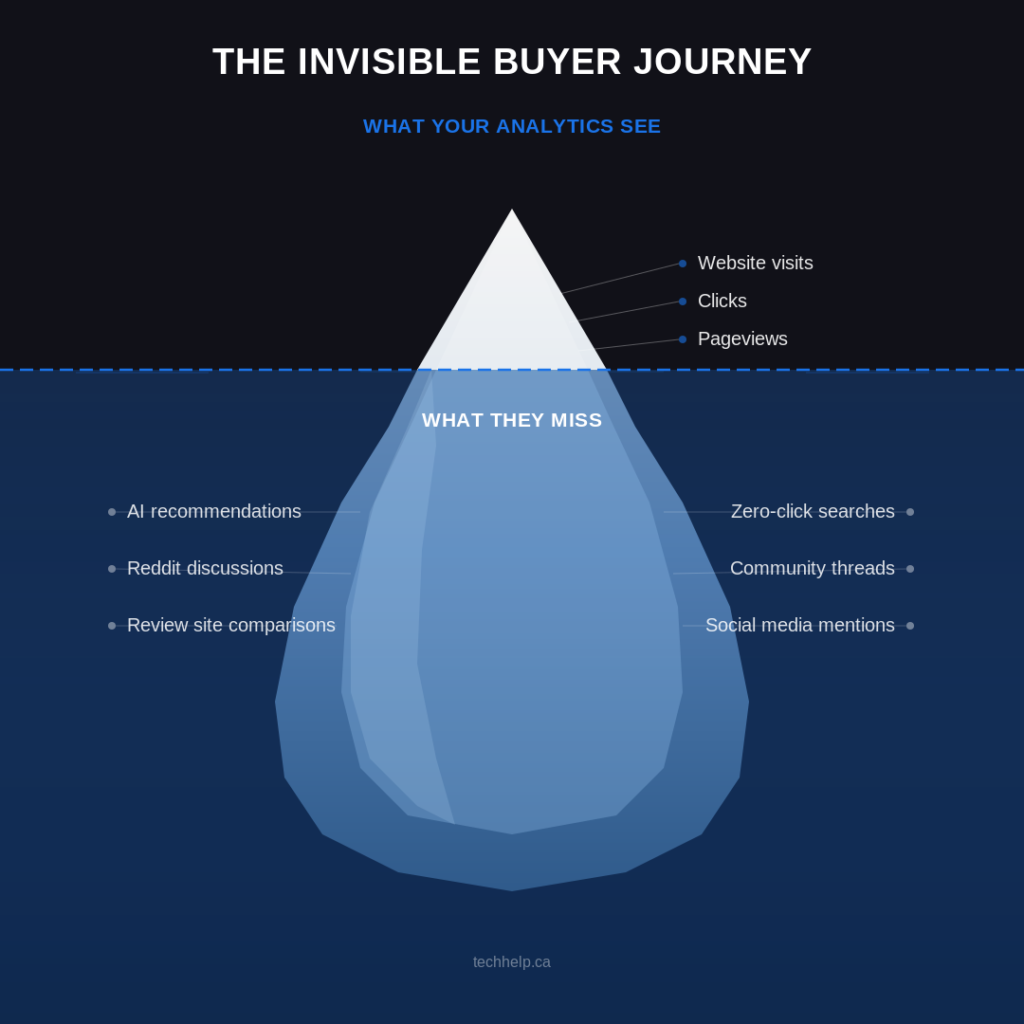
Right now, a potential customer might see your competitor mentioned in a Google AI Overview, ask ChatGPT which service to use, scroll through a Reddit thread comparing options, or read a third-party review article. Most of that research either won’t show up in your traffic reports or won’t show up in a way that explains what influenced the buyer. You’re losing visibility, or gaining it, in places your analytics can’t see.
That’s a problem, because if you’re only watching traffic, you’re only watching part of the game. The part you’re missing may be where the buying decision actually happens.
Let’s look at why traffic has become an incomplete metric, where buying decisions are actually happening now, and what you should be paying attention to instead.
Where Buying Decisions Actually Happen Now
The way people search for products, services, and solutions has fundamentally shifted, and it’s happening faster than most business owners realize.
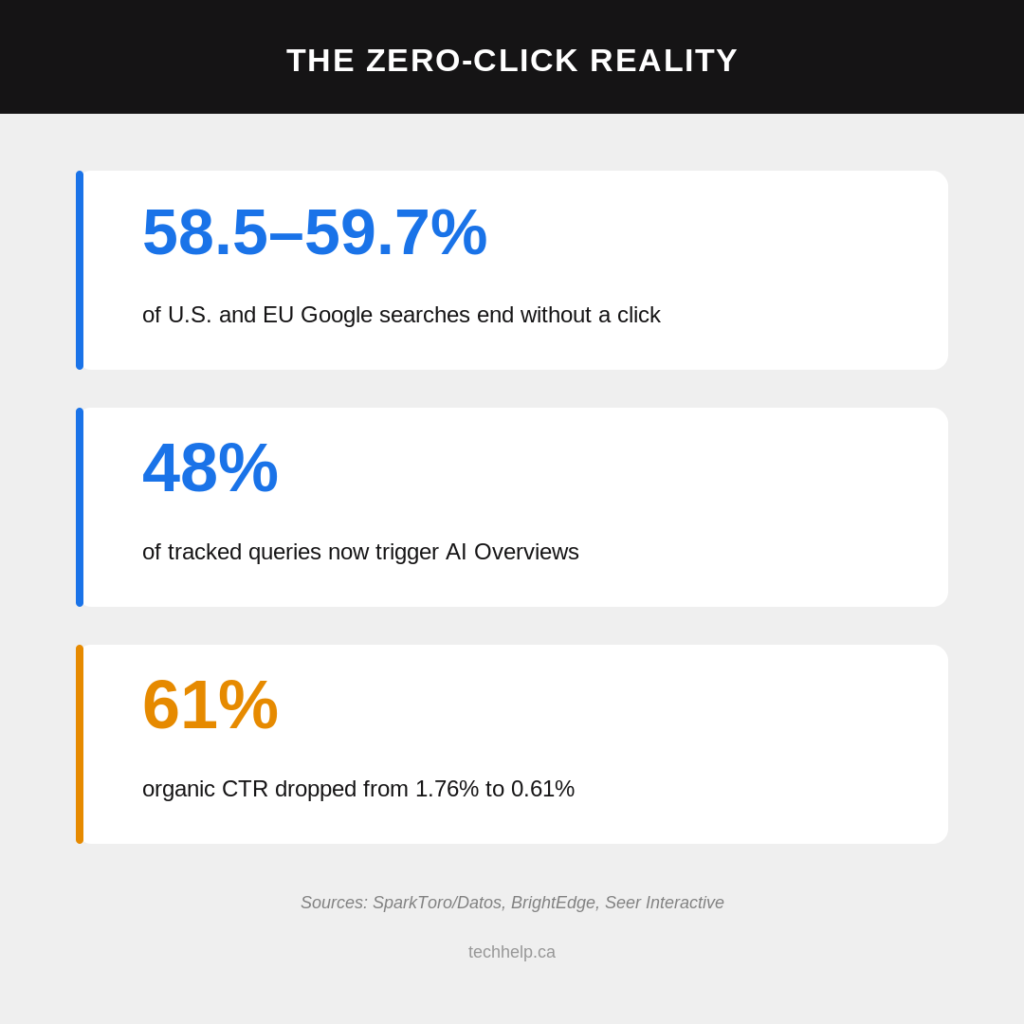
Most Google searches in the U.S. and EU now end without a single click. SparkToro and Datos found that 58.5% of U.S. Google searches and 59.7% of EU Google searches ended without a click in 2024. The searcher gets their answer from a snippet, a knowledge panel, or an AI-generated summary and never visits a website. That’s not a glitch. It’s increasingly how Google works.
A big reason for that shift is AI Overviews, the AI-generated answer boxes that appear at the top of Google’s search results. BrightEdge found that AI Overviews grew from roughly 30% to 48% of tracked queries over one year, a 58% increase. When an AI Overview appears, organic click-through rates can fall sharply. Search Engine Land, citing Seer Interactive’s research, reported that organic CTRs for AI Overview queries dropped from 1.76% to 0.61%.
Your page might still rank on the first page, but far fewer people may scroll past the AI answer to find it.
Beyond Google, AI-powered tools have become full-blown recommendation engines. ChatGPT now has around 900 million weekly users, according to OpenAI reporting cited by TechCrunch. Perplexity, another AI search tool, has also grown into a major AI search destination. People are typing questions like “what’s the best accounting software for freelancers” or “which CRM should a small team use” directly into these tools and getting specific brand recommendations in response. If your business isn’t showing up in those answers, you’re invisible to a growing segment of your market.
Then there are the platforms that have always influenced decisions but never generated direct traffic to your site. Reddit threads, G2 and Capterra reviews, YouTube comparison videos, LinkedIn discussions, and industry blog roundups all influence how buyers see their options. Someone might read a glowing Reddit comment about your competitor, form a preference, and then go directly to that competitor’s website. In your analytics, that person never existed. In reality, they were a potential customer you never had a chance to win.
The bottom line is straightforward: a growing share of your market is researching, comparing, and forming opinions about businesses like yours in places your website analytics may not capture clearly.
Your Analytics Dashboard Has a Blind Spot
It’s not just that buyer behavior has changed. Your measurement tools are struggling to keep up.
Google Analytics has a well-known catch-all bucket called “Direct” traffic. In theory, Direct traffic represents people who typed your URL directly into their browser. In practice, GA4 often records visits it can’t properly attribute as Direct. That can include visitors who came from AI tools like ChatGPT or Perplexity, links shared in messaging apps and emails, bookmarks, and a range of other sources that don’t pass referral data reliably.
So if someone reads a ChatGPT recommendation for your business, clicks through, and lands on your site, there’s a chance your analytics will record that as a “direct” visit, as if the person just happened to know your URL by heart. You may never know AI search played any role.
The scale of this blind spot is significant. TechCrunch, citing Similarweb data, reported that AI platforms generated more than 1.13 billion referrals to the top 1,000 websites globally in June 2025, up 357% year over year. That’s a massive volume of traffic flowing through a channel many businesses still don’t measure well.
The combined effect of all this is measurable. Chartbeat data cited by the Reuters Institute found that Google organic search traffic to more than 2,500 sites fell 33% globally between November 2024 and November 2025. That doesn’t mean fewer people are searching. It means more searches are resolving without a click, and more clicks are flowing through channels that don’t get tracked properly.
This is why traffic has become a lagging indicator. By the time someone types your URL into their browser or clicks a branded search result, the discovery and evaluation process is often already complete. The research happened in an AI tool. The comparison happened on Reddit. The social proof came from a review site. Your analytics only captured the final step and attributed it to “Direct.”
If you’re making marketing decisions based primarily on traffic data, you’re working with an incomplete picture. And the missing pieces are exactly the ones that count most.
What to Pay Attention to Instead
There’s a concept in marketing called “share of voice,” and it’s quickly becoming one of the most important metrics for businesses that want to understand their real competitive position.
In simple terms, share of voice measures how often your business shows up compared to your competitors across the places your buyers actually look. Not just Google search results, but AI answers, review platforms, community discussions, social media, and third-party content. It’s your slice of the conversation in your market.
The difference between traffic and share of voice is the difference between counting who walked through your door and understanding whether people even know your door exists. Traffic tells you who already found you. Share of voice tells you whether you’re in the running at all.
The data makes a strong case for paying attention to this. Seer Interactive found that brands cited in AI Overviews earned 35% more organic clicks than brands that weren’t cited. That doesn’t prove the citation caused the higher click volume. Stronger brands may simply be more likely to get cited. But it does point to the same practical takeaway: being visible inside AI-generated answers is becoming part of organic visibility, not something separate from it.
Early data also suggests that traffic from AI sources can convert at higher rates than traditional search traffic. Similarweb has reported in its own research that Gen AI traffic converts at a higher rate than any other channel in markets like U.S. retail. Visibility in these newer channels isn’t just about brand awareness. It can influence revenue.
Here’s where it gets interesting for small businesses specifically. AI tools don’t automatically favor big brands with massive budgets. They often draw from the strength and consistency of public information they can find across the web: reviews, third-party mentions, useful content, and credible references. A small business with 200 genuine reviews, a handful of industry mentions, and content that directly answers common customer questions can compete with a much larger competitor that has a bigger ad budget but weaker public proof.
That’s a meaningful advantage if you know how to use it.
Five Steps to Start Measuring Your Real Visibility
An AI visibility tool can help if you want deeper tracking, but you don’t need enterprise-level software or a dedicated analytics team to get a baseline read on your visibility.
Here are five practical steps you can take this week.
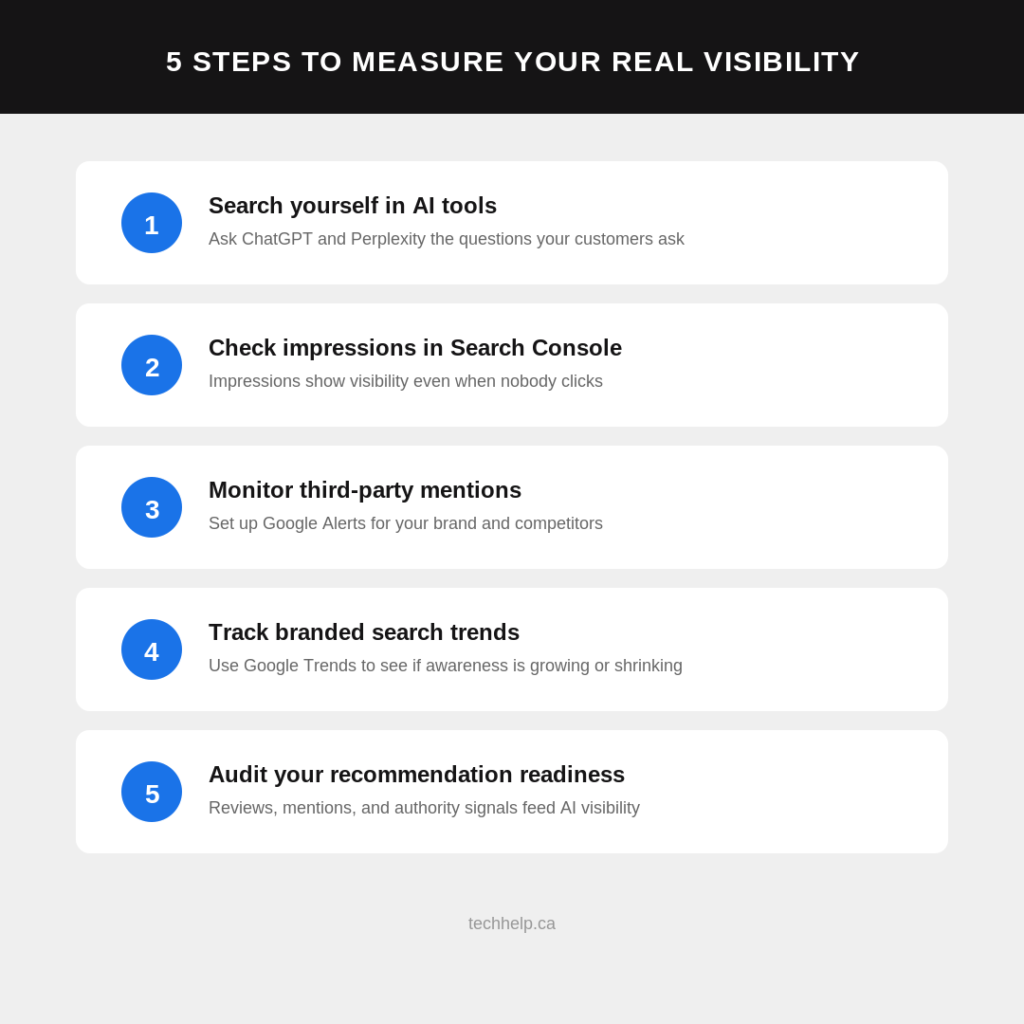
1. Search Yourself in AI Tools
Open ChatGPT, Perplexity, or Google’s AI Mode. Type in the kinds of questions your customers would ask, such as “best [your service] in [your city]” or “what should I look for in a [your product category].” See whether your business comes up in the response. If it doesn’t, that’s a visibility gap that no amount of website optimization will fix. Do the same search for your top two or three competitors to see where you stand relative to them.
2. Check Impressions, Not Just Clicks, in Google Search Console
Most business owners look at clicks in Search Console and ignore impressions entirely. That’s a mistake. Impressions tell you how often your site appeared in search results, even when nobody clicked. A high impression count with a low click-through rate means you’re showing up but not standing out. Your titles and descriptions might need work. A declining impression count is a bigger problem: it means you’re losing visibility in the results altogether.
3. Monitor What People Say About You on Third-Party Platforms
Set up a Google Alert for your business name and the names of your top competitors. Periodically check review sites relevant to your industry, such as Google Business Profile, G2, Capterra, or Yelp. Browse Reddit threads and forum discussions in your niche. This is where opinions form long before anyone visits your website, and it’s where AI tools may pull some of their recommendations from.
4. Track Branded Search Trends
Go to Google Trends and enter your business name. Is the trend line rising, flat, or declining? Rising branded searches indicate growing awareness. People are hearing about you somewhere and then searching for you by name. This is one of the clearest signs that your visibility efforts are working, even if your overall traffic metrics look flat. A declining trend line, on the other hand, suggests you’re losing mindshare.
5. Audit Your “Recommendation Readiness”
Ask yourself a few honest questions: How many credible websites mention your business? Do you have recent, genuine reviews on the platforms that count in your industry? Have you been quoted or featured in any relevant publications or blogs? Do you participate in community discussions where your expertise is visible? These are some of the public clues AI tools can use when deciding which businesses to recommend. If the answers are thin, that’s where your visibility work should start.
The Bigger Picture
The way people discover and evaluate businesses has changed faster in the past two years than in the previous ten. AI-powered search, zero-click results, and fragmented buyer journeys mean that traditional website traffic captures a shrinking slice of what’s actually happening in your market.
Traffic still matters. Don’t misread this as a reason to stop caring about it. But traffic alone is no longer enough to tell you whether your marketing is working. If you’re not visible where buying decisions start, including AI-generated answers, search result snippets, review platforms, and community conversations, you’re losing opportunities that will never appear in any dashboard.
The good news is that you don’t have to overhaul everything at once. Start with one step: search your business category in ChatGPT or Perplexity today and see what comes back. That single action will tell you more about your real competitive position than a month of staring at traffic reports.
The businesses that pay attention to this shift now, while many competitors are still fixated on pageviews, will have a clearer read on where buyer attention is moving.
Tech Help Canada Staff researches, writes, and reviews practical content for business owners and professionals. Our coverage spans business, marketing, SEO, technology, and the tools and systems people use to grow and operate online. We focus on clear, useful information backed by research, hands-on experience, and editorial review. Learn more about our team and editorial standards. Need help with something? Contact Us