

Marketing changes every time buyers get a new way to discover, compare, question, and talk about what they buy. But marketing started with reputation.
Before campaigns, funnels, dashboards, and content calendars, marketing was mostly reputation in motion. A merchant’s location, display, product quality, price, and personal credibility were the message. If people trusted the seller, they came back. If they had a good experience, they told someone else.
That early version of marketing still feels familiar. Reviews, referrals, social posts, creator mentions, product demos, and customer photos are modern forms of word-of-mouth. The difference is scale. One customer’s experience can now travel far beyond the physical place where it happened.
For local businesses, this shift matters. BrightLocal’s 2026 consumer review research found that reviews still influence how people choose local businesses, but consumers also move across websites, social feeds, video platforms, and AI tools to confirm what they see. Trust is no longer built in one place.
Print made marketing scalable
Print gave sellers a way to repeat the same message beyond one conversation. Newspapers, catalogues, posters, packaging, and magazines made marketing more scalable. Industrialization added pressure. When businesses could produce more goods and distribute them farther, they needed ways to stand apart from competitors a customer might never meet.
Harvard Business School’s advertising history archive describes how post–Civil War advertising promoted mass-produced goods through new printing technologies, national magazines, full-page ads, images, and brand names. The shift was not only about reach. It was about recognition. If a customer couldn’t meet the maker, the brand name, package, and ad had to carry trust.
Print didn’t stop mattering just because digital channels grew. Direct mail, packaging, local publications, catalogues, signage, and premium print pieces can still work when the audience, offer, and timing are right. The older ANA/DMA benchmark behind the chart below should be read as historical context, not a current promise for every campaign.
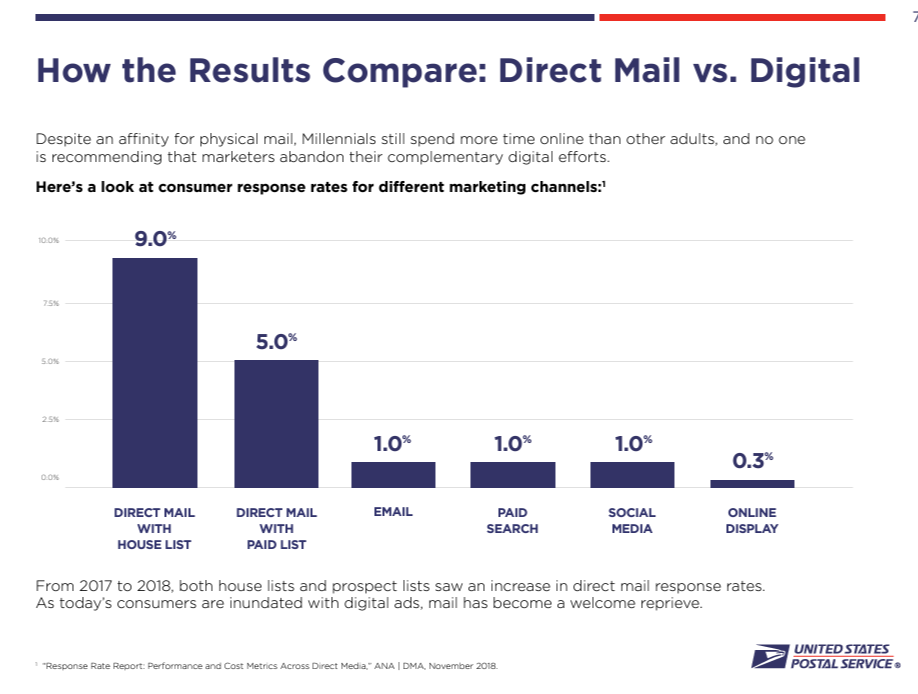
The useful lesson isn’t that print beats digital. It’s that a physical touchpoint can still earn attention when most messages arrive on screens.
Radio and TV turned brands into personalities
Radio changed marketing by giving brands a voice. The Library of Congress points to a 10-minute WEAF radio advertisement in New York on August 28, 1922, as a key marker in the birth of commercial broadcasting in America. Television added motion, faces, product demonstrations, and emotional storytelling at mass scale. Guinness World Records lists Bulova’s July 1, 1941 watch ad on WNBT as the first TV advert.
Broadcast media gave marketers repetition, sound, motion, and cultural presence. Jingles, slogans, sponsorships, spokespeople, and recurring characters made brands feel familiar before customers touched the product.
Today, the same idea runs through connected TV, streaming video, podcasts, short-form clips, and digital audio. The format changed. The value of a memorable, credible message didn’t.
The customer eventually moved to the center
Marketing also evolved as a business philosophy. OpenStax describes the evolution of the marketing concept through several stages, from production and product thinking to sales, customer orientation, and societal considerations. That progression is useful because it shows how marketing moved from making goods available to understanding what people actually want.
- Production: Make goods widely available and affordable.
- Product: Improve quality, features, and performance.
- Selling: Persuade people to buy what the company already makes.
- Marketing: Start with customer needs, then build the offer and message around them.
- Societal marketing: Consider customer needs, business goals, and longer-term social or environmental effects.
Many businesses still slip backward. They start with the product they want to sell, then look for a slogan, an ad, or a channel to push it. Strong marketing usually starts earlier. It asks who the buyer is, what they’re trying to solve, what they already believe, and what proof they need before they’ll act.
Digital marketing changed the speed of feedback
The internet turned marketing into something faster, more measurable, and more fragmented. Websites turned brochures into owned media. Search engines turned demand into visible queries. Email, analytics, CRM systems, landing pages, and online ads gave marketers feedback that print and broadcast could rarely match.
In 2025, IAB and PwC reported that U.S. internet advertising revenue reached $294.6 billion. Digital marketing is no longer a side channel. But scale created a new problem. More dashboards don’t automatically create better decisions.
The best digital marketing connects data to intent. A high-traffic post that attracts the wrong readers won’t do much for the business. A low-volume keyword can be valuable if it captures someone close to buying. This is why strong content marketing and SEO copywriting still depend on audience understanding, not just keywords, tools, or traffic charts.
Social media made trust portable
Social platforms changed who gets to introduce a brand. Pew Research Center reported that, among U.S. adults surveyed in 2025, YouTube and Facebook remained the most widely used platforms, while Instagram, TikTok, WhatsApp, and Reddit had grown since 2021. That reach makes social hard to ignore, but reach is not the same as trust.
Creator marketing grew because audiences often give more attention to people than logos. IAB projected U.S. creator ad spend would reach $37 billion in 2025. The risk is mismatch. When the creator, audience, product, and disclosure don’t align, the promotion can feel borrowed rather than believed.
For smaller businesses, this matters even without celebrity influencers. Customer photos, founder posts, service videos, review replies, tutorials, before-and-after examples, and employee expertise can all carry proof. The common thread is credibility.
AI is changing marketing again
AI is not just another channel. It changes planning, production, search, support, and measurement. McKinsey’s 2025 global AI survey reported that 88% of respondents said their organizations regularly used AI in at least one business function. The same report said IT and marketing and sales have consistently been among the business functions where respondents most often report AI use.
For marketers, AI can draft briefs, group customer themes, refresh older content, summarize research, generate first-pass email variants, analyze feedback, support chat experiences, and speed reporting. It can also produce confident errors, bland copy, and unsupported claims if nobody checks the work.
AI can’t carry the burden of accuracy, strategy, empathy, or original expertise on its own. If you’re using AI for SEO, use it for research support and structure, then verify facts, improve the angle, and add experience before publishing. Tech Help Canada has a deeper guide on using AI tools for SEO without publishing low-value content.
AI search also changes discovery. Search results are becoming more conversational, with answers, comparisons, and summaries appearing before a traditional click. That makes clear, useful, well-structured content more valuable, not less. We’ve covered this shift in more detail in our article on how AI is changing search.
Privacy and proof now matter more than targeting tricks
The digital era trained marketers to expect granular tracking. That world is less stable. Google’s 2025 Privacy Sandbox update showed how unsettled third-party cookie planning remained in Chrome after years of proposed changes. Regulations, browser settings, platform policies, and user expectations keep pushing marketers toward first-party relationships and consent-based data.
The same pressure applies to claims. In Canada, the Competition Bureau says the Competition Act prohibits businesses from making false or misleading claims to promote a product, service, or business interest, and that both the general impression and literal meaning of a claim matter. In the U.S., the FTC’s Green Guides warn marketers against broad, unqualified environmental claims such as “green” or “eco-friendly.” Values-based messaging only works when the proof is specific.
What businesses should take from the evolution of marketing
The channel changes. The job stays familiar: find the right audience, understand the buying moment, make a credible promise, and reduce the friction between interest and action.
- Start with the buyer’s problem, not your channel. If you don’t know what the buyer is trying to solve, the channel won’t save the campaign.
- Build assets you control. Your website, email list, customer data, brand voice, and content library give you resilience when platforms change.
- Use proof early. Reviews, case studies, demos, screenshots, samples, credentials, and guarantees reduce doubt faster than polished claims.
- Match media to the job. Search captures demand. Social creates discovery. Email nurtures. Print can reinforce. AI can accelerate research and workflow.
- Keep humans in the loop. Automation can multiply good strategy, but it can also multiply weak thinking.

I can suggest related Tech Help Canada articles based on the topic you’re reading now.

Gabriel Nwatarali is the founder of Tech Help Canada and has worked in SEO, copywriting, and web strategy since the early 2000s. His work has helped drive more than 10 million app downloads and 2,900% organic traffic growth for startups, agencies, and brands across North America. He writes about SEO, marketing, AI, and the decisions that shape how businesses grow online, drawing on hands-on experience building websites, content systems, and digital strategies.