If you’ve been anywhere near the SEO world lately, you’ve probably noticed a flood of new buzzwords. AEO. GEO. “Answer engine optimization.” People selling courses on how to “hack” your way into AI search results. It’s been noisy, confusing, and if we’re being honest, a little exhausting.
Then, on May 15, 2026, Google did something that cut through all of it. They published their official guide to optimizing for generative AI features on Google Search. Not a blog post. Not a tweet thread. A full, detailed guide on Google Search Central, the same place they publish their core SEO documentation.
And the message? It’s surprisingly simple.
Most of the tactics being sold as “AI search optimization” aren’t effective. What actually works is the kind of content strategy that’s always worked, executed with more intention and depth. If that sounds like good news for business owners who’d rather focus on running their company than chasing algorithm tricks, that’s because it is.
So what did Google actually say, and what should your business do with it?
Why Google Published This Guide Now
Google’s search experience has changed dramatically over the past year. AI Overviews now appear often enough to change how people find information, especially in research-heavy categories like health, education, and technology. And according to a December 2025 study from Ahrefs, AI Overviews reduce clicks to the top-ranking organic result by up to 58%.
That changes how people find and interact with information online.
At the same time, a cottage industry sprang up around the disruption. Consultants started branding themselves as “AEO specialists” and “GEO experts,” promising new frameworks for a new era. The problem? Many of those frameworks were built on assumptions, not on how Google’s systems actually work.
Google’s guide is a direct response to that confusion. And the core message couldn’t be clearer: optimizing for AI search is SEO. Not a new discipline. Not a separate practice. SEO.
From Google’s perspective, terms like AEO and GEO describe work that’s “specifically focused on improving visibility in AI search experiences.” But since their AI features are rooted in the same ranking and quality systems that power regular search results, the optimization approach is the same.
How Google’s AI Search Pulls Answers Together
Google’s advice makes more sense once you understand two parts of how AI search works.
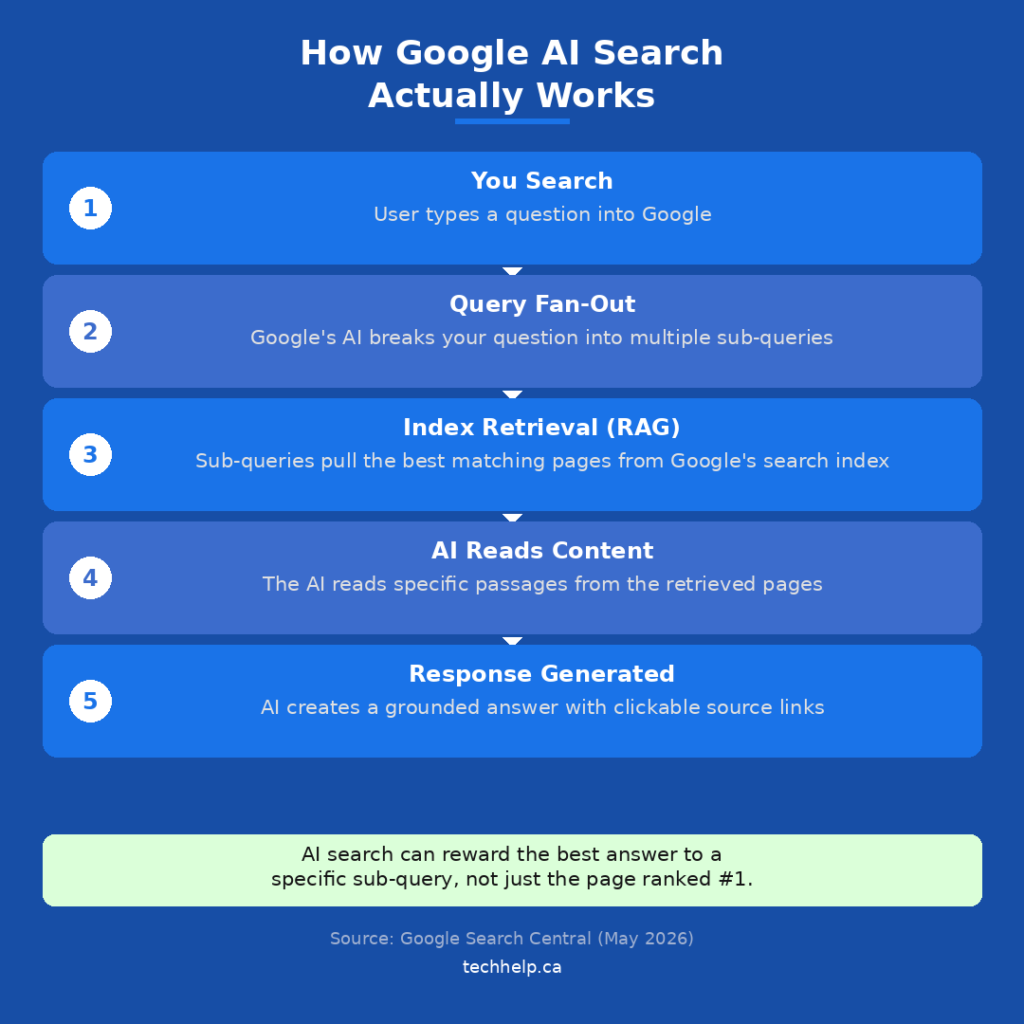
The first is retrieval-augmented generation, or RAG. When Google’s AI generates an overview or responds in AI Mode, it doesn’t pull answers from a separate AI database. It queries the same search index that powers traditional results, retrieves relevant pages, reads the specific content on those pages, and then generates a response grounded in what it found. The AI answer includes clickable links back to those source pages.
The second concept is query fan-out. When you ask a question, Google’s AI doesn’t just run your exact query. It automatically generates multiple related sub-queries and runs them simultaneously. A question like “how do I fix a lawn full of weeds” might trigger sub-queries for “best herbicides for lawns,” “remove weeds without chemicals,” and “how to prevent weeds from coming back.” Each sub-query pulls the best content from different sources, and the AI synthesizes all of it into one response.
Here’s why this matters for you: your page doesn’t need to rank #1 to get cited in an AI answer. Some third-party research suggests many AI Mode citations may come from pages outside the organic top 10. What matters is whether a specific section of your content is the best answer to one of those sub-queries. A detailed paragraph about your hands-on experience with organic weed removal, buried in an article that ranks at position 30, can beat a generic “top 10 tips” guide that ranks at position 3.
That’s a meaningful shift in how visibility works — and it rewards depth over breadth.
What Google Says You Don’t Need to Do
Google also dedicates an entire section to debunking popular AI search optimization tactics. They call it “mythbusting,” and it reads like a direct response to the AEO/GEO playbook that’s been circulating online.
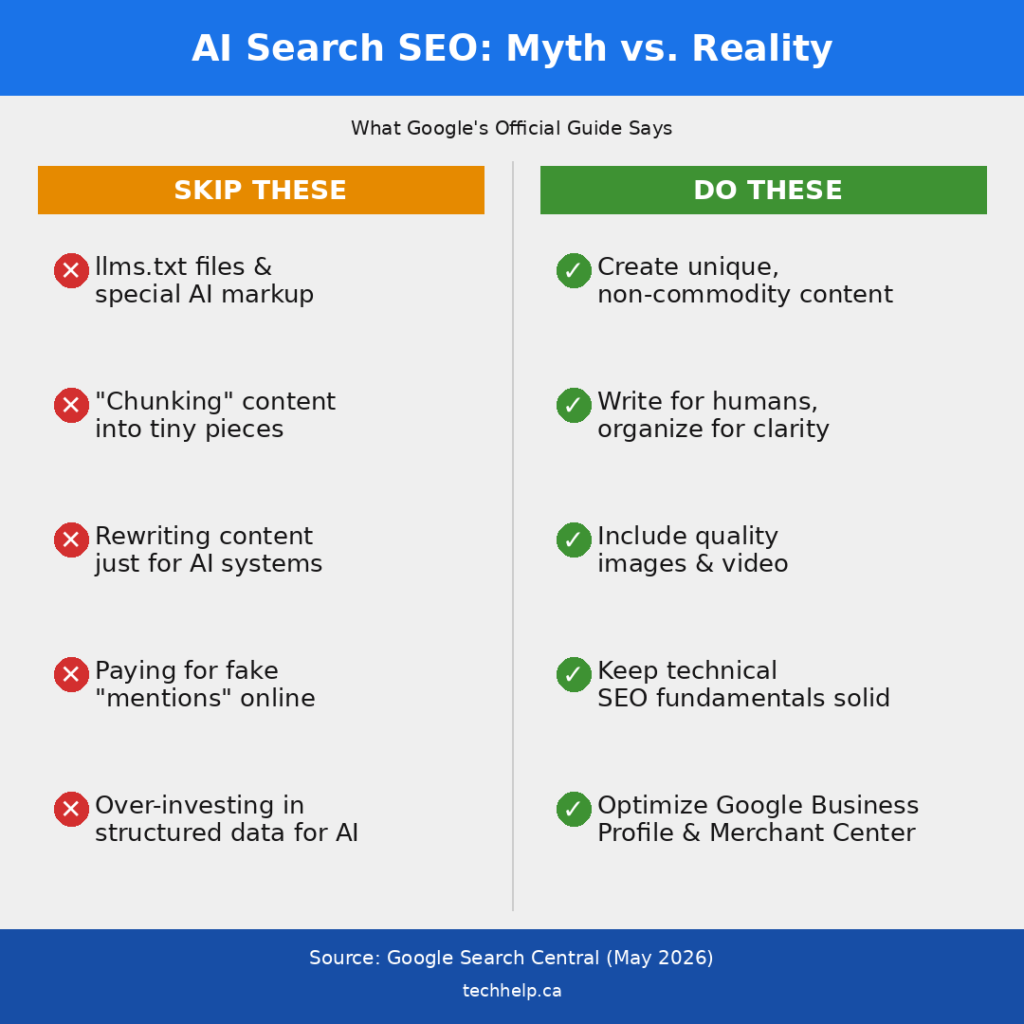
Here’s what they say you can skip.
You Don’t Need llms.txt Files or Special AI Markup
There’s been a trend of creating machine-readable text files specifically designed for AI systems. Google’s guide is explicit: you don’t need new machine-readable files, AI text files, markup, or Markdown to appear in generative AI search. Google crawls and indexes many file types, but none of them receive special treatment for AI purposes.
You Don’t Need to “Chunk” Your Content Into Small Pieces
Some consultants have recommended breaking articles into tiny sections so AI can digest them more easily. Google says their systems can understand the nuance of multiple topics on a single page. There’s no ideal page length — write what serves your audience, not what you think an AI model wants to see.
You Don’t Need to Rewrite Your Content for AI
Google’s AI understands synonyms and general meanings. You don’t need to obsessively target every possible long-tail keyword variation or restructure your writing to sound more “machine-friendly.” Write naturally for the people reading your content.
You Don’t Need Fake Mentions Across the Web
Paying for your brand to be mentioned on random blogs, forums, or review sites in hopes of influencing AI responses? Google’s spam systems are built to catch exactly that. Their guide notes that “seeking inauthentic mentions across the web isn’t as helpful as it might seem.”
You Don’t Need to Over-Invest in Structured Data for AI
Schema markup isn’t required for AI search, and there’s no special schema.org markup that improves your chances. That said, structured data still helps with rich results in regular search, so don’t abandon it — just don’t treat it as an AI search silver bullet.
If someone is currently charging you for a service built primarily around these tactics, it’s worth asking what exactly you’re paying for.
What Google Says Actually Works
After clearing away what doesn’t matter, Google’s guide focuses on what does. And none of it requires a proprietary framework or expensive retainer.
Create Non-Commodity Content
This is one of the strongest themes in the guide. Google draws a clear line between commodity content, meaning generic advice that could come from anyone, and non-commodity content that offers unique expertise or experience.
Their example is instructive. An article titled “7 Tips for First-Time Homebuyers” is commodity content. It’s based on common knowledge, adds little unique insight, and could be written by anyone (or any AI model). An article titled “Why We Waived the Inspection and Saved Money: A Look Inside the Sewer Line” is non-commodity. It’s rooted in specific experience, offers a perspective you can’t get anywhere else, and gives readers something genuinely new.
For your business, this means leaning into what makes your expertise distinctive. You’ve dealt with specific situations, solved particular problems, and learned things that generic content can’t capture. That’s your competitive advantage in AI search — content that only you can create.
Write for Humans, Organize for Clarity
Clear paragraphs, logical section headings, and content that’s easy to follow. This isn’t about optimizing for algorithms. It’s about making your content easy to navigate and useful for the people reading it. As a side benefit, well-organized content also makes it easier for Google’s AI to identify and cite the most relevant passage.
Include Quality Images and Video
Google’s AI features can surface media alongside text. If your content would benefit from photos, diagrams, or video walkthroughs, include them. Follow the same image and video SEO best practices that have always applied — descriptive alt text, relevant file names, and proper formatting.
Keep Your Technical SEO Foundation Solid
None of this is exciting, but it’s the infrastructure that everything else depends on. Your pages need to be crawlable and indexable. Your site needs to be fast, mobile-friendly, and free of excessive duplicate content. If Google can’t find and process your pages, no amount of great content will matter. Tools like Google Search Console are free and will tell you exactly where you stand.
Optimize Your Local and Ecommerce Details
If you serve local customers, your Google Business Profile can help Google understand and display accurate information about your business. If you sell products, Merchant Center feeds can help your products appear in AI responses and other Google Search experiences.
The Rise of AI Agents — And Why Your Website Needs to Be Ready
Google’s guide also looks ahead to a shift in how people interact with websites.
The guide introduces the concept of “agentic experiences” — AI systems that can perform tasks on behalf of users. Think of an AI assistant that browses websites to book a restaurant reservation, compare product specifications, or fill out a service request form. These aren’t hypothetical. Google describes them as browser agents that analyze visual renderings, inspect the structure of your web pages, and interpret accessibility features to complete tasks.
What does this mean practically? If an AI agent visits your website to book an appointment or compare your pricing, it needs to be able to navigate your site the same way a person would, but through code. Semantic HTML, clear navigation, and accessibility support all make your site easier for people and AI agents to interpret.
Google also mentions the Universal Commerce Protocol (UCP), an emerging standard that would allow search-connected AI agents to interact with businesses more directly — handling things like transactions and service requests.
This is still early. You don’t need to overhaul your website tomorrow. But if your business involves booking, scheduling, ecommerce, or any kind of online transaction, it’s worth paying attention to how this space develops. The businesses with accessible, well-structured websites will be the first ones AI agents can work with effectively.
What This Means for Your Business Right Now
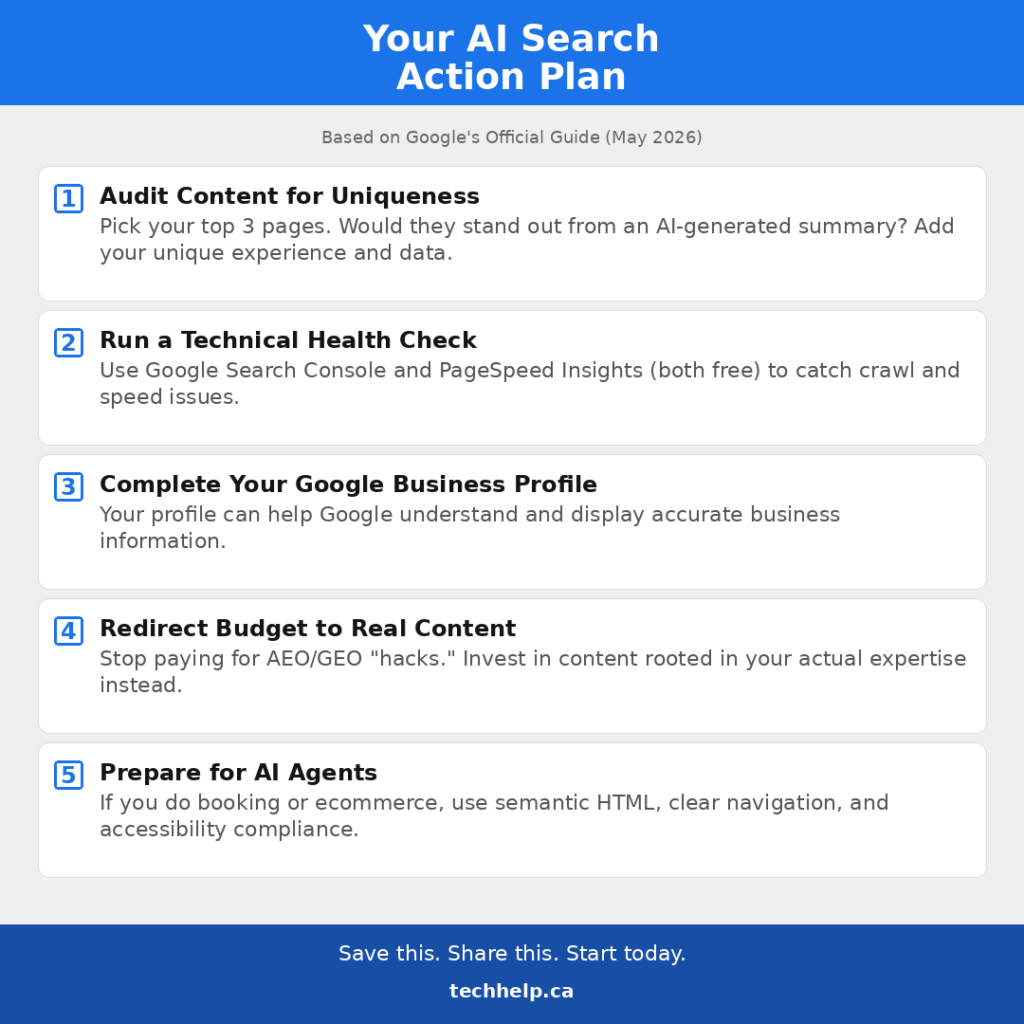
Google’s guide covers a lot of ground, but the action steps are surprisingly manageable. Here’s what you can do today.
Audit Your Content for Uniqueness
Pick your three most-visited pages and ask yourself: would this stand out from an AI-generated summary of the same topic? If the answer is no, it’s time to add your unique experience, proprietary data, or specific perspective. The goal isn’t to write more content — it’s to write content that only you can write.
Run a Quick Technical Health Check
Can Google crawl your key pages? Does your site load quickly on mobile? Google Search Console and PageSpeed Insights are both free, and they’ll surface any critical issues in minutes. Don’t skip this step — technical problems can silently prevent your best content from ever appearing in AI results.
Complete Your Google Business Profile
If you serve local customers, this is probably the highest-ROI action on this list. Your profile information feeds directly into AI responses for local queries. Make sure it’s complete, accurate, and up to date.
Redirect Your Budget From AI Gimmicks to Genuine Content
If you’re currently paying for “AEO optimization” or “GEO services” built around the tactics Google just debunked, that money is better spent creating content rooted in your real-world experience. Tools like HelperX Bot can help you brainstorm unique angles and develop content frameworks based on what you actually know — which, as Google’s guide makes clear, is exactly what their systems are looking for.
Prepare for AI Agents if Relevant
If your business involves booking, ecommerce, or online transactions, start thinking about whether AI agents could navigate your website effectively. Strong site structure, semantic HTML, and accessibility compliance will put you ahead of the curve.
AI Search Rewards Businesses Worth Citing
Google’s guide is, in a way, a permission slip. It’s telling you that you don’t need to panic about AI search. You don’t need to rewrite your website for machines or invest in tactics that Google itself says don’t work.
What you do need is to be truly useful to the people you’re trying to reach. Create content that reflects your real expertise. Keep your website technically sound. Show up in the places where Google is already looking for information about businesses like yours.
The businesses that will thrive in AI search aren’t the ones gaming a system that doesn’t exist. They’re the ones that have always been worth citing. AI search just gives them more ways to prove it.
Tech Help Canada Staff researches, writes, and reviews practical content for business owners and professionals. Our coverage spans business, marketing, SEO, technology, and the tools and systems people use to grow and operate online. We focus on clear, useful information backed by research, hands-on experience, and editorial review. Learn more about our team and editorial standards. Need help with something? Contact Us