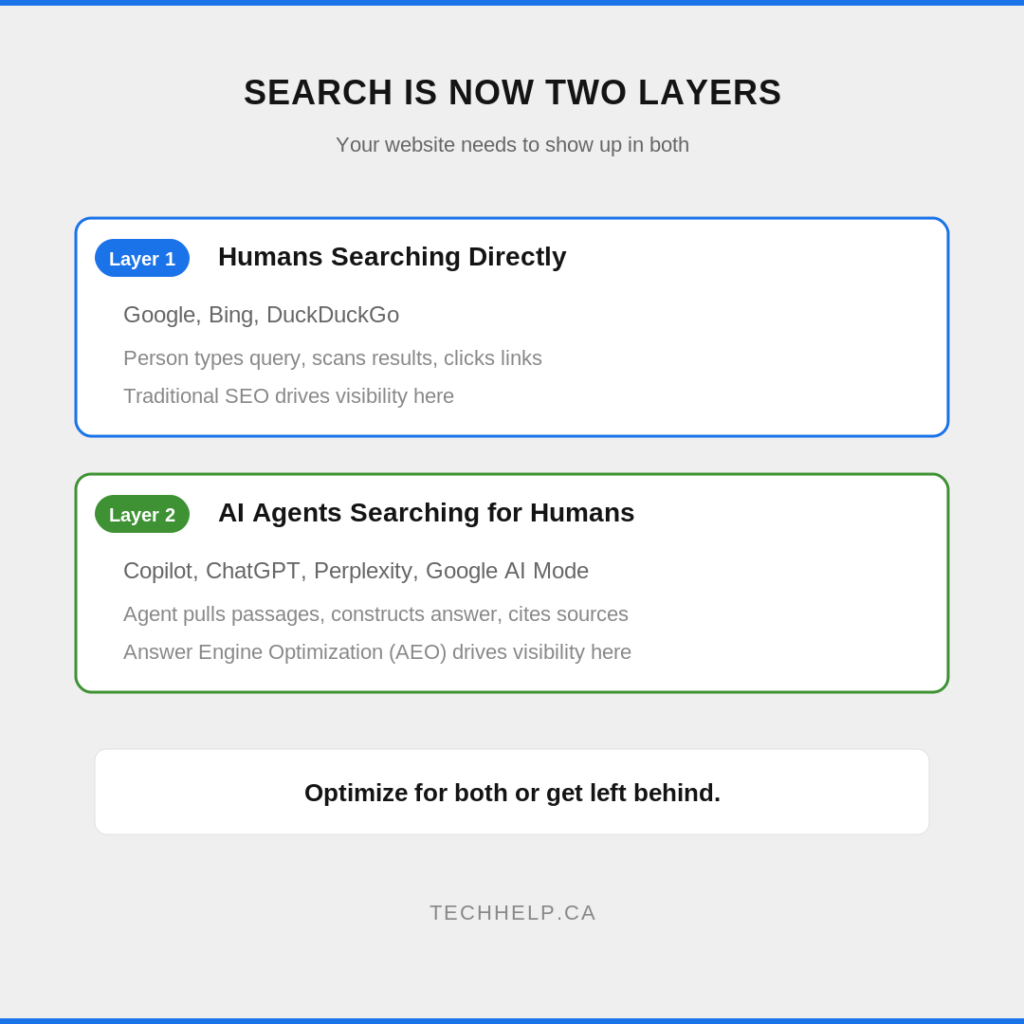
Microsoft’s new Web IQ system is built for AI agents, not human searchers. A person asks Copilot, ChatGPT, or another AI tool a question. Behind the scenes, an agent may search the web, pull evidence, compare sources, and use that information to build an answer.
That changes what “being found” means. For years, businesses optimized pages so people could find them in Google or Bing, scan the title, click the result, and read the page. Web IQ points to a different search layer: AI agents retrieving evidence from the open web before the customer ever sees a results page.
If your website isn’t easy for those systems to understand, extract, and cite, you may miss a growing part of how people make decisions.
What Microsoft Web IQ Is
Microsoft announced Web IQ on June 2, 2026. The company describes it as a suite of AI-native grounding APIs built to connect AI systems and agents to fresh information from the web, including pages, news, images, and videos.
That’s the technical phrasing. The practical version is simpler: Web IQ is Bing reworked for agents.
Traditional Bing gives humans search results. Web IQ gives AI systems passages, structured evidence, and fresh web context that can be used inside an answer. Instead of returning a full page for someone to browse, it helps an AI agent retrieve the parts of the web it needs to reason through a task.
Microsoft says Web IQ is built on the Bing global index, but redesigned around agent workloads. Agents don’t usually search once and stop. They may retrieve information repeatedly, compare evidence, adjust the query, and continue until they have enough context to respond.
That makes speed, freshness, and evidence quality more important. Microsoft says Web IQ operates below 165 milliseconds at p95 latency, meaning 95% of tested responses fall under that threshold. In Microsoft’s internal comparisons, it ran nearly 2.5 times faster than the next best alternative from the tested competitor set.
Those performance claims matter less to a small business than the direction they reveal. Microsoft isn’t treating AI search as a chatbot feature bolted onto Bing. It’s building infrastructure for a world where agents search constantly on behalf of people.
Why Your Website Needs to Be Machine-Readable
AI agents don’t browse your site like a person.
They don’t notice your hero image, your color palette, or the clever line at the top of the page. They look for evidence: clear answers, structured information, recent facts, named entities, useful passages, and signals that the page is reliable enough to cite.
If your key information is buried under vague introductions, thin explanations, outdated stats, or unclear headings, an agent may skip your page for a source that makes the answer easier to extract.
That doesn’t mean design stops mattering. Humans still visit websites, compare options, and judge trust visually. But the audience for your content is expanding. You now have to serve people who read and systems that retrieve.
This connects directly to the broader shift covered in Tech Help Canada’s guide to AI in search. Search visibility isn’t only about ranking in a list of links anymore. It’s also about whether AI systems can use your page as evidence.
Web IQ Changes the Search Audience
The old search model was built around a human typing a query into a search box. That person saw ten links, chose a result, and judged the source.
The agent-search model works differently. A user asks an AI tool a question, and the tool may perform several searches in the background. The user sees the final answer first, with citations if the system provides them. Your website may influence that answer without getting the same kind of click you used to expect.
Search Engine Land reported that Web IQ uses the same API infrastructure operating inside Microsoft Copilot and many other AI systems, including ChatGPT. That doesn’t mean every ChatGPT answer depends on Web IQ. It does mean Microsoft’s web index and grounding stack are already part of major AI-answer workflows.
For business owners, the implication is direct: your site isn’t only competing for rankings. It’s competing to become a useful source inside AI answers.
That’s a different kind of visibility. A citation may not send as much traffic as a traditional ranking, but it can still influence what a customer believes, which brands they remember, and which options make it into their consideration set.
What Bing Webmaster Tools Can Now Show You
Microsoft also introduced AI Performance reporting in Bing Webmaster Tools earlier in 2026. It gives site owners a measurement layer for AI visibility, which has been hard to track directly.
The AI Performance dashboard shows how your content appears across Microsoft Copilot, AI-generated summaries in Bing, and selected partner integrations. According to Microsoft’s Bing Webmaster blog, the report includes total citations, average cited pages, grounding queries, page-level citation activity, and trends over time.
That gives business owners and marketers a practical starting point. You can see whether your pages are being used as sources in AI-generated answers, which URLs appear most often, and which query phrases led the system to retrieve your content.
One caution: this isn’t the same as a ranking report. Microsoft says citation data doesn’t show page importance, answer placement, or authority within a specific response. It shows participation. That’s still useful, but it shouldn’t be read like a traditional keyword ranking report.
If you use Bing Webmaster Tools, your SEO dashboard now has a new question to answer: “Are AI systems citing us?”
How to Make Pages Easier for Agents to Use
Most of the work overlaps with strong SEO and strong content.
Start by making the answer obvious. Each important page should quickly explain what the page is about, who it helps, and what problem it solves. If an agent has to dig through five soft paragraphs before finding the useful part, your competitor’s clearer page has the advantage.
Use headings that describe the information under them. A heading like “Pricing Factors” is more useful than “Things to Consider.” A heading like “How Long Does Implementation Take?” is easier to retrieve than “Getting Started.”
Support meaningful claims with evidence. Microsoft specifically points to examples, data, and cited sources as trust signals for AI-generated answers. If your page makes a comparison, explains a process, or gives advice, show where that confidence comes from.
Keep high-value pages current. Microsoft recommends regular updates so AI systems reference the most accurate version of a page. For fast-moving topics, quarterly review may not be enough. For stable service pages, a scheduled twice-yearly review can still catch stale language, old statistics, and broken references.
Use structure where it helps. Clear headings, tables, FAQ sections, schema markup, and consistent entity names can all make a page easier for machines to interpret. Don’t add structure as decoration. Add it where it makes meaning clearer.
Finally, consider IndexNow if your site changes often. Microsoft’s Bing Webmaster guidance points to IndexNow as a way to notify participating search engines when content is added, updated, or removed. For AI answers that depend on fresh information, faster discovery can matter.
What This Doesn’t Mean
Web IQ doesn’t mean human SEO is over. It doesn’t mean every website needs to become a technical encyclopedia. It doesn’t mean you should stuff pages with artificial Q&A sections and schema just to look machine-readable.
It means the web now has another kind of searcher.
People still search directly. They still click links. They still judge design, tone, proof, and ease of use. At the same time, AI agents are starting to retrieve information before users ever reach your site.
The best response isn’t to choose one audience over the other. It’s to make your best pages useful to both.
Write clearly enough for a person to trust you. Structure the page well enough for a machine to identify the useful parts. Keep facts fresh enough that both can rely on the answer.
That also means your content strategy should stop treating “traffic” as the only sign of visibility. A page can influence a buyer inside an AI answer even if the click never comes. That’s uncomfortable for marketers who are used to measuring everything by sessions, but it reflects where discovery is heading.
What to Do Now
Start with Bing Webmaster Tools. Verify your site if you haven’t already, then check whether the AI Performance report is available for your property. Look at cited URLs, grounding queries, and trends over time.
Next, audit your five most commercially important pages. These are usually your service pages, product pages, pricing pages, comparison pages, or high-intent educational pages. Ask four questions:
Does the page answer the main question clearly near the top?
Does it include specific evidence, examples, or data?
Are the headings descriptive enough for a reader or agent to understand the page quickly?
Is the information current, accurate, and consistent with the rest of your web presence?
Then test your visibility manually. Ask Copilot, ChatGPT, Perplexity, and Gemini questions a customer might ask before buying from you. Search by problem, category, location, and comparison. Don’t only search your brand name.
If your business doesn’t appear, don’t assume the model is broken. Your page may not be clear, specific, trusted, or current enough to use. Tech Help Canada’s guide to LLM SEO covers the broader work of making content easier for AI systems to understand and cite.
For teams learning how agents behave, the guide to AI agents is also useful background. Web IQ matters because agents don’t simply display search results. They retrieve, evaluate, and package information into answers.
Make Your Site Worth Citing
Microsoft Web IQ is another sign that search is splitting into layers.
Humans still search. AI tools now answer. Agents increasingly retrieve the evidence behind those answers. Your website should be ready for all three contexts.
That doesn’t require panic. It requires clearer pages, stronger evidence, fresher information, and better measurement of AI citations. The businesses that adjust early won’t just be easier to rank. They’ll be easier for agents to trust, cite, and bring into the customer’s decision.
Tech Help Canada Staff researches, writes, and reviews practical content for business owners and professionals. Our coverage spans business, marketing, SEO, technology, and the tools and systems people use to grow and operate online. We focus on clear, useful information backed by research, hands-on experience, and editorial review. Learn more about our team and editorial standards. Need help with something? Contact Us