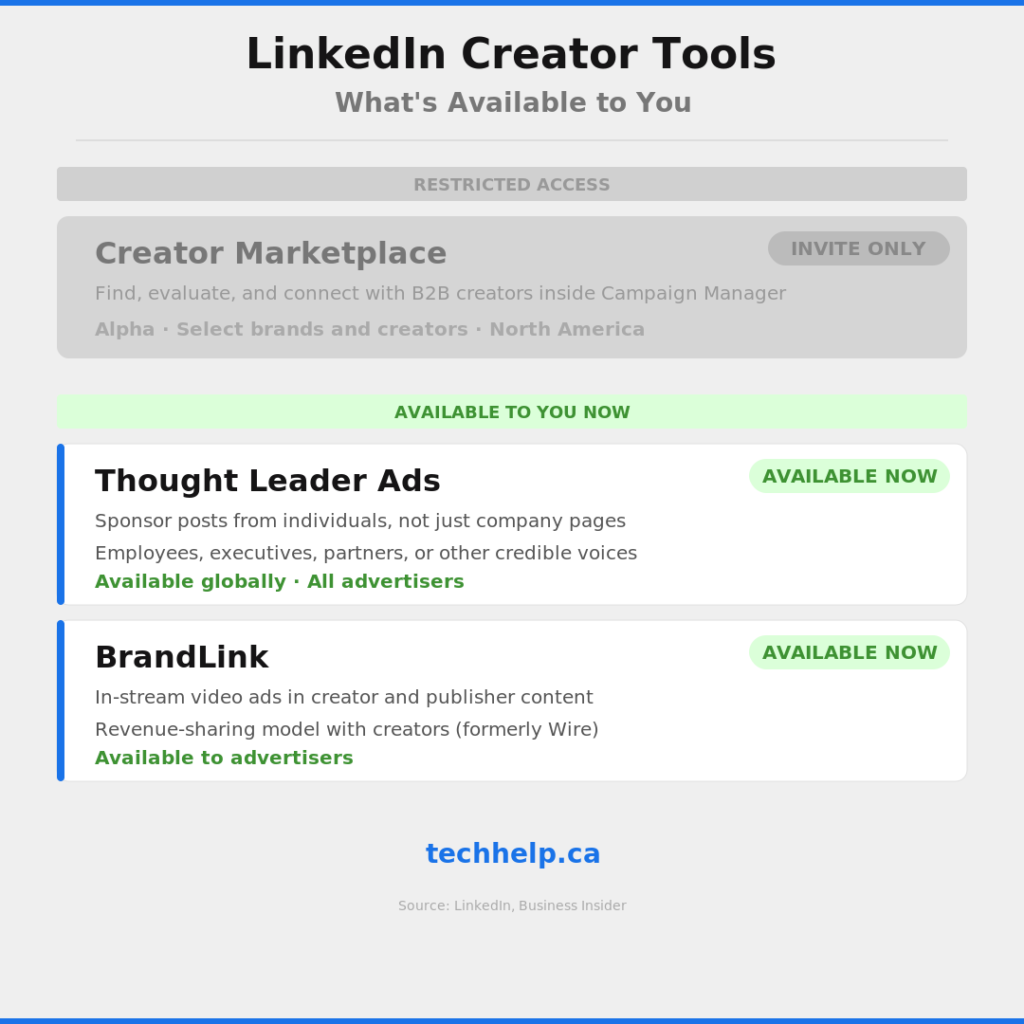
LinkedIn has finally built a creator marketplace for B2B. The catch is that most businesses can’t use it yet. The new Creator Marketplace lives inside Campaign Manager, and LinkedIn says it’s still in alpha and limited to select brands and creators in North America. If you’re a small business, agency, consultant, or niche B2B operator, you probably won’t get an invite right away.
That doesn’t make the launch irrelevant. It makes it a signal: LinkedIn is formalizing something B2B marketers have been seeing for years. Buyers trust credible people more than branded posts, and the marketplace is LinkedIn’s attempt to make those credible people easier for advertisers to find, evaluate, and sponsor.
You don’t need marketplace access to start learning from the shift. The real opportunity is already available: identify trusted voices in your market, partner with them directly, and use LinkedIn’s existing ad tools to distribute posts that feel more like expert perspective than corporate promotion.
What LinkedIn launched
LinkedIn’s Creator Marketplace is a new section inside its ad platform that helps advertisers find B2B creators by sector, topic, and audience fit. Business Insider reported that creators can opt in, share contact information, showcase top posts, and make it easier for brands to reach out for sponsored content, speaking opportunities, advisory work, or other partnerships.
The distinction is practical. LinkedIn’s marketplace isn’t trying to copy consumer influencer platforms exactly. TikTok, Instagram, Snapchat, and YouTube have had creator-brand tools for years, but those platforms often optimize around reach, entertainment, lifestyle fit, or cheap impressions.
LinkedIn’s version is different because the unit of value is credibility. A creator who understands enterprise software procurement, healthcare operations, commercial real estate, supply chain risk, cybersecurity, or HR compliance may not look like a traditional influencer. They may be a consultant, founder, operator, analyst, educator, or former executive with a specific audience that trusts their judgment.
LinkedIn is also building around the creator opportunity in other ways. Business Insider reported that LinkedIn has launched BrandLink, formerly Wire, which lets brands place in-stream video ads in publisher and creator content with revenue sharing. It has also invested in original video programming with business-focused creators and has explored more creator monetization products, including events, subscriptions, and paid experiences. LinkedIn wants to become a serious B2B creator platform, not just a professional networking site where creators happen to post.
Why B2B creator marketing is moving fast
B2B buying is trust-heavy. The products are expensive, the decisions involve several people, and the buyer often has to defend the choice internally. That makes personal credibility unusually powerful.
LinkedIn’s 2026 Global B2B Marketing Outlook says 77% of B2B marketers believe buyers need to trust a brand before engaging with it. The same research says 82% believe creators increase credibility with decision-makers, and 70% say buyers rely more on peer voices and subject-matter experts than brand-produced content.
That tracks with the broader market. Influencer Marketing Hub reports that B2B influencer marketing adoption rose from 34% in 2020 to 85% in 2025, while investment grew 171% year over year heading into 2026.
This isn’t a vanity channel anymore. It’s becoming part of how B2B companies build trust before the sales conversation starts.
AI makes the shift even sharper. As more companies publish polished, generic content at scale, the scarce signal becomes earned trust. A credible person with a real point of view can cut through in a way another branded PDF often can’t.
For small businesses, that should be encouraging. You don’t need a celebrity. You need the right person with the right audience and enough trust to make your message feel worth considering.
The tools already available
The new marketplace is a discovery layer. It helps brands find creators more efficiently. But discovery is only one part of the work.
The distribution layer is already available through Thought Leader Ads. LinkedIn’s Thought Leader Ads let advertisers sponsor eligible posts from people, not only company pages. With permission, a business can put paid distribution behind content from an employee, executive, customer, partner, or other credible voice.
That’s the practical opening. You can test creator-led LinkedIn campaigns before the marketplace becomes widely available.
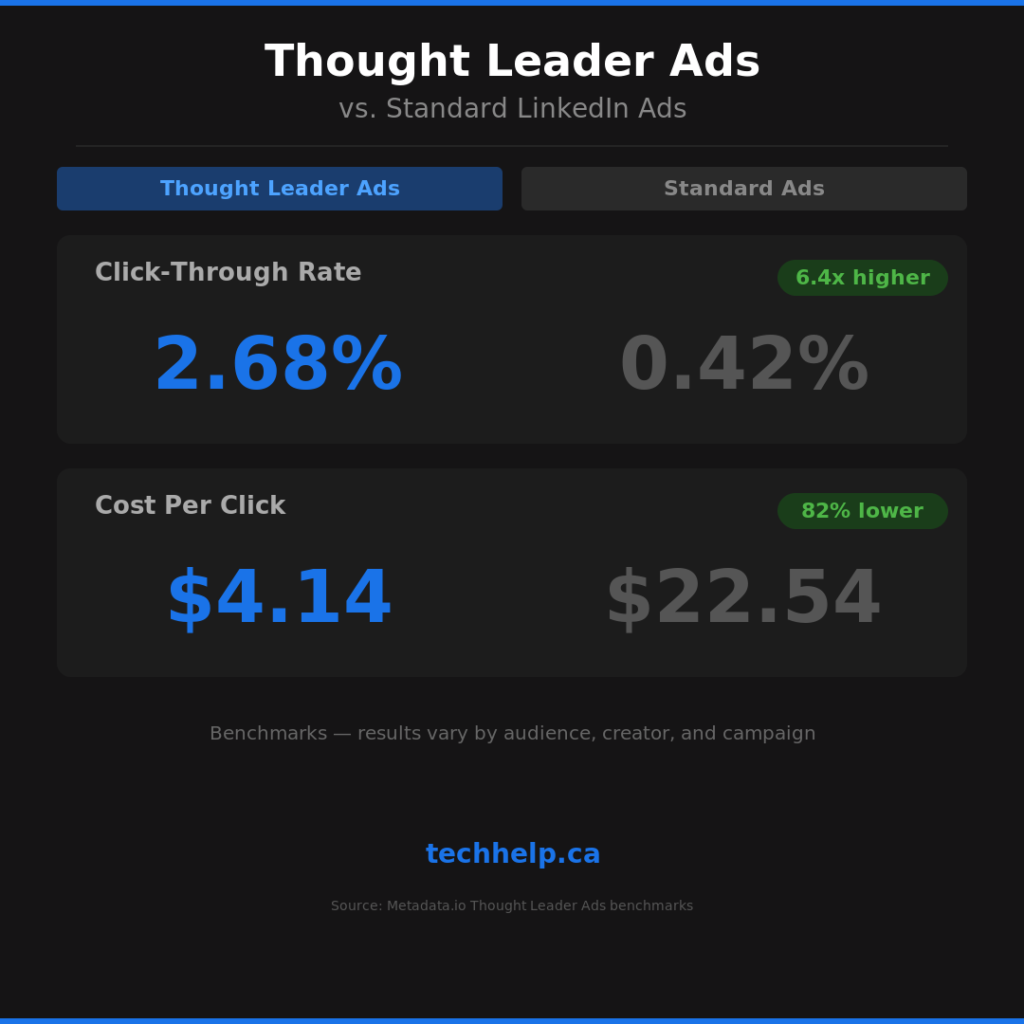
Metadata.io’s Thought Leader Ads benchmark data makes the case for testing. Its reported median click-through rate for Thought Leader Ads was 2.68%, compared with 0.42% for standard single-image ads. It also reported a median cost per click of $4.14 for Thought Leader Ads, compared with $22.54 for brand awareness campaigns.
Treat those numbers as benchmarks, not promises. Your results will depend on audience fit, the post, the creator, the offer, and the campaign objective. But the direction is clear: when a credible individual carries the message, LinkedIn ads can behave differently.
What you can do without marketplace access
Start by finding creators manually. Search LinkedIn for the topics your buyers care about, then study who consistently creates useful posts and attracts the right commenters. Don’t stop at follower count. Look at job titles, industries, companies, and the quality of discussion under the post.
Next, look for posts that already worked organically. A post with thoughtful comments from the right audience is a better starting point than a fresh sponsored post nobody has responded to yet. Organic response gives you a signal before you spend.
Then reach out directly. B2B creators are often working professionals, not full-time influencers waiting for generic brand pitches. Reference a specific post, explain why their audience fits, and propose a clear partnership. A vague “let’s collaborate” message is easy to ignore. A specific offer with a defined deliverable is much easier to evaluate.
If the creator agrees, run a small test. Sponsor one post, define one audience, and compare the result against your usual LinkedIn ad performance. Measure click-through rate, cost per click, engagement quality, website behavior, lead quality, and any downstream sales movement you can realistically track. The relationship still matters, even when the distribution happens through a paid ad product.
How to evaluate a B2B creator
B2B creator selection is different from consumer influencer selection. The wrong creator can waste money even if the numbers look impressive.
Audience fit should lead the decision. A creator with 8,000 followers who are mostly CFOs, procurement managers, agency owners, architects, or HR leaders in your target market can be more valuable than a creator with 200,000 broad business followers. Read the comments. The audience is usually visible there.
Credibility comes next. Does this person have real experience in the category, or are they summarizing trends they barely understand? B2B buyers can spot thin expertise quickly. The strongest creator partners can explain the problem in language your buyer recognizes.
Consistency matters too. A person who posts about one area of expertise every week builds clearer authority than someone bouncing between unrelated business topics. In B2B, depth often beats volume.
Engagement quality matters more than engagement volume. A few serious comments from decision-makers can matter more than hundreds of generic reactions. Look for questions, disagreements, shared experiences, and comments from people who appear to match your buyer.
Finally, check how they handle sponsored work. Clear disclosure, good judgment, and a natural fit matter. If every sponsored post feels forced, their audience has probably learned to tune it out.
Where LinkedIn creator partnerships fit
Creator partnerships shouldn’t replace your LinkedIn page, your content strategy, or your paid media. They fill a specific gap: trust transfer.
Your owned content builds your point of view. Your paid ads buy reach. Creator partnerships borrow credibility from someone your audience already pays attention to.
That makes creator partnerships a strong fit when your product needs explanation, your buyer is specific, the purchase involves risk, and your company needs more trust before asking for a sales conversation. They’re weaker when your buyer persona is unclear, your offer is hard to explain, or you’re expecting one sponsored post to create a full pipeline by itself.
The right first test is small. Pick one creator, one strong post, one audience, and one measurable outcome. Don’t turn the first test into a six-month brand campaign. Use it to learn whether creator-led distribution can outperform your standard LinkedIn ads with the audience you actually care about.
For a broader social strategy context, Tech Help Canada’s A to Z social media guide can help connect creator partnerships to content, paid distribution, audience fit, and measurement.
The bigger signal for B2B marketers
LinkedIn is late to creator marketplaces, but it may be early to the version B2B actually needs. The consumer creator economy rewards personality, attention, and entertainment. B2B creator marketing rewards expertise, trust, specificity, and timing. That’s the gap LinkedIn is trying to own.
If the marketplace works, it will make B2B creators easier to find and easier to sponsor. But the businesses that wait for full marketplace access may lose time they could have spent building relationships, testing Thought Leader Ads, and learning which voices their buyers trust.
You don’t need LinkedIn’s marketplace invite to start. You need a clear buyer, a credible creator, a strong post, a small test budget, and a willingness to measure what happens.
The companies that learn now will be ahead when LinkedIn opens the marketplace wider. The ones waiting for the platform to make creator marketing easy will be starting from zero.
Tech Help Canada Staff researches, writes, and reviews practical content for business owners and professionals. Our coverage spans business, marketing, SEO, technology, and the tools and systems people use to grow and operate online. We focus on clear, useful information backed by research, hands-on experience, and editorial review. Learn more about our team and editorial standards. Need help with something? Contact Us