AI can help people research faster, compare ideas, write better, automate work, and make better decisions. Businesses should use it. Governments should use it. Consumers should use it. Pretending AI is bad because it disrupts old habits is lazy thinking.
But there is a problem that countries cannot afford to ignore.
AI answer engines are starting to sit between users and the businesses, publishers, creators, review sites, and service providers that make the internet valuable. These systems don’t just help people find information. Increasingly, they summarize it, repackage it, rank it, recommend from it, and give users enough of an answer that they don’t need to click through to the source.
Clicks are not vanity metrics.
Clicks become traffic. Traffic becomes leads, ad revenue, affiliate commissions, subscriptions, sales, booked calls, customers, payroll, taxes, and investment.
Drain the clicks, and you drain the traffic. Drain the traffic, and you drain the revenue. Drain enough revenue across enough companies, and eventually you are no longer talking about a search feature. You are talking about economic damage.
That is the conversation regulators need to have now, not five years from now after the damage is baked in.
This is already happening
The shift is already showing up in the data.
Pew Research Center analyzed Google searches and found that when users encountered an AI summary, they clicked a traditional search result in 8% of visits. When no AI summary appeared, they clicked a traditional result in 15% of visits. Users clicked links inside the AI summary itself in only 1% of visits.
That’s not a small behavior change. That’s a direct hit to the open web’s revenue model.
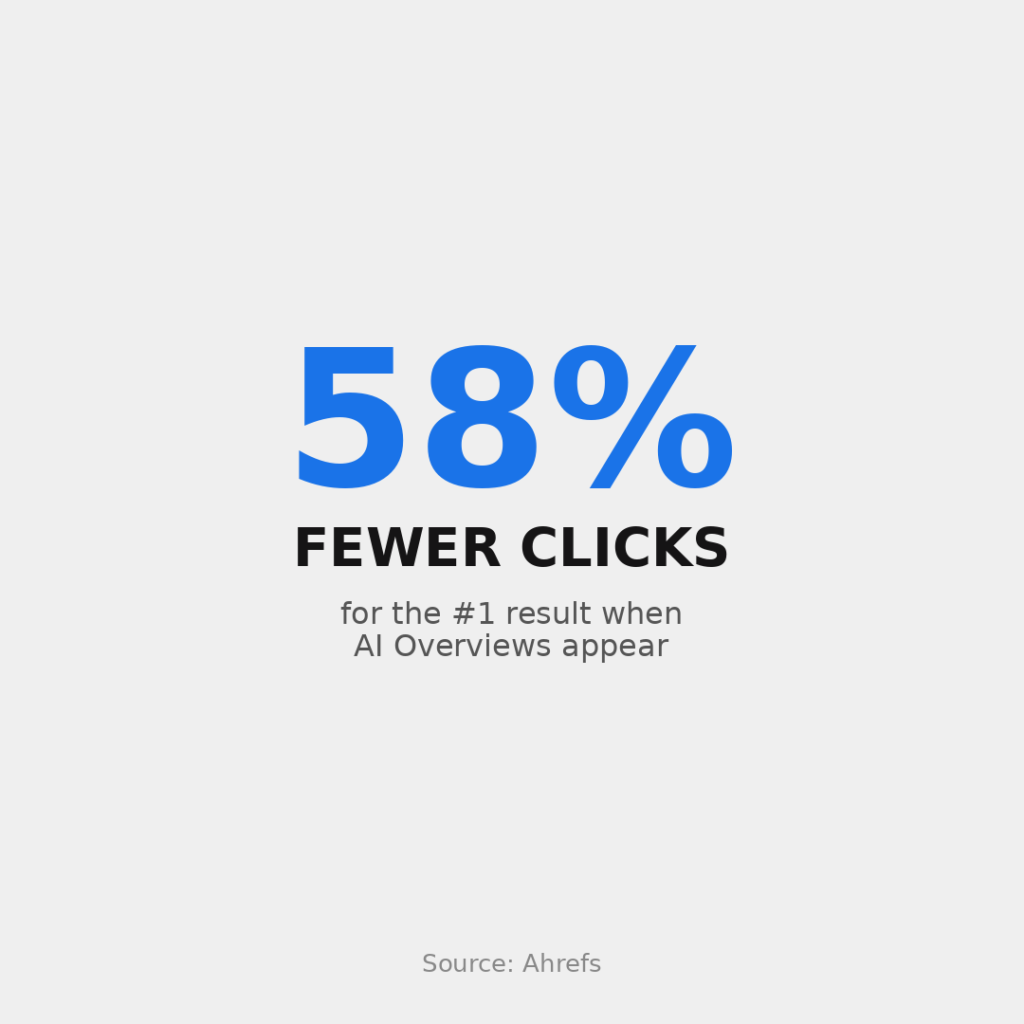
Ahrefs found a similar pattern. Among keywords that triggered AI Overviews in December 2025, the click-through rate for the top organic result dropped sharply compared with informational keywords that did not trigger an AI Overview. After accounting for the broader decline in click-through rates across both groups, Ahrefs estimated that AI Overviews reduced the click-through rate for the number-one result by 58%.
For a small publisher, that can mean the difference between hiring writers and cutting staff. For an affiliate business, that can mean the difference between profit and collapse. For a local service business, that can mean fewer calls. For a SaaS company, it can mean fewer trials. For a media company, it can mean less ad revenue.
People talk about AI search like it’s just a better interface. It’s not just a better interface. It changes who gets paid.
A citation doesn’t make that whole — not if the answer already removed the reason to click.
This is not just a publisher problem
It’s tempting to frame this as publishers complaining about lost traffic. That framing is too small.
The internet is economic infrastructure.
A World Bank diagnostic for Ghana cited a 2016 Huawei and Oxford Economics estimate that placed the global digital economy at $11.5 trillion, or 15.5% of global GDP, and forecast the digital economy’s share of GDP would reach nearly 25% within a decade. The U.S. Department of Commerce says the digital economy added nearly $2.6 trillion in value to the U.S. economy in 2022.
Those figures use different definitions and shouldn’t be treated as directly comparable. But the point holds: the internet is where businesses acquire customers, build reputations, and earn revenue.
When AI answer engines begin replacing visits to the websites that power those decisions, the risk is not limited to bloggers. It touches the flow of money.
Imagine an affiliate marketing company generating $100 million a year in revenue from comparison content, software reviews, buyer guides, and product testing. If AI answers summarize the conclusions, name the “best” tools, and send only a tiny fraction of users back to the source, that company could lose tens of millions in revenue.
Now scale that across thousands of businesses. Software review sites. Travel publishers. Local directories. Financial comparison sites. Health information websites. Product testing labs. Tutorial sites. News publishers. Independent blogs. Marketplaces. Agencies. Service businesses.
At some point, this stops being a content problem and becomes a market access problem.
Who gets seen? Who gets recommended? Who gets skipped? Who gets paid?
If a handful of private AI platforms can influence those answers at massive scale, regulators cannot treat this like a normal product update.
Google is the biggest pressure point, but this is not only a Google problem
Google deserves the most scrutiny because Google is still the dominant search gatekeeper. The UK Competition and Markets Authority says Google accounts for more than 90% of UK search queries. Google also says AI Overviews now have more than 2.5 billion monthly active users, and AI Mode has already passed one billion.
That’s enormous. When Google changes how answers appear, entire markets feel it.
But this is not only a Google problem. Microsoft’s Copilot Search in Bing gives users summarized answers with cited sources. OpenAI describes ChatGPT Search as a way to get fast, timely answers with links to sources without needing to visit a separate search engine.
Those product descriptions sound helpful. And they are helpful in many cases. But they also reveal the economic shift. Search used to be a bridge to the web. AI search can become a replacement for the web.
That’s where the danger starts. If an AI assistant answers “What is the best CRM for a small business?” and gives a ranked recommendation, it’s not merely summarizing information. It’s influencing demand.
If it answers “Is this company reliable?” it can affect reputation. If it answers “Which software should I buy?” it can move revenue from one company to another. If it answers “What are the top agencies in my city?” it can influence which businesses get leads.
If it answers these questions based on unclear criteria, incomplete sources, stale information, or hidden ranking logic, that is not neutral search. That is private market steering.
The legal system is starting to notice
In May 2026, the Regional Court of Munich I ruled in preliminary-injunction proceedings that Google could be legally liable for false claims made in AI Overviews. The case involved AI-generated summaries that linked two German publishers to scams and dubious business practices. Google disagreed with the ruling and said it planned to appeal.
But the core issue matters. The court reportedly treated AI Overviews as Google’s own generated content, not merely a list of third-party search results. That distinction is huge.
Traditional search says, “Here are pages that may answer your question.” AI search often says, “Here is the answer.”
Those are not the same thing. Once the platform generates the answer, structures the claim, chooses the sources, decides what to include, and presents the result as a synthesized response, it becomes much harder to argue that the platform is a passive directory.
That’s why this issue won’t stay limited to one court case in one country.
If AI systems can damage a business by making false claims, they create legal liability. If AI systems can drain revenue by intercepting traffic, they create economic policy issues. If AI systems can influence which products, companies, publishers, or services users choose, they create competition issues.
It has required Google to give publishers tools to prevent their content from being used to power AI features in search, including AI Overviews. It has also required clearer attribution and links in AI-generated search results, and pushed Google toward more transparent ranking rules, objective criteria, complaint processes, and better controls for businesses.
That’s the right direction. But it can’t stop at attribution.
Attribution is not enough. A link is not enough. A citation is not enough.
If the AI answer gives away the practical value of the source, the source has already lost the visit. If the source loses the visit, it may lose the revenue. If it loses enough revenue, it may stop producing the work the AI system depends on.
That’s not a sustainable ecosystem. That’s extraction.
AI should guide users to sources, not replace them
The solution is not to ban AI answers. That would be unrealistic and unnecessary. AI can make search better. It can help users understand complex topics, organize information, surface options, explain tradeoffs, and help people discover sources they might have missed.
But for commercial and high-impact queries, AI needs stricter rules.
When a user asks which product to buy, which software to choose, which company to hire, which review to trust, or which service provider is best, the AI shouldn’t casually become the final judge. The safer model is source-first discovery.
For example, instead of saying: “Zapier is better than Make for most businesses.”
An AI answer should say something closer to: “Zapier, Make, and several other automation tools appear frequently in independent reviews. Different reviewers evaluate them based on integrations, pricing, workflow complexity, ease of use, and support. Here are the review sources that compared them. Read the original reviews before deciding.”
That’s still helpful. It gives the user direction, shows the decision space, and points to the sources. But it doesn’t replace the work of the people who tested, compared, researched, and published the original analysis. For commercial searches, that difference matters.
AI can say, “Here are the sources.” AI can say, “Here are the criteria these sources used.” AI can say, “Here is where the reviews seem to agree or disagree.”
But once AI starts saying, “Buy this,” “choose that,” or “this company is better,” it’s no longer just helping users navigate the web. It’s steering revenue. That should come with responsibility.
Regulators should treat AI answer engines as economic infrastructure
Countries do not need to panic. But they do need to wake up.
AI answer engines are becoming part of the infrastructure of commerce — and right now, they operate with almost no rules.
That means regulators should consider rules in several areas.
First, AI platforms should be liable for harmful false claims generated by their systems. If an AI answer damages a business with a false statement, the platform shouldn’t be able to hide behind a vague disclaimer.
Second, publishers and businesses should have meaningful control over whether their content is used to power AI answers. If a company invests in research, testing, reporting, or expert analysis, it shouldn’t be forced into a system where its work is used to replace its own traffic.
Third, AI-generated commercial answers should push users toward original sources, not merely decorate the answer with citations. The source shouldn’t be an afterthought. It should be the path.
Fourth, ranking and recommendation logic needs oversight. If AI systems are recommending products, businesses, or publishers, regulators should require more transparency around what factors influence those recommendations.
Fifth, there needs to be a fair exchange of value. If AI platforms use publisher content to reduce clicks to publisher websites, there should be a serious conversation about licensing, revenue sharing, compensation, or other mechanisms that prevent the open web from being hollowed out.
This is not anti-AI. It is pro-accountability. It is pro-business. It is pro-open web. And it is pro-economy.
The bleed needs to stop before the damage becomes normal
The most dangerous thing about this shift is that it can happen quietly.
A website does not need to disappear overnight. It can lose 10% of search traffic, then 20%, then 40%. A review site can still rank but get fewer clicks. A publisher can still be cited but lose revenue. A business can still appear somewhere in the answer but stop receiving the customer.
From the user’s side, everything looks fine. The AI answered the question. The source was cited. The interface worked.
But behind the scenes, the revenue chain is being cut.
That is why regulators need to move now. Not because AI is bad. AI is not bad. But AI answer engines are already changing the economics of the web, and the web is too important to let a few private platforms rewrite its rules without accountability.
The internet is not just content. It is customer acquisition. It is commerce. It is advertising. It is publishing. It is software discovery. It is local business visibility. It is national economic infrastructure.
If AI platforms want to sit on top of that infrastructure and answer the world’s questions, they should have rules that match the power they now hold.
They should not be allowed to drain traffic, drain revenue, and then call it innovation.
AI can help users. AI can improve discovery. AI can make the web easier to use.
But AI cannot be allowed to become the invisible referee of commerce.
Not without liability. Not without source protection. Not without fair value exchange. And not without governments stepping in to stop the bleed.
Get new small business insights by email
Practical ideas and useful articles to help you make better business decisions.
Tech Help Canada Staff researches, writes, and reviews practical content for business owners and professionals. Our coverage spans business, marketing, SEO, technology, and the tools and systems people use to grow and operate online. We focus on clear, useful information backed by research, hands-on experience, and editorial review. Learn more about our team and editorial standards. Need help with something? Contact Us