
If your Google Ads Target CPA is set to $10 but the campaign has been getting conversions for $5, that $5 result may be living on borrowed time.
Starting August 17, 2026, Google is changing how budget-limited campaigns behave when they use target-based bidding. Campaigns that have been delivering better results than the target you entered may start moving closer to the target sitting in your account.
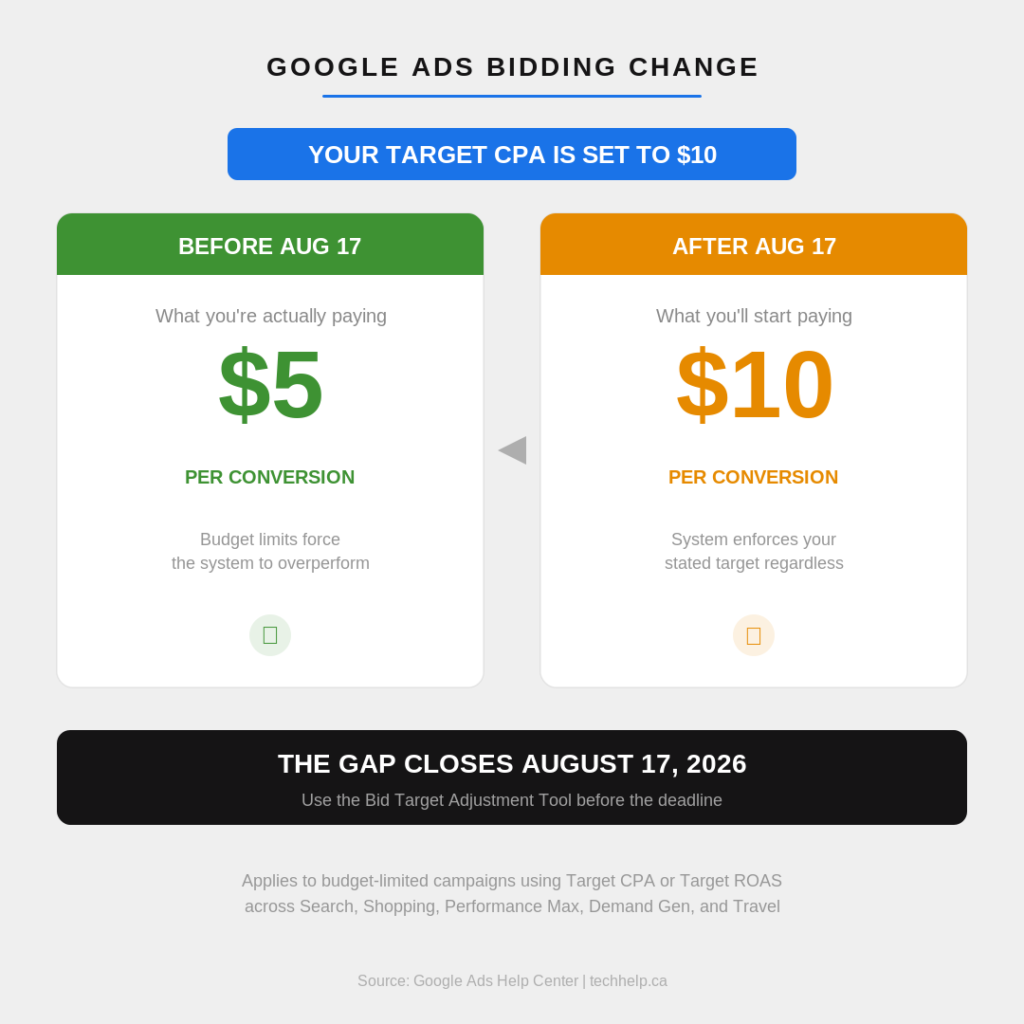
Google’s own example is blunt: if a campaign has a $10 Target CPA but has recently been achieving a $5 actual CPA, it will deliver closer to a $10 CPA starting August 17 unless you update the target.
For small businesses, that can feel like a cost increase even though Google isn’t directly raising your budget or changing the auction. The platform is making the campaign follow the number you already gave it. If that number is old, too loose, or forgotten, the cost of a lead or sale could jump before anyone notices.
Google says the Bid Target Adjustment Tool becomes available in Google Ads on July 6. Advertisers have roughly six weeks to review affected campaigns before the August 17 change starts.
What’s changing on August 17
The change applies to campaigns that are marked “Limited by budget” and use a target-based bidding strategy, such as Target CPA or Target ROAS. For Demand Gen campaigns, Target CPC is also affected.
Under the current behavior, a budget limit can make the bidding system more selective. A campaign may have a $10 Target CPA, but because the daily budget is tight, it only enters enough auctions to deliver conversions at $5 or $6. The campaign looks efficient, but the stated target and actual performance no longer match.
After August 17, Google says these campaigns will perform more consistently toward the target you entered, including when you adjust budgets. Google’s framing is predictability: advertisers should be able to raise budgets and know what performance target the system is chasing.
That may help accounts scale with fewer surprises. It also removes a quiet efficiency many advertisers had been benefiting from.
Search Engine Roundtable summarized the concern plainly, saying the update could end up costing advertisers more money. PPC Land went further, warning that some CPAs could double under the new behavior. Both are reacting to the same practical issue: if your campaign has been getting $5 conversions under a $10 target, Google is telling you it may move toward $10.
Google isn’t forcing you to pay more than your daily or monthly budget allows. But if the target in your account is higher than what you’ve actually been paying, the system can spend the same budget less efficiently.
Which campaigns are affected
Google says the update applies to Search, Shopping, Performance Max, Demand Gen, and Travel campaigns using affected target-based bid strategies while limited by budget.
App campaigns, Video reach campaigns, and Video view campaigns are excluded. Hotel and Display campaigns already use the newer behavior, so August 17 doesn’t change them.
Campaigns that aren’t limited by budget are also unaffected. If a campaign already has enough budget to run freely, Google says it already scales in line with the stated target.
Portfolio bidding and shared budgets are included. In those cases, Google says adjustments must happen at the portfolio or shared budget level. For shared budgets, the effect is distributed across the campaigns in that group.
Performance Max and Demand Gen accounts deserve extra attention because they run across multiple channels. Google says advertisers may see changes in how traffic is distributed across placements after the update, not only a change in overall cost per conversion.
Campaigns using campaign total budgets are not affected. Those campaigns already work from a fixed amount over a defined date range unless a target constraint gets in the way.
How to check your account before the deadline
Start in Google Ads by filtering for campaigns with a “Limited by budget” status. Then narrow the list to campaigns using Target CPA, Target ROAS, or Demand Gen campaigns using Target CPC.
For each affected campaign, compare the stated target to recent actual performance. If the Target CPA is $15 and the campaign has been averaging $8, the account has exposure. After August 17, Google may optimize closer to $15 unless the target is changed.
The same logic applies to ROAS. If a campaign is set to a 200% Target ROAS but has been delivering 400%, the campaign may drift toward the lower target after the update. Revenue may hold if volume changes, but the campaign may stop protecting the efficiency you’ve been seeing.
Google’s Bid Target Adjustment Tool is built for this review. Google says accounts with campaigns that were limited by budget at any point in the past 12 months, and that use an affected strategy, should receive a notification pointing to the tool starting July 6.
The tool shows historical performance and lets advertisers update targets quickly.
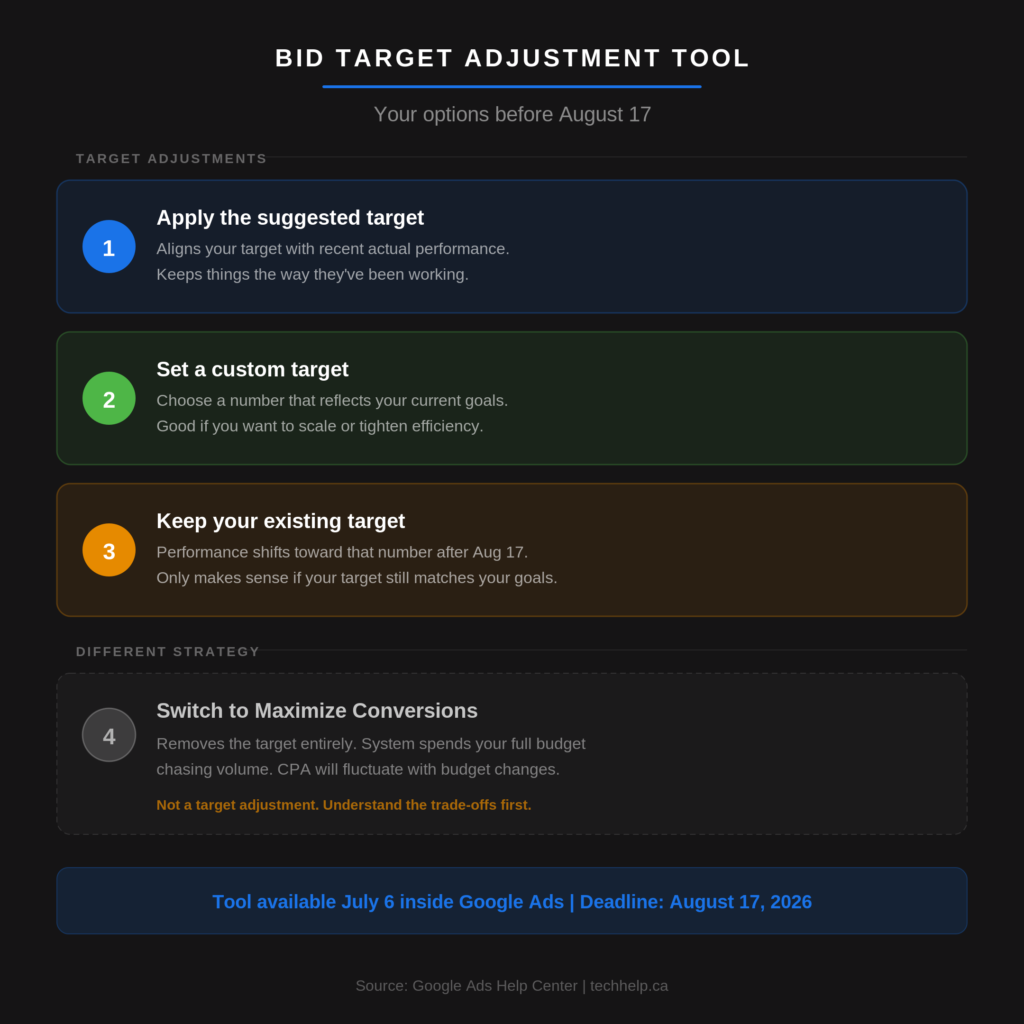
If you want to keep recent performance, Google says you can apply a suggested target based on the performance shown in the tool. You can also set a custom target based on current business goals.
Leaving the target unchanged is also an option, but it needs to be intentional. If the number in the account genuinely reflects what you’re willing to pay for a conversion or the return you’re willing to accept, no change may be needed. If the number is stale, August 17 is the deadline forcing the issue.
Don’t react with the wrong fix
Google’s FAQ warns advertisers not to apply data exclusions or new bid limits solely because of this update. Google says those moves can create additional performance fluctuations.
The safer first step is target cleanup. Match targets to your actual business economics, then give campaigns enough time to stabilize. Google recommends waiting one to two conversion cycles before evaluating performance after target changes.
Forecasting also needs caution. Google says Performance Planner and other planning tools will be updated for the new behavior, but forecasts may be less accurate from August 17 to August 31 during the transition period.
The bigger lesson is that Google Ads targets can’t be treated like one-time settings. A target CPA or target ROAS is a business decision. If it sits unchanged for months while campaign economics shift, the automation eventually starts optimizing toward a number that no longer belongs there.
If an agency manages your Google Ads
Many small business owners don’t manage their own campaigns day to day. They hand the account to an agency, freelancer, or consultant and look at results later.
This update is exactly the kind of change that can slip through that arrangement.
Google won’t automatically update targets or budgets. The notification may appear in the Google Ads account before it reaches the business owner. If your agency has multiple accounts to manage, yours may not be reviewed immediately unless someone has a process for it.
Ask direct questions before August 17: do any campaigns show a “Limited by budget” status? What are the stated Target CPA or Target ROAS settings? How do those compare with the actual cost per conversion or return on ad spend over the past 30 to 90 days? Has the Bid Target Adjustment Tool been reviewed? Which targets will be updated before the deadline?
A good ad manager should have clear answers. This is the second major Google Ads shift this summer, after Google’s updated AI ad terms placed more responsibility on advertisers starting July 1. Accounts running on autopilot are becoming riskier.
Two other Google Ads bidding updates arrived with it
Google’s June 15 update included more than the August 17 target-based bidding change.
Smart Bidding Exploration is expanding beyond Search. Search Engine Land reported that the feature is now available for Performance Max campaigns without product feeds, with a beta for Shopping and Performance Max campaigns that do use product feeds. Google says campaigns using Smart Bidding Exploration see an average 18% increase in unique converting search query categories and 19% more conversions, though results vary by advertiser.
Promotion Mode is also entering beta for Search and Performance Max. It lets advertisers schedule temporary changes to ROAS tolerance and add daily budget during defined peak windows, such as product launches, seasonal sales, or flash promotions. PPC Land reported that Google’s Ginny Marvin said the setup uses a start and end date, with a time span of 3 to 14 days. PPC Land also reported that the feature is different from seasonality adjustments because it changes ROAS tolerance and budget, not only expected conversion-rate signals.
Those features may be useful, but they are optional. The August 17 change is not. If your campaign is eligible and limited by budget, the new behavior is coming whether you use the new tool or ignore it.
Six weeks is less time than it sounds
The deadline is close enough to act now.
Check for budget-limited campaigns. Compare stated targets with recent performance. Use Google’s tool when it appears. If someone else manages your ads, ask for the review in writing.
The businesses that prepare have a better chance of keeping their cost per conversion under control. The ones that wait may discover, too late, that Google is simply doing what they told it to do.
Frequently Asked Questions
Will my Google Ads budget increase because of this change?
No. Your daily and monthly budget limits stay exactly where you set them. What changes is how the bidding system optimizes within that budget. If your campaign has been delivering conversions well below your Target CPA, it will start performing closer to the target you entered. Your costs per conversion may rise, but your overall budget won’t increase automatically.
What happens if I don’t do anything before August 17?
Your budget-limited campaigns using Target CPA or Target ROAS will start optimizing toward the target number currently in your account. Demand Gen campaigns using Target CPC can also be affected. If that number was set months or years ago and your actual performance has been much better than the target, you’ll likely see your cost per conversion increase toward the stated target. Google won’t adjust your targets for you.
Do I need to take action if my campaigns aren’t budget-limited?
No. This change only affects campaigns with a “Limited by budget” status while using Target CPA, Target ROAS, or Demand Gen campaigns using Target CPC. If your budget gives the algorithm enough room to operate without hitting the daily limit, you shouldn’t see a behavior change from this update.
Should I switch to Maximize Conversions instead of Target CPA?
It depends on your goals. Maximize Conversions removes the target constraint entirely and optimizes to get as many conversions as possible within your budget. That can work well if you have a fixed budget and want maximum volume, but your cost per conversion will fluctuate more when you adjust budgets. If predictable cost per conversion matters to your business, updating your Target CPA to match your actual recent performance is usually the better path.
How do I find out if my campaigns are affected?
Log into your Google Ads account and filter for campaigns with a “Limited by budget” status that use Target CPA or Target ROAS bidding. Also check Demand Gen campaigns using Target CPC. If any of those campaigns were budget-limited at any point over the past 12 months, you should also see a notification directing you to Google’s Bid Target Adjustment Tool, which Google scheduled to become available on July 6, 2026.

I can suggest related Tech Help Canada articles based on the topic you’re reading now.

Tech Help Canada Staff researches, writes, and reviews practical content for business owners and professionals. Our coverage spans business, marketing, SEO, technology, and the tools and systems people use to grow and operate online. We focus on clear, useful information backed by research, hands-on experience, and editorial review. Learn more about our team and editorial standards. Need help with something? Contact Us