

You can still make money writing, but the market has split.
Generic content is under pressure. Upwork’s 2025 platform research found continued AI substitution in lower-value content writing and sales copywriting work. At the same time, AI-related freelance work on the platform paid more than a 40% hourly premium compared with non-AI work.
That tells you where the money moved. Businesses still pay writers, but they pay more for judgment, subject-matter knowledge, research, strategy, interviews, technical accuracy, and copy that helps revenue. They pay less for writing that looks like it could’ve come from any freelancer, any template, or any AI tool.
If you want to earn money by writing in 2026, don’t start with “I like writing.” Start with the business model.
Writers usually earn through one of three models: selling writing services, building writing assets, or doing platform-based writing work. The fastest money usually comes from services. The highest long-term upside often comes from assets. Platform work can fill the gaps, but it’s rarely the whole plan.
Where the money is now
If you need money quickly, start with freelance content writing, copywriting, or technical writing. You’re selling a skill directly to a client or employer, so the feedback loop is faster.
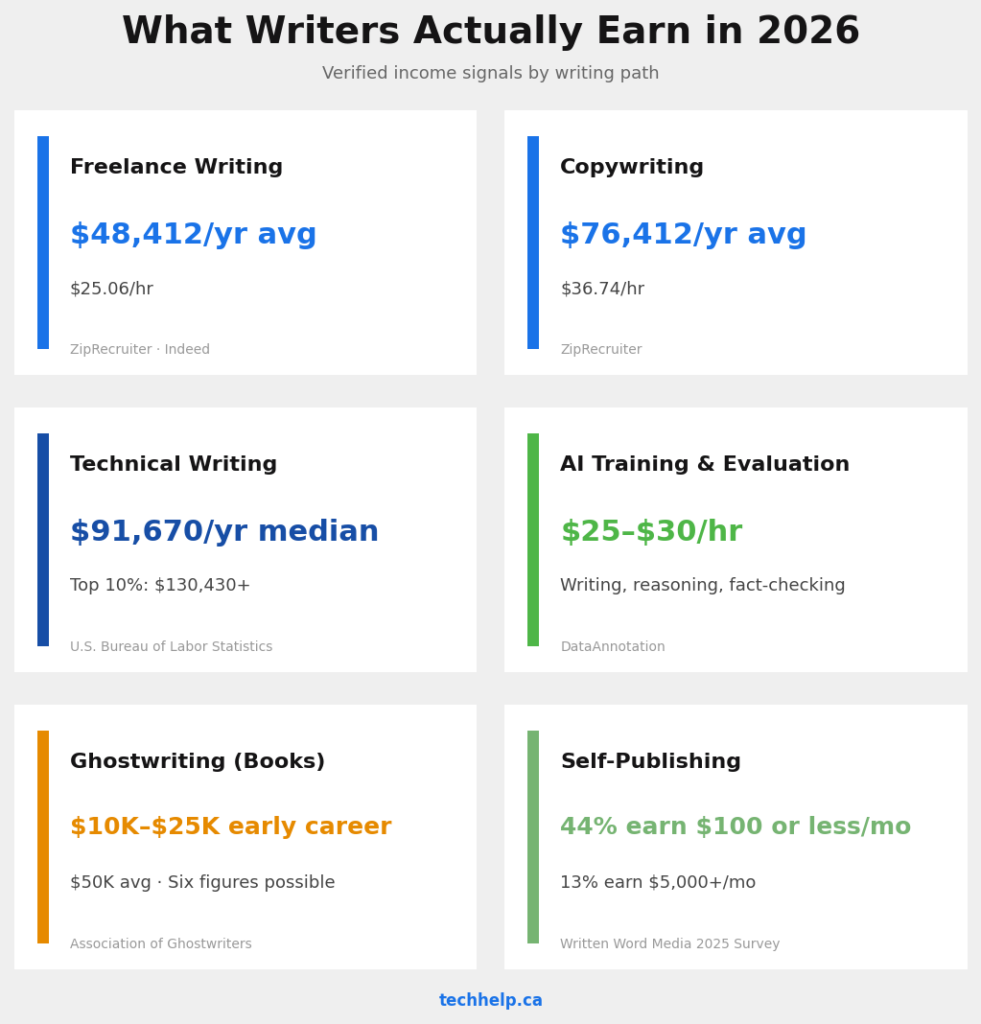
If you have a specific professional background, technical writing or niche content writing can give you a stronger income floor than general blogging. The U.S. Bureau of Labor Statistics reported a median annual wage of $91,670 for technical writers in May 2024, compared with $72,270 for writers and authors overall.
If you want long-term leverage, build assets: books, newsletters, blogs, guides, or owned audiences. Those can pay beyond the first assignment, but they usually take longer and the income distribution is uneven.
If you want flexible side income, AI training and evaluation work can be useful. DataAnnotation, for example, advertises writing, reasoning, fact-checking, and communication work starting at $25 to $30 per hour. The catch is availability. Good hourly rates don’t help if there aren’t enough tasks.
Here’s the practical comparison.
| Writing path | Fastest realistic use | Income signal | Main risk |
|---|---|---|---|
| Freelance content writing | Getting paid to write articles, guides, case studies, and website content | All Things Freelance Writing found 15.7% of surveyed freelance writers earned over $10,000 per month, while 65.9% earned $5,000 or less | Low positioning, weak niche, inconsistent client pipeline |
| Copywriting | Writing sales pages, emails, ads, landing pages, and product copy | ZipRecruiter listed average U.S. copywriter pay at $76,412 as of July 22, 2026 | Harder proof requirement because clients expect revenue impact |
| Ghostwriting | Writing under someone else’s name for executives, founders, authors, and thought leaders | Association of Ghostwriters says experienced book ghostwriters often cluster around $50,000 per project, with six-figure projects becoming more common | Relationship-heavy work, voice matching, long sales cycles |
| Technical writing | Writing documentation, manuals, API guides, and technical support content | BLS reported a $91,670 median annual wage for technical writers | Requires domain knowledge and comfort with complex material |
| AI training and evaluation | Rating, editing, fact-checking, and improving AI outputs | DataAnnotation advertises many generalist projects starting at $25 to $30 per hour | Task availability and qualification tests |
| Self-publishing | Selling books, ebooks, and series | Written Word Media’s 2025 indie author survey found 44% earned $100 or less per month, while 13% earned over $5,000 per month | Slow catalog building and marketing burden |
| Newsletters and blogs | Building an audience you own | Substack shows 1,000 subscribers paying $5 per month can produce $60,000 per year before fees | Audience growth takes time, and early revenue is often low |
Those numbers don’t point to one perfect path. They point to the same lesson: writing income rises when the writing solves a valuable problem.
Choose the income model first
The phrase “make money writing” hides several different businesses.
Freelance writing means you get paid by clients to write something they need. That could be blog articles, reports, newsletters, website pages, case studies, white papers, email sequences, scripts, or thought leadership content.
Copywriting means you write to influence action. You may be selling a product, getting someone to click, improving signups, increasing replies, or helping a campaign convert. Copywriting usually pays more when you can connect your work to measurable outcomes.
Ghostwriting means the client gets the byline or public credit. You may write LinkedIn posts, speeches, articles, newsletters, books, or executive essays in someone else’s voice.
Technical writing means you make complex information usable. You may write product documentation, software guides, API docs, operating procedures, user manuals, or internal knowledge-base content.
Publishing means you write assets you own. Books, newsletters, and blogs can earn through sales, subscriptions, affiliate income, ads, sponsorships, and products.
AI evaluation means you use writing and reasoning skills to improve model outputs. You’re not building an audience or client base, but you can earn for high-quality judgment.
The mistake is treating all of these as the same career. They aren’t. They use overlapping skills, but the economics are different.
Freelance writing is still the fastest entry point
Freelance writing is usually the easiest way to get paid to write because the offer is simple: a business needs content writing services, and you provide them.
You don’t need a publishing deal. You don’t need a huge audience. You don’t need to wait for a platform to approve monetization. You need samples, a clear niche, and a way to reach buyers.
It’s also one of the more practical work-from-home jobs because the deliverable is digital and most client communication can happen online.
The pay range is wide because “freelance writer” includes everyone from part-time content marketplace writers to specialists writing for finance, healthcare, SaaS, legal, and B2B companies.
ZipRecruiter listed average U.S. freelance writer pay at $48,412 as of July 22, 2026. Indeed listed freelance writer pay at $25.06 per hour in June 2026, based on 200 salary entries from job postings over the previous 36 months. Those salary-site averages are useful, but they don’t capture the full freelance spread.
Writer survey data shows the split more clearly. All Things Freelance Writing surveyed 346 freelance writers and found that 65.9% earned $5,000 or less per month, while 15.7% earned $10,001 or more per month. The same survey found that 53.3% of freelance writers used fixed project pricing, more than per-word or hourly pricing.
That’s the direction beginners should notice. Per-word pricing can be useful early, but it often caps income because it rewards volume instead of value. A $750 case study, $1,200 white paper, or $600 buyer-intent article can be more profitable than chasing five-cent-per-word blog posts.
If you want to start with zero experience, don’t pitch yourself as a general writer. Pick one market you can understand faster than the average person. That might be home services, accounting, HR, cybersecurity, real estate, ecommerce, fitness, health, fintech, construction, education, or software.
Then create three samples in that niche. They don’t need to be published. They need to prove you can explain the subject clearly and write for the buyer’s audience.
Your first goal isn’t to become famous. It’s to get proof that someone will pay you.
Copywriting pays more when you can prove impact
Copywriting is writing with a measurable job.
A blog article may educate. A landing page has to turn visitors into leads. An email sequence has to get replies, clicks, sales, or renewals. A product page has to reduce hesitation and help the buyer choose.
That revenue connection is why copywriting can pay more than general content writing. ZipRecruiter listed average U.S. copywriter pay at $76,412 as of July 22, 2026, or about $36.74 per hour. Strong freelance copywriters can charge by project because the work is tied to outcomes, not word count.
The best way in is to start with small, measurable assets.
Rewrite a homepage hero section. Improve product descriptions. Write a five-email nurture sequence. Create ad variations. Write sales page sections. Improve onboarding emails. These projects are easier to scope than a full brand campaign, and they help you build before-and-after proof.
If copywriting is your path, learn the basics of hooks, offers, objections, proof, and calls to action. Our guide to copywriting hooks can help you see how different openings create curiosity, urgency, or desire without sounding forced.
The trap is calling yourself a copywriter before you understand the customer. Great copy rarely starts with wordplay. It starts with knowing what the buyer wants, what they fear, what they misunderstand, and what would make the decision feel safer.
Ghostwriting is premium because trust is the product
Ghostwriting can be one of the highest-paying writing paths because clients aren’t only buying words. They’re buying discretion, voice, positioning, structure, and the ability to turn messy thinking into polished public communication.
Executives, founders, consultants, creators, and professionals often have ideas but little time. They need LinkedIn posts, speeches, newsletters, op-eds, articles, books, and internal messages. A good ghostwriter makes them sound like the best version of themselves.
Book ghostwriting sits at the premium end. The Association of Ghostwriters says early-career book ghostwriters often charge $10,000 to $25,000, while many experienced ghostwriters cluster around $50,000 per book project. Six-figure projects are becoming more common for writers with strong track records, agent referrals, or access to high-profile clients.
You don’t need to begin with books. Most writers should start with shorter executive content: LinkedIn posts, founder essays, newsletters, speeches, or long-form articles. These projects build trust faster and can turn into retainers.
The core skill is voice. You need to interview well, listen for phrasing, understand the client’s point of view, and write in a way that sounds like them instead of you.
AI has made that more valuable, not less. The U.S. copyright conversation around AI-generated work still centers on human authorship and creative control. Clients who care about authority, originality, and reputation have a strong reason to work with human writers who can use tools carefully without handing the thinking to the machine.
Technical writing has the strongest income floor
Technical writing is rarely the flashiest path, but it’s one of the most reliable.
Businesses need people who can turn complex information into instructions that customers, employees, developers, or operators can follow. That work shows up in software, healthcare, engineering, manufacturing, cybersecurity, finance, insurance, government, and internal operations.
BLS reported a median annual wage of $91,670 for technical writers in May 2024, with the top 10% earning more than $130,430. It also projected about 4,500 openings per year from 2024 to 2034.
The reason the floor is high is simple: technical writing isn’t only writing. It’s understanding systems.
If you’ve worked in software, healthcare, operations, finance, engineering, IT, legal, construction, or a regulated industry, you may already have the domain knowledge that makes technical writing valuable. You can build the writing side by practicing documentation, tutorials, standard operating procedures, and support content.
Technical writing is a strong choice if you like clarity more than persuasion. Success means making the next step unmistakable.
AI training work is useful, but don’t mistake it for a business
AI companies need human feedback. Models still make factual errors, miss instructions, contradict themselves, and produce weak reasoning. Writers can help test, rate, rewrite, and improve those outputs.
This has created a new category of paid writing-adjacent work. DataAnnotation advertises generalist projects involving writing, reasoning, fact-checking, problem solving, and communication, with many rates starting at $25 to $30 per hour. Upwork’s research also shows that freelancers doing AI-related work earn a premium compared with non-AI work on the platform.
This can be a good side income stream, especially if you’re strong at logic, clarity, editing, research, and evaluation. It also helps you understand how AI systems fail, which can make you a better writer and editor.
But treat it carefully. Platform work depends on qualification tests, project supply, geography, task availability, and changing rules. You don’t own the client relationship. You don’t own the audience. You don’t own the workflow.
Use it to earn, learn, and fill gaps. Don’t make it your only plan.
Self-publishing works, but the average is misleading
Self-publishing is attractive because you own the asset. A book can sell while you’re working on something else. A series can compound. A small catalog can become a business.
The income curve is uneven.
Written Word Media’s 2025 indie author survey found that 44% of respondents earned $100 or less per month from their writing, while 13% earned more than $5,000 per month and 8% earned more than $10,000 per month. The survey also notes that its audience skews toward serious indie authors, which means the broader author population may earn less.
Self-publishing is a business, not only a writing project.
You need genre fit, cover design, editing, pricing, reviews, distribution, reader expectations, email list building, and usually more than one book. Authors with series, repeat readers, and a backlist have a better chance than someone who uploads one book and waits.
If you want to write stories for money, self-publishing can be a path. Short stories, serial fiction, genre fiction, and niche nonfiction can all work. But the early revenue is often small, so it’s usually smarter to pair publishing with service income until the catalog proves itself.
Newsletters and blogs build leverage slowly
Newsletters and blogs aren’t the fastest ways to make money writing, but they can become powerful assets.
A newsletter gives you direct access to readers. Substack’s own paid-newsletter page gives a simple model: 1,000 subscribers paying $5 per month equals $60,000 per year before fees. That math is real, but getting 1,000 people to pay is the hard part.
Blogs can earn through affiliate marketing, ads, sponsorships, services, digital products, and lead generation. But blog income usually takes time because you need traffic, trust, and a monetization model.
This is where people confuse two different goals.
If your goal is to get paid to write, client work is faster. If your goal is to build a writing asset, newsletters and blogs make sense. Both are valid, but they don’t solve the same problem on the same timeline.
If you choose the newsletter route, learn how to capture and keep readers. Our guide on how to build an email list can help once you’re ready to turn casual readers into people you can reach again.
Sites that pay you to write can help, but they’re not the ceiling
Many beginners search for sites that pay you to write because it feels easier than pitching clients.
That can work. Writing platforms, job boards, publications, and content marketplaces can help you get early clips and learn what editors or buyers expect. They can also remove some friction because the buyer is already looking for writers.
The downside is competition. When hundreds of writers can see the same opportunity, rates often compress. You may also have less control over scope, timelines, revisions, and client relationships.
Use writing sites as a bridge, not a home. Your long-term goal is to build direct relationships with clients, editors, companies, or readers who value your specific expertise.
That shift changes everything. Instead of being one more writer applying to a post, you become the person who writes healthcare case studies, cybersecurity explainers, founder LinkedIn content, technical docs for SaaS companies, or ecommerce email campaigns.
A specific offer beats being generally available.
How to start making money writing in 90 days
The first 90 days shouldn’t be complicated. You need a niche, samples, outreach, feedback, and a small offer.
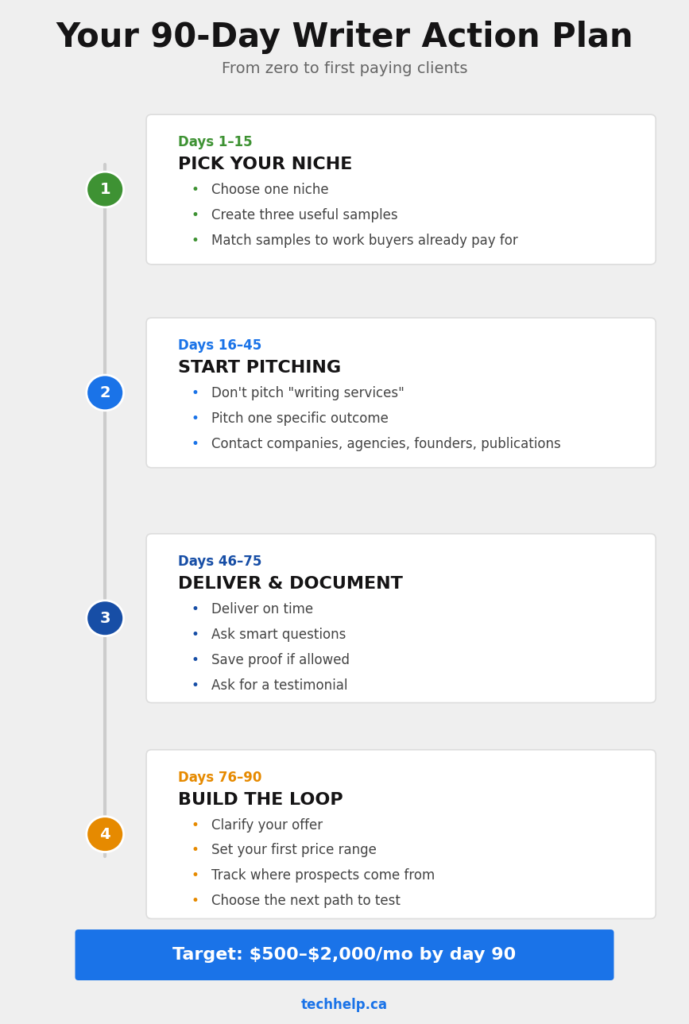
Days 1 to 15: Pick a market and create proof
Choose one market where you have some advantage. It can come from work experience, education, personal interest, location, or a subject you’re willing to study deeply.
Then create three samples. Make them useful, not decorative. A sample article, a short case study, a landing page rewrite, a technical tutorial, or a newsletter issue can all work.
If you want freelance content writing, write the type of content your ideal client already buys. If you want copywriting, rewrite a page or email and explain your reasoning. If you want technical writing, create a tutorial or documentation sample that shows sequence, accuracy, and clarity.
Days 16 to 45: Pitch one focused offer
Don’t pitch “writing services.” Pitch a specific outcome.
For example, “I write founder-led LinkedIn posts for B2B consultants,” “I write case studies for managed IT providers,” or “I turn technical product features into customer-facing help articles.”
Send direct pitches to companies, agencies, consultants, founders, or publications that already publish the kind of content you create. Keep the message short. Show the sample. Explain the fit. Ask if they need help with that specific content type.
You can also apply through job boards, but don’t rely only on them. Direct outreach is where better client relationships often start.
Days 46 to 75: Deliver, document, and raise the standard
Your first paid assignment is more than income. It’s proof.
Deliver on time. Ask smart questions. Make revisions easy. Save the before-and-after if the client allows it. Ask for a testimonial once the work is accepted.
Then review what happened. Which pitch got a reply? Which sample opened the door? Which part of the project took longer than expected? What would make the next project easier to sell and deliver?
This is where you start turning writing into a business.
Days 76 to 90: Build a repeatable pipeline
By day 90, your goal isn’t perfection. It’s a repeatable loop.
You should know who you write for, what offer you’re selling, what your first price range looks like, and where your next prospects come from. You should also know which path you’re testing next: better clients, higher-value copywriting, technical writing, ghostwriting, AI evaluation work, or a small owned asset.
A realistic 90-day target is $500 to $2,000 per month if you’re consistent, focused, and willing to pitch. Some writers move faster. Many move slower. The biggest variable isn’t talent. It’s consistent outreach plus a clear offer.
How to price your writing without trapping yourself
Most beginners underprice because they think clients are buying words.
Clients are usually buying something else: time saved, leads, clarity, trust, search visibility, sales enablement, authority, documentation, or customer education. Once you understand that, pricing becomes easier.
Hourly pricing is simple when the scope is unclear. Per-word pricing can work for straightforward articles, but it can punish tight editing. Project pricing is often better once you understand the work because the client pays for the deliverable, not every minute or word.
Retainers work when the client needs writing every month. A monthly package for four articles, weekly LinkedIn posts, two case studies, or an email newsletter can smooth your income and reduce constant pitching.
Start with prices you can confidently say out loud. Then raise them as your proof improves.
What AI changed about writing work
AI didn’t end paid writing. It removed some of the easiest excuses clients had for paying low-value writers.
If the assignment is “write 1,000 words about a topic everyone has covered,” AI can produce something passable. That kind of work is under pressure.
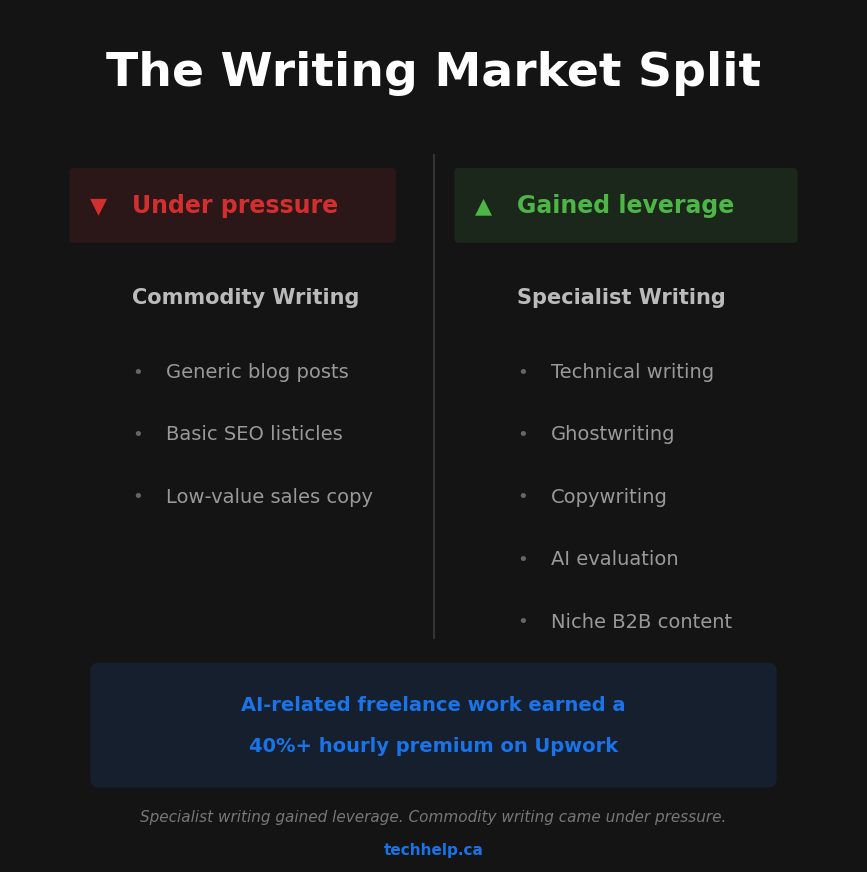
If the assignment requires interviewing customers, spotting weak positioning, checking facts, understanding a complex market, writing in a founder’s voice, explaining a technical product, or turning a messy idea into something useful, human writers still have leverage.
The writers doing well aren’t pretending AI doesn’t exist. They’re using it for research support, outlining, brainstorming, transcription, editing, and analysis while keeping human judgment in charge.
Publishers Weekly reported on a Gotham Ghostwriters and Bernoff.com study of 1,481 working writers that found 61% used AI tools and reported an average productivity increase of 31%, while only 7% had published AI-generated text.
That’s the healthy model. Use tools. Keep authorship, judgment, and accountability human.
The best writing path depends on your situation
If you need money this month, start with services. Freelance content writing, copywriting, editing, and technical writing give you the fastest path to paid work.
If you already have domain expertise, technical writing or specialist content writing may be the smartest move. A nurse, software developer, accountant, marketer, lawyer, contractor, or HR professional can often earn more by writing from that knowledge than by competing as a generalist.
If you want higher project fees, move toward copywriting, case studies, white papers, ghostwriting, and strategy-heavy content. These projects pay for thinking, not typing.
If you want leverage, build an owned asset while service work pays the bills. A newsletter, blog, book series, or niche resource can become valuable later, but it usually won’t replace income quickly.
If you want flexible side work, test AI evaluation platforms, but keep building something you control.
You don’t have to choose forever. Many strong writing businesses combine service income, audience building, and owned assets over time.
Start with the highest-probability move
The best way to make money writing in 2026 isn’t to chase every option at once.
Start with the path most likely to pay you first.
For most beginners, that’s a focused freelance writing offer in a market they can understand. For people with technical backgrounds, it’s technical writing. For people with strong persuasion skills, it’s copywriting. For people with access to founders or executives, it’s ghostwriting.
Pick one. Create proof. Pitch consistently. Deliver well. Raise your rates as your proof gets stronger.
Writing still pays. But the market now rewards writers who bring more than sentences. It rewards people who understand a reader, a problem, a market, and the decision the writing is supposed to help someone make.
Frequently Asked Questions
Can you still make money writing in 2026?
Yes, but the best opportunities have shifted toward specialized writing, copywriting, ghostwriting, technical writing, and AI-assisted workflows. Generic low-value content is under more pressure, so writers need a clear niche, useful samples, and a specific offer.
What type of writing pays the most?
Technical writing, ghostwriting, conversion-focused copywriting, white papers, case studies, and specialized B2B content tend to have stronger earning potential than general blog writing. The highest rates usually go to writers who combine writing skill with industry knowledge, strategy, research, or revenue impact.
How do beginners get paid to write?
Start by choosing one niche, creating three strong samples, and pitching a focused writing offer to companies, agencies, publications, or founders in that market. Beginners can also use job boards and writing platforms for early clips, but direct outreach usually creates better long-term client relationships.
Do you need a degree to make money writing?
No, not for most freelance writing paths. Clients usually care more about samples, reliability, subject knowledge, and whether your writing solves a business problem. Some employed roles, technical writing jobs, and journalism positions may prefer or require a degree, but freelance clients often hire based on proof.
Can you make money writing from home?
Yes. Freelance writing, copywriting, ghostwriting, technical documentation, newsletter writing, self-publishing, and AI evaluation work can all be done remotely. The bigger challenge isn’t location. It’s finding a specific market, building proof, and pitching consistently enough to create income.
Is AI replacing freelance writers?
AI is replacing some low-value writing tasks, especially generic content that doesn’t require much expertise or original thinking. It’s also creating new work for writers who can use AI well, edit critically, check facts, interview people, explain complex topics, and add judgment that tools can’t provide on their own.
References
- https://www.upwork.com/research/ai-impact-work-categories
- https://www.ziprecruiter.com/Salaries/Freelance-Writer-Salary
- https://www.indeed.com/career/freelance-writer/salaries
- https://allthingsfreelancewriting.com/blog/how-much-do-writers-make/
- https://www.ziprecruiter.com/Salaries/Copywriter-Salary
- https://associationofghostwriters.org/the-2025-ghostwriting-industry-report/
- https://www.bls.gov/ooh/media-and-communication/technical-writers.htm
- https://www.bls.gov/ooh/media-and-communication/writers-and-authors.htm
- https://www.writtenwordmedia.com/2025-indie-author-survey-results-insights-into-self-publishing-for-authors/amp/
- https://substack.com/going-paid
- https://dataannotation.tech/generalist
- https://www.publishersweekly.com/pw/by-topic/digital/copyright/article/99019-new-report-examines-writers-attitudes-toward-ai.html
- https://www.congress.gov/crs-product/LSB10922

I can suggest related Tech Help Canada articles based on the topic you’re reading now.

Tech Help Canada Staff researches, writes, and reviews practical content for business owners and professionals. Our coverage spans business, marketing, SEO, technology, and the tools and systems people use to grow and operate online. We focus on clear, useful information backed by research, hands-on experience, and editorial review. Learn more about our team and editorial standards. Need help with something? Contact Us