You want to publish your expertise on someone else’s site. Maybe you’re after backlinks, brand exposure, referral traffic, or access to a new audience. Whatever the reason, you’ve probably noticed that most guest posting advice boils down to the same thin formula: find a blog, send an email, get a link.
That advice is incomplete. In 2026, it’s also a good way to get ignored.
Editors see too many lazy pitches. Many publications have tightened their contributor rules because low-effort outreach, link-first submissions, and AI-generated drafts have made it harder to spot contributors who know the topic from people who are just chasing placements.
The people who still get published consistently aren’t using a secret formula. They’re doing the work that weaker campaigns skip: choosing better sites, sending pitches that show real familiarity with the publication, writing content that meets editorial standards, and building relationships that can turn one accepted article into a useful long-term connection.
This guide walks through the process from prospecting to promotion to measurement. If you’re looking for a list of sites that accept anything, this isn’t that. If you want to guest post in a way that earns placements on sites people actually read, start here.
What guest posting is
Guest posting is writing and publishing an article on someone else’s website. In exchange for contributing useful content, you may receive a byline, an author bio, and a relevant link back to your own site.
The benefits can go beyond the backlink. A strong guest post can introduce your name to a new audience, send qualified referral traffic, support credibility, and build relationships with editors, publishers, creators, or potential partners. If you’re still building your SEO foundation, our guide on what SEO is and how it works covers the basics.
Guest posting is not a shortcut for getting commercial links onto high-authority domains. It’s not a link exchange. It’s not article spinning across dozens of weak blogs. And it’s not a 600-word placeholder written so you can tuck a product link into the middle.
Done well, guest posting sits between link building, content marketing, and digital PR. If you want the broader picture of how it fits with other backlink tactics, our link building strategies guide covers the larger system. This article focuses on guest posting as one specific tactic.
Does guest posting still work?
Yes, but the bar is higher than it used to be.
Guest posting still works when it’s treated like publishing, not spam. The weak version is mass-producing thin articles, forcing exact-match anchors, and placing content on sites with no real audience or editorial standards. The strong version is simple: contribute something useful to a relevant publication, respect its editorial process, and make sure the article deserves to exist even without the link.
Legitimate guest contributions are different from link schemes. The problem is scale without standards. A useful article written by a qualified person, reviewed by an editor, published on a relevant site, and linked naturally is very different from a campaign of thin posts placed across unrelated blogs with exact-match commercial anchors.
Ahrefs has also published a useful reality check: referral traffic from guest articles can be modest. In its survey of 239 guest articles, the average referral traffic was 50 visits. Judge the tactic by the full mix of benefits: relevance, credibility, relationships, referral traffic, brand mentions, and links that make sense in context.
Audience size is a weak proxy for guest posting value. A site with 100 real monthly readers who trust the publication can be more valuable than a site with thousands of low-quality visits and no engagement. What matters is whether the site has a real audience, serves that audience consistently, and publishes work people actually read.
The useful shift is simple: fewer targets, better fit, higher standards, and real editorial value.
How to find sites worth pitching
Before you write a guest post, build a prospect list. Not every site that accepts guest posts is worth your time, and some of the best opportunities don’t advertise that they accept contributors.
Use search operators
Search operators help you find sites that openly accept guest contributions. Combine your niche keyword with phrases like:
your keyword "write for us"
your keyword "contribute"
your keyword "guest post"
your keyword "submission guidelines"
your keyword "become a contributor"
your keyword "editorial guidelines"
You can add filters like -forum -site:reddit.com if your results are full of forums or community threads. Adding the current year can also help surface pages that have been updated recently.
This step gives you volume, not quality. Many results won’t be worth pitching. The filtering work comes next.
Study competitor backlinks
Competitors who rank above you may already have links from publications that accept outside contributions. Use a tool like Ahrefs, Semrush, Moz, or another backlink platform to review their referring domains.
Look for publication pages with bylines, author bios, contributor language, or article formats that suggest outside expertise. You can also filter for anchors, titles, or page text that includes phrases like “guest post,” “contributor,” or “written by.”
Don’t copy your competitor’s link profile blindly. Use it to find publications, then qualify each site on its own.
Follow the author trail
Find people in your niche who guest post often and trace where they’ve published. Search for their name plus terms like “guest post,” “contributor,” or “written by.” You can also check their LinkedIn profile, personal website, or author pages.
This works because active contributors often publish across similar sites. One credible author’s portfolio can reveal several publications that already accept outside expertise in your space.
Watch social and community signals
Editors, newsletter writers, podcast hosts, and community managers sometimes ask for contributors on LinkedIn, X, niche Slack groups, private communities, and industry forums. Search for phrases like “looking for contributors,” “accepting pitches,” “guest post wanted,” or your niche plus “writer.”
Newsletter editors are worth watching too. If someone curates weekly links or expert commentary in your industry, they may accept pitches, quotes, or article ideas. Many of the same principles that apply to influencer outreach apply here: become familiar before you ask for something.
How to qualify a site before you pitch
Finding sites is easy. Deciding which ones deserve your time is where the campaign gets better or worse.
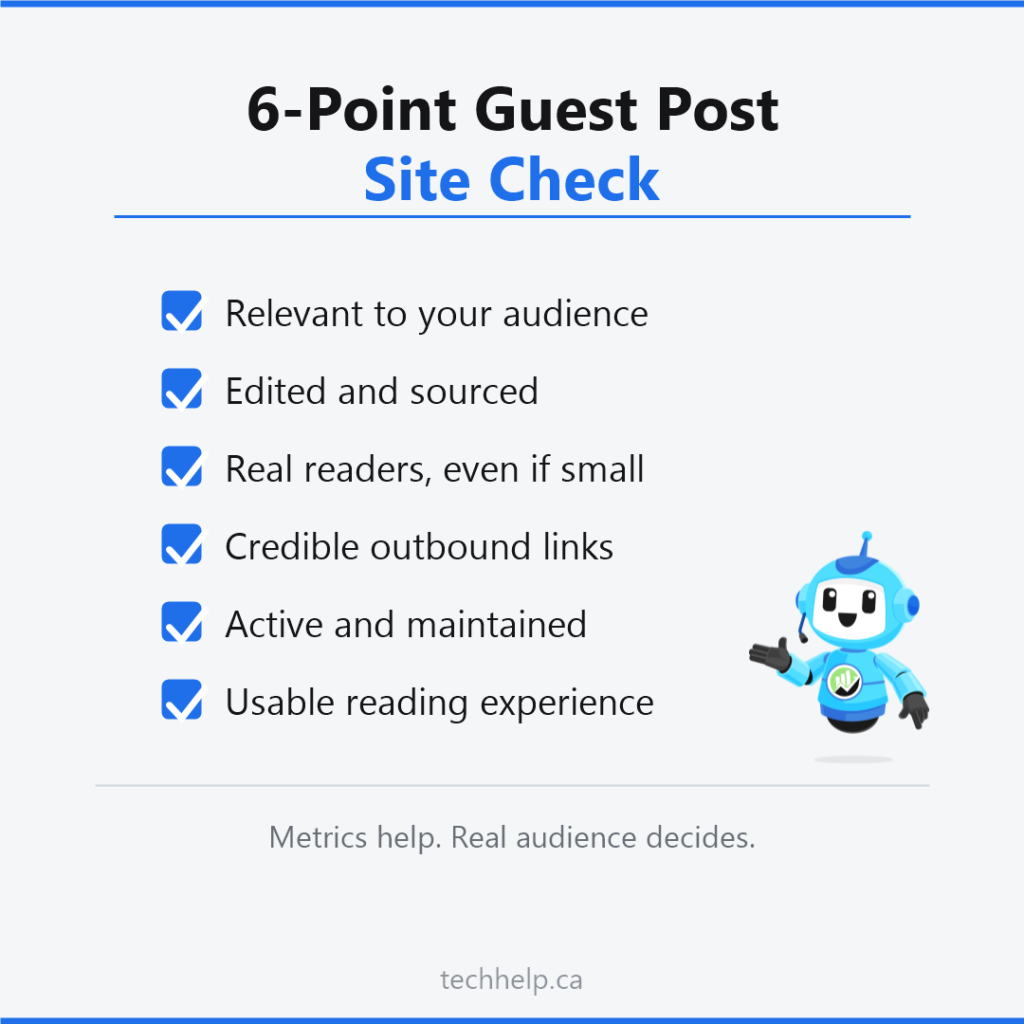
Start with relevance. Does the site serve your topic, audience, or industry? A cybersecurity consultant writing for a security publication makes sense. The same contributor writing for an unrelated lifestyle blog usually doesn’t. Relevance can exist at the site level, the page level, or the audience level, but it has to be there.
Then check editorial standards. Read five or six recent posts. Are they edited? Do they use clear structure, real examples, and proper sourcing? Or are they thin, repetitive, and packed with unrelated outbound links? A site with standards protects your reputation. A site with no standards can damage it.
Look for audience signals. Comments, social engagement, author visibility, newsletter activity, return contributors, and citations from other sites can all suggest real readership. Lack of comments doesn’t automatically mean a site is weak, and a small audience isn’t a problem by itself. A publication with 50 engaged readers in the right niche can be worth more than a larger-looking site where visitors bounce, bots inflate the numbers, or no one seems to care.
Review outbound links. If the publication links to credible resources and relevant sites, that’s a good sign. If it links out to casinos, payday loans, unrelated affiliate pages, and obvious link placements across every article, skip it.
Check freshness. A site that hasn’t published in months may have gone dormant. Even if your post goes live, the audience may not be there anymore.
Check the site experience too. The site doesn’t need to look expensive or polished. Some plain, dated sites have loyal readers. But if the pages are broken, overloaded with spammy ads, hard to read, or clearly neglected, treat that as part of the quality picture.
A simple six-part filter works well: Is it relevant? Is it edited? Does it appear to have real readers? Are the outbound links credible? Is the site still active? Is it maintained enough that readers can use it comfortably? If the answer isn’t yes, move on.
Red flags to avoid
Some sites look like opportunities until you inspect them closely. Be careful with sites that accept everything, publish dozens of unrelated guest posts per week, use generic author names across many articles, or appear to exist mainly to sell access rather than serve readers.
Also watch for sites that hide their editorial process, give no clear quality standards, or publish content that seems copied, spun, or barely edited. If the site exists mostly to transfer links, it isn’t a strong publishing opportunity.
Be skeptical of sites that look good only inside an SEO tool. A high authority score or traffic estimate can be useful context, but it should not decide the placement for you. If the site has no visible readership, no editorial care, no topical fit, and no reason for real people to return, the metric is doing too much work.
How to write a pitch that gets opened
A good pitch is short, specific, and easy to evaluate. It proves you know the publication, offers topics that fit the audience, and gives the editor enough confidence to reply.
Muck Rack’s analysis of 5.2 million PR pitches found that emails sent to one recipient had a much higher open rate than emails sent to large recipient lists. The lesson for guest posting is straightforward: tight targeting beats broad blasting.
Subject lines
Don’t overthink the subject line, but don’t waste it either. The subject should make the idea easy to understand at a glance.
These work better than a generic “Guest Post Request”:
Content idea for [Site Name]: [Topic Angle]
Contributor idea: [Specific Reader Problem]
[Topic] article idea for [Site Name]
Muck Rack’s subject-line analysis found that clear, direct, timely subject lines often outperform clever ones. It also found that many top-performing subject lines were longer than common best-practice advice suggests, so clarity matters more than hitting a strict character count.
Avoid all caps, excessive punctuation, fake urgency, and vague labels like “quick question” when the email is really a pitch.
Email structure
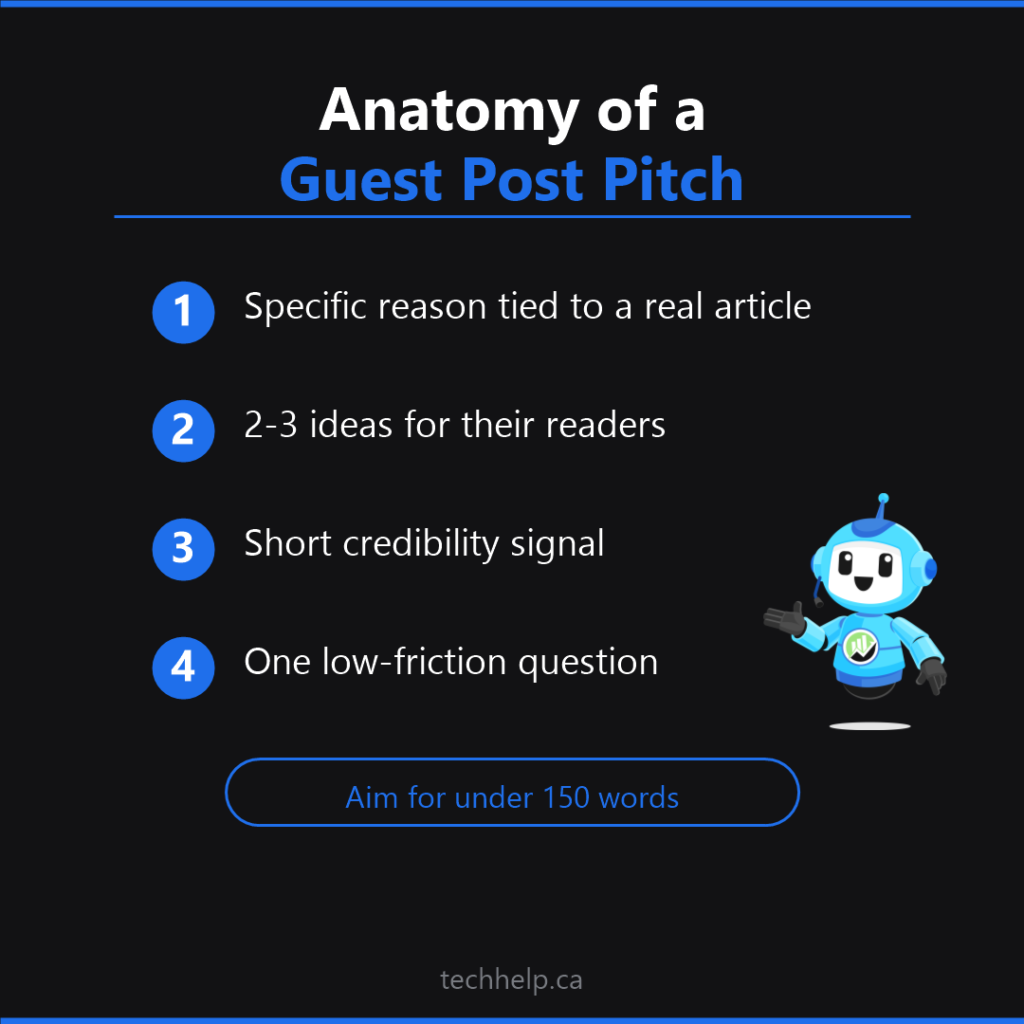
Open with a specific reason you’re contacting that publication. Mention a recent article, recurring column, audience angle, or editorial gap. Don’t write “I love your blog.” Editors have seen that line too many times.
Then offer two or three article ideas. Give each idea a working title or one-sentence angle so the editor can judge fit quickly. A single idea gives them only one way to say no. A small set of relevant ideas gives them options without making the email feel like a menu.
Add one sentence about why you’re qualified to write the piece. Link to your best writing sample or a relevant author page if you have one. Keep the credential short; the ideas should carry most of the weight.
End with a low-friction question: “Would any of these fit your editorial calendar?” That’s enough. Don’t ask for link terms, publication dates, or approval of a full draft in the first email.
Length and follow-ups
Keep the first pitch under 150 words when you can. Editors scan. If the email needs scrolling, it’s probably too long.
One or two polite follow-ups are reasonable. Space them a few business days apart, keep them short, and stop if you don’t hear back. A follow-up is a nudge, not a guilt trip.
A pitch template you can adapt
Subject: Content idea for [Site Name]: [specific topic angle]

Hi [Name],

Your recent article on [specific article] stood out to me, especially the point about [specific observation].

I had a few article ideas that may fit your readers:

1. [Topic idea 1] - one-sentence angle
2. [Topic idea 2] - one-sentence angle
3. [Topic idea 3] - one-sentence angle

I write about [your area of expertise]. Here's a relevant sample: [link]

Would any of these fit your editorial calendar?

[Your name]
Use the template as a starting point, not a script. The pitch should feel written for that editor and that publication.
How to write a guest post that passes editorial review
Getting a yes to your pitch is only half the work. Now you have to deliver an article that fits the publication.
Read at least five recent articles before you draft. Pay attention to tone, structure, formatting, sourcing, and depth. If the site publishes detailed analysis and you submit a generic list post, the idea may still get rejected even if the pitch was accepted.
Follow the submission guidelines exactly. If the publication asks for 1,500 to 2,000 words, don’t send 3,500. If they ask for Google Docs, don’t attach a Word file. If they allow two self-referential links, don’t include four. Guidelines exist because editors need a repeatable workflow.
Write for their audience, not yours. The post should be useful even if your author bio and links disappeared. Share original examples, tested frameworks, lived experience, first-party data, or a useful way to solve the reader’s problem. A guest post that could appear unchanged on any website usually isn’t specific enough.
If you want to sharpen the writing itself, our SEO copywriting tips cover how to write content that searchers can understand, trust, and keep reading.
Handle links carefully
If the publication allows links to your site, use them carefully. Link to a resource that genuinely supports the point you’re making, not to your homepage by default and not to a sales page unless the editor explicitly allows it and the context justifies it.
Anchor text should sound natural. A descriptive anchor like “this study on email subject lines” is usually safer and more useful than an exact-match commercial phrase like “best email marketing software 2026.” Exact-match anchors repeated across many guest posts can look manufactured.
Follow the publication’s link policy. Some sites allow contextual links, some limit links to the author bio, and some qualify certain links based on their editorial standards or sponsorship rules. The main thing is to keep the link useful, relevant, and honest instead of forcing it into the article just because you want the backlink.
Proofread before you submit
Proofreading is part of your reputation. Run spell check, read the article aloud, test every link, verify every claim, and make sure the draft follows the publication’s formatting rules.
Editors remember contributors who make their job easier. A polished draft gets reviewed faster, needs fewer revisions, and makes the next pitch easier to accept.
How to write your author bio
Your author bio is small, but it does useful work. It’s where a reader who just spent time with your thinking decides whether to learn more about you.
Write it in third person unless the publication asks for first person. Keep it between 50 and 100 words. Open with a clear credential that explains why you’re qualified to write on the topic. Mention what you do and who you help, then include one relevant link if the publication allows it.
Customize the bio for the audience. If you’re writing for a marketing publication, lead with your marketing experience. If you’re writing for a technical audience, lead with your technical background. The same person can emphasize different parts of their expertise depending on the site.
Use a clear headshot if the publication displays author photos. A blurry image, logo, or cropped group photo weakens the personal trust your byline is trying to build.
Before you submit, test every bio link. Dead links make a careful article feel careless.
What to do after your guest post goes live
Publication isn’t the finish line. What you do after the post goes live affects whether you get one placement or a continuing contributor relationship.
Start by thanking the editor. A short email is enough. If you share the article publicly, tag the publication or editor when it makes sense. Many contributors disappear once the link is live, so basic follow-through stands out.
Promote the post on your own channels. Share it on LinkedIn, in your newsletter, in relevant communities, or anywhere your audience would genuinely find it useful. Our guide on how to promote an article has more distribution tactics you can adapt.
Don’t just drop the link. Add a useful summary, pull out a key lesson, or explain why the topic is worth reading now. Treat the guest post with the same care you’d give your own best content.
Respond to comments if the publication allows comments. This shows the editor that you’re engaged and gives you a chance to build trust with readers.
After a few weeks, suggest a follow-up topic if the first article performed well or sparked discussion. The strongest guest posting results often come from repeat relationships, not one-off placements.
How to measure whether guest posting is working
“We got a backlink” isn’t enough. Guest posting takes time, so you need to know whether the work is producing value.
Start with referral traffic. In Google Analytics, check how much traffic each guest post sends and what those visitors do after they arrive. If you’re allowed to use UTM parameters in bio or body links, use them so you can track performance more clearly. Measure traffic by quality too. A placement that sends 20 engaged readers can be more useful than one that sends 500 accidental clicks.
Review link quality, not just link count. Third-party authority metrics like Domain Rating or Domain Authority can be useful directional signals, but they aren’t Google metrics. Relevance, editorial context, placement, anchor text, and whether the link appears on a real article with a real audience matter more than a score.
Track keyword movement over time, but don’t expect instant results. Links can take weeks or months to correlate with ranking changes, and many other factors influence rankings. Look for patterns across several quality placements rather than treating one post as a magic lever.
Watch brand signals too. Branded searches, social mentions, unlinked brand mentions, inbound opportunities, editor responses, and requests for quotes can all show that guest posting is building visibility beyond direct traffic. For some brands, a clear mention on a relevant, trusted site can be more useful than a weak backlink on a site nobody reads. Ideally, you earn both the mention and the link, but do not dismiss a strong unlinked mention if the publication has topical trust.
If guest posting supports lead generation, track conversions. Use UTM parameters, dedicated landing pages, or CRM notes so you can connect placements to sign-ups, inquiries, assisted conversions, or qualified conversations.
At small scale, focus on placement quality and relationship strength. At larger scale, track pitches sent, response rate, acceptance rate, posts published, links earned, referral traffic, conversions, and repeat opportunities.
Guest posting mistakes that get you ignored
Most failed guest posting campaigns break before the article is written. The target is wrong, the pitch is weak, or the contributor treats the publication like a link source instead of a real editorial platform.
Pitching irrelevant sites is the first problem. Sorting prospects by authority score and ignoring topic fit wastes time. A high-authority site in the wrong industry usually won’t help readers, editors, or your brand.
Another mistake is treating websites as spreadsheet scores instead of publications. Domain Rating, Domain Authority, and traffic estimates can help with prioritization, but they are not the decision. A smaller site with a narrow, loyal audience can be a better guest posting target than a larger site with weak engagement, poor topical fit, or inflated numbers.
Sending templated pitches at scale is another fast way to get deleted. If the email doesn’t reference a specific article, audience, or editorial gap, it reads like one of hundreds.
Promotional articles also get rejected quickly. A guest post should teach, explain, challenge, or clarify. If it reads like a product page, the editor has no reason to publish it.
Keyword-stuffed anchors create risk. If every link you ask for uses a commercial phrase, you’re telling the editor the link matters more than the article.
Ignoring guidelines is still one of the easiest mistakes to avoid. Word count, format, topic scope, sourcing rules, image rules, and link limits are not suggestions.
Pitching topics the site already covered is another common miss. Search the site before pitching. If the publication already has a recent article on the same idea, offer a different angle or choose another topic.
Following up too aggressively can hurt future opportunities. Two polite follow-ups are fine. Repeated pressure after silence is not.
Confusing an editorial fee with a guaranteed placement is a common mistake. An editorial fee can be completely legitimate when it covers the publisher’s time to review, edit, format, publish, and maintain contributed content. What you should avoid is a site with no standards, no review process, and no real reason to publish the article beyond taking payment.
Safe vs. risky guest posting
The practical issue is not guest posting itself. It’s whether the article is a real editorial contribution or just a thin page created to carry a link.
The link spam policy focuses on links created to manipulate rankings. It includes paid links that pass ranking credit, excessive link exchanges, automated link creation, low-quality directory links, and large-scale guest posting with keyword-rich anchor text.
The site reputation abuse policy is separate but related. Google introduced it in 2024 and said it would take effect starting May 5, 2024. The policy targets third-party pages published on a host site mainly to take advantage of that host site’s ranking signals. Google later clarified in November 2024 that first-party involvement or oversight doesn’t automatically make third-party content safe if the purpose is still to exploit the host site’s ranking signals.
Those policies are search-risk guidance, not the whole business case. They do not decide whether a publisher can charge an editorial fee, whether a niche placement has brand value, or whether a real audience is worth reaching.
The practical distinction is editorial value. A column, opinion piece, expert article, or guest contribution can be legitimate when it serves the publication’s audience and goes through real editorial judgment. A paid page placed mainly to rank because of the host domain’s authority is closer to the behavior Google is trying to stop.
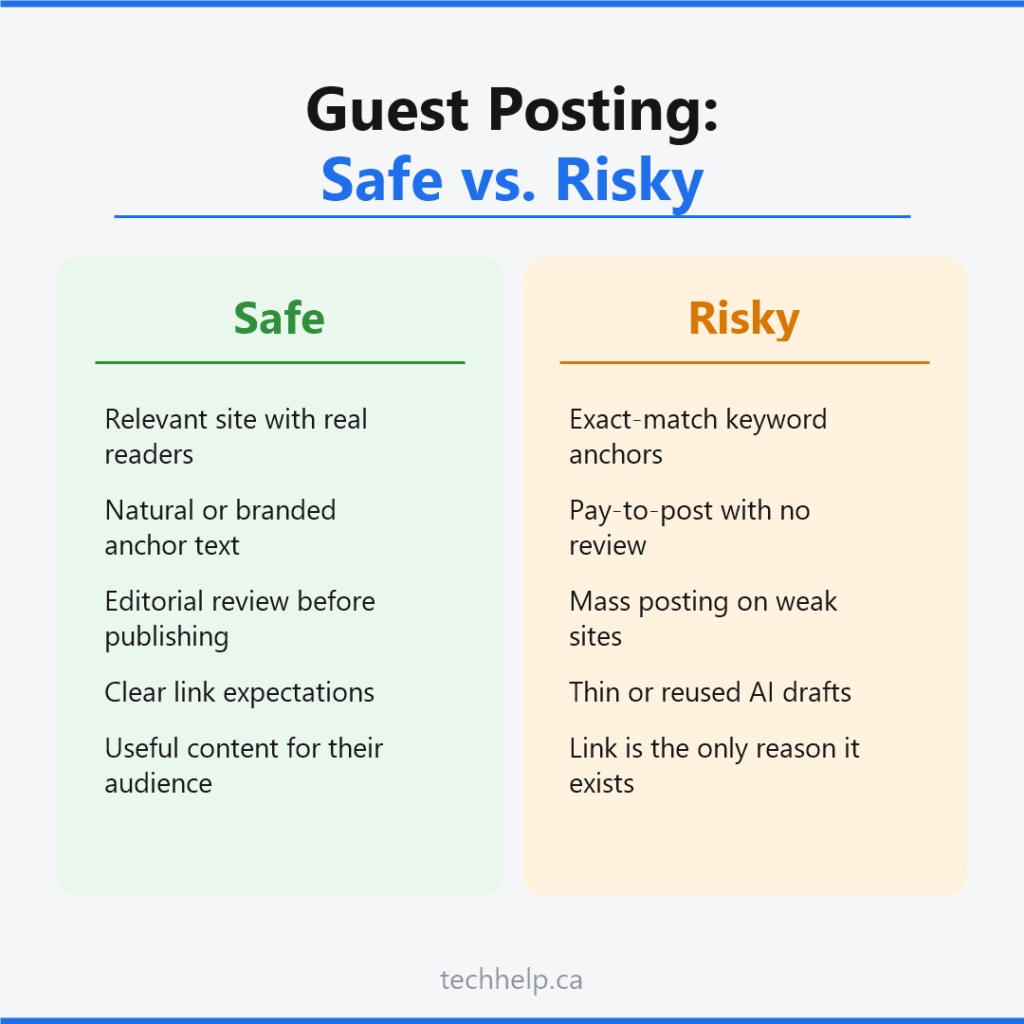
Safe guest posting usually has these traits: a relevant publication, a real audience, editorial review, useful content, natural links, and clear expectations between the contributor and publisher.
Risky guest posting usually looks like this: mass placement across weak sites, exact-match commercial anchors, pay-to-post placements with no review process, thin AI-generated drafts, reused content, and arrangements where the link is the only reason the article exists.
Use one practical test: would this article still be worth publishing if search engines didn’t exist? If the answer is yes, you’re much closer to safe territory.
How to scale guest posting without losing quality
Once you get a few placements, it’s tempting to send more pitches, publish more posts, and chase more links. Scale can work, but only if the quality control gets stronger at the same time.
Build a tracker before volume increases. At minimum, track site name, contact, email, topic pitched, date pitched, follow-up dates, status, publication date, live URL, target link, anchor text, referral traffic, and notes about the relationship.
Separate the workflow into stages: prospecting, qualification, pitching, topic approval, outlining, drafting, internal review, submission, revision, publication, promotion, and measurement. Most campaigns stall because all of those steps live in one messy to-do list.
Protect the writing stage. Guest posts that pass editorial review require research, examples, structure, and polish. If scaling means lower-quality drafts, the campaign will eventually burn the same relationships it depends on.
Prioritize repeat relationships. A recurring contributor relationship with a few respected publications can outperform constant cold outreach to weaker sites. It reduces prospecting time, improves trust, and gives you a better sense of what each editor wants.
Editorial fees are normal in many guest posting programs. A publication may charge a fee because reviewing submissions, editing drafts, formatting articles, publishing them, handling images, managing author details, and maintaining old content all take staff time. That fee does not automatically mean the publication is selling links or doing anything wrong.
The important distinction is what the fee covers. A legitimate editorial fee covers the work required to evaluate and process the article. It does not necessarily guarantee acceptance, a specific link, a followed backlink, or permanent placement. Strong publishers still reserve the right to reject weak content, request revisions, or limit links based on their standards.
Scale should make the process more consistent, not less selective.
Final takeaway
Guest posting works when you treat it as publishing, not link acquisition.
The people who earn consistent placements on respected sites aren’t gaming the system. They’re contributing useful expertise to publications that serve real audiences.
The process is simple, even if the work takes effort: find sites that fit your expertise, pitch with specificity, write something genuinely useful for their readers, and build the relationship beyond a single post.
Each quality placement can make the next one easier. Your portfolio grows. Editors have proof that you can deliver. Readers encounter your thinking in places they already trust, even when those places serve a small niche audience. Your backlink profile strengthens in a way that looks earned because it was earned.
That’s the version of guest posting that still works. Not because it’s a loophole. Because it’s good marketing.
Frequently Asked Questions
What is guest posting?
Guest posting is writing an article for another website or publication. The goal is to contribute something useful to that site’s audience while building your credibility, visibility, relationships, and sometimes referral traffic or backlinks.
Is guest posting still good for SEO?
Guest posting can still support SEO when the article is useful, relevant, editorially reviewed, and published on a site with a real audience. It becomes risky when the main purpose is to place keyword-rich links across low-quality or unrelated sites.
How do you find guest posting sites?
You can find guest posting sites with search operators, competitor backlink research, author portfolio research, social media searches, newsletter research, and industry communities. The better question is whether the site is relevant, edited, active, and trusted by real readers.
Does audience size matter for guest posting?
Audience size matters only if direct traffic is your main goal. For most guest posting campaigns, the better question is whether the site has a real, relevant audience. A small publication with engaged readers can be more valuable than a larger-looking site with weak engagement or inflated traffic.
How long should a guest post pitch be?
A strong guest post pitch is usually short enough to scan quickly. Aim for roughly 80 to 150 words, mention something specific about the publication, offer two or three relevant topic ideas, include one credibility signal, and end with a simple question.
How many links should a guest post include?
Follow the publication’s guidelines. Many sites allow one or two relevant links, often including an author bio link. The safest approach is to link only where it genuinely helps the reader and to avoid exact-match commercial anchor text.
Should you pay for a guest post?
Sometimes. Many legitimate publications charge an editorial or review fee to cover the time required to review, edit, format, publish, and maintain contributed content. The fee should cover the editorial process, not guarantee acceptance, a specific link, or a followed backlink. Avoid sites that accept everything with no real review process.
What should you do after a guest post is published?
Thank the editor, share the article with your audience, respond to comments if the site allows them, track referral traffic and conversions, and look for a natural follow-up topic if the placement performed well.
Get new small business insights by email
Practical ideas and useful articles to help you make better business decisions.
Tech Help Canada Staff researches, writes, and reviews practical content for business owners and professionals. Our coverage spans business, marketing, SEO, technology, and the tools and systems people use to grow and operate online. We focus on clear, useful information backed by research, hands-on experience, and editorial review. Learn more about our team and editorial standards. Need help with something? Contact Us