The way your customers find products and services is changing fast. Instead of typing keywords into Google and scrolling through search results, a growing number of buyers are asking ChatGPT, Gemini, and Perplexity questions like “what’s the best CRM for small businesses?” or “which project management tool should a startup use?”
If your brand doesn’t show up in those AI-generated responses, you’re easier to miss by a growing group of buyers. That’s the problem HubSpot AEO was built to solve.
Launched on April 14, 2026, it’s designed to help you track how your brand appears inside AI answers and get recommendations for improving that visibility. This review looks at what HubSpot AEO does, what it costs, where it’s strongest, and where it still falls short.
Best for HubSpot Marketing Hub users
HubSpot AEO
★★★★☆Tech Help Canada rating: 4/5
HubSpot AEO is a useful AI visibility tool for tracking brand mentions, prompts, citations, and content opportunities across major AI answer engines. It’s strongest if you already use HubSpot Marketing Hub.
Why we like it
Tracks how your brand appears across ChatGPT, Gemini, and Perplexity.
Includes prompt tracking, citation analysis, competitor analysis, and prioritized recommendations.
The free AEO Grader is a useful first check before paying for ongoing monitoring.
Marketing Hub Pro and Enterprise users get more value because CRM-powered prompt suggestions connect AI visibility to real buyer data.
Worth knowing
The standalone plan does not include the CRM-powered prompt suggestions that make HubSpot AEO most interesting.
Engine coverage is limited compared with broader AI visibility tools that track Claude, Google AI Overviews, Copilot, or more platforms.
Product Specs
Best UseAI visibility monitoring and content opportunity tracking
Product TypeAEO / AI search visibility software
Tracked EnginesChatGPT, Gemini, and Perplexity
Best FitMarketing Hub Pro and Enterprise users
Free OptionAEO Grader for a one-time visibility snapshot
Standalone PlanUseful baseline tool, but without CRM-powered prompt suggestions
AEO stands for Answer Engine Optimization. It’s the practice of improving how your brand appears in AI-generated answers across platforms like ChatGPT, Gemini, and Perplexity. SEO helps you rank in traditional search results. AEO helps you show up inside the answer itself.
HubSpot’s own data gives the shift some weight: organic traffic for its customers dropped 27% year over year, while HubSpot AEO beta users saw AI referral traffic grow 20% compared to customers who weren’t using the tool. Gartner also predicted that traditional search volume would fall 25% by 2026.
There may also be a commercial upside. According to the 2026 HubSpot State of Marketing report, 58% of marketers say visitors referred by AI tools convert at higher rates than traditional organic traffic. That doesn’t mean every AI visitor is ready to buy, but it does suggest AI referrals may be more valuable than raw traffic numbers make them look.
What HubSpot AEO Actually Is
HubSpot AEO launched during HubSpot’s Spring Spotlight event. It follows HubSpot’s 2025 agreement to acquire XFunnel, a platform built to help businesses monitor and improve their presence across AI answers. The product tracks how your brand appears across three AI engines: ChatGPT, Gemini, and Perplexity. It also gives you data and recommendations to improve that presence.
There are two distinct products under the AEO umbrella. The first is the AEO Grader, which is a free, one-time diagnostic tool. The second is the paid AEO tool, which provides ongoing monitoring, prompt tracking, citation analysis, competitor analysis, and prioritized recommendations. You can access the paid version as a standalone subscription or as part of Marketing Hub Pro and Enterprise.
The Free AEO Grader: A Solid Starting Point
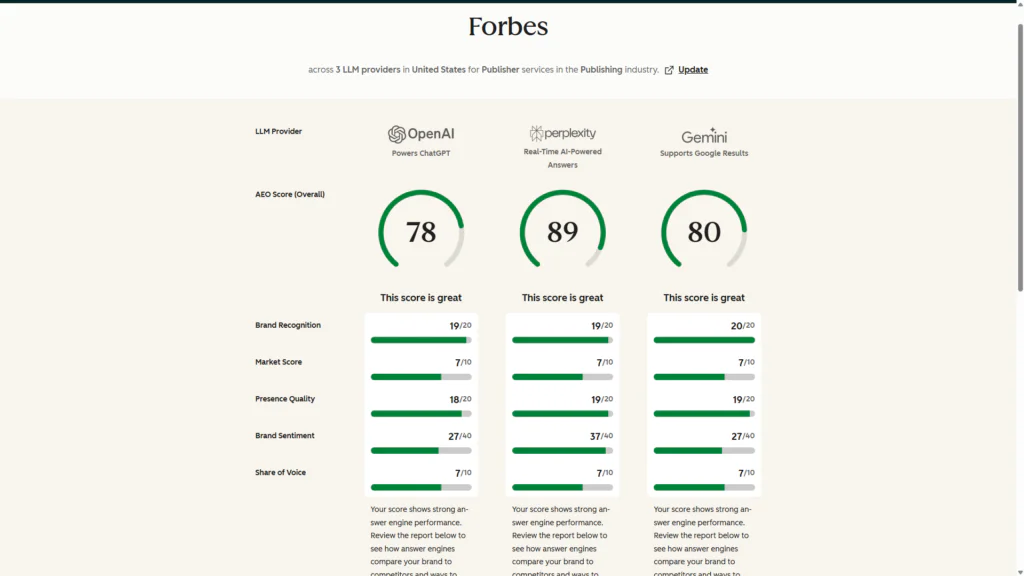
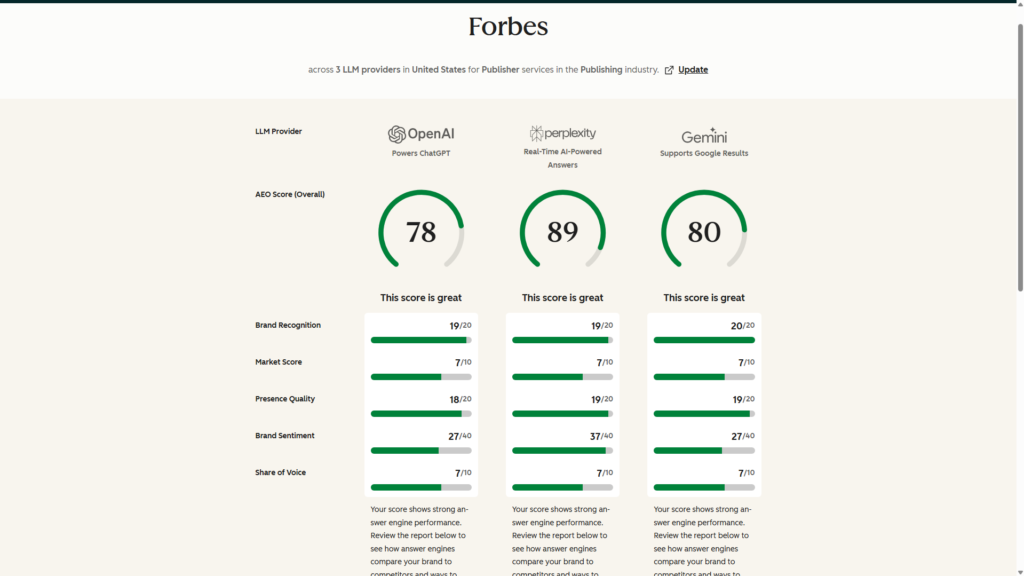
The AEO Grader is a useful first check. There’s no cost, and you don’t need a credit card. You enter your brand information, let it run its assessment across ChatGPT, Perplexity, and Gemini, and fill out a short form to access your results.
The Grader returns a composite score out of 100 across five weighted dimensions.
Sentiment Analysis carries the most weight at 40 points and measures how AI platforms characterize your brand. Presence Quality accounts for 20 points and looks at the depth and accuracy of your mentions. Brand Recognition, also 20 points, measures whether AI engines know who you are when prompted. Share of Voice accounts for 10 points and compares your visibility against competitors, while Market Competition accounts for the final 10 points.
Beyond the score itself, you’ll get a narrative theme analysis showing the common threads in how AI describes your brand, plus a source quality breakdown that identifies which content assets are getting cited. You can also run the Grader on any competitor’s brand and compare results side by side.
Think of the AEO Grader as a snapshot. It’s useful for establishing a baseline, but it won’t track changes over time. For that, you’ll need the paid tool.
Key Features of the Paid Tool
The paid version turns HubSpot AEO from a one-time check into an ongoing monitoring tool. Its main features are:
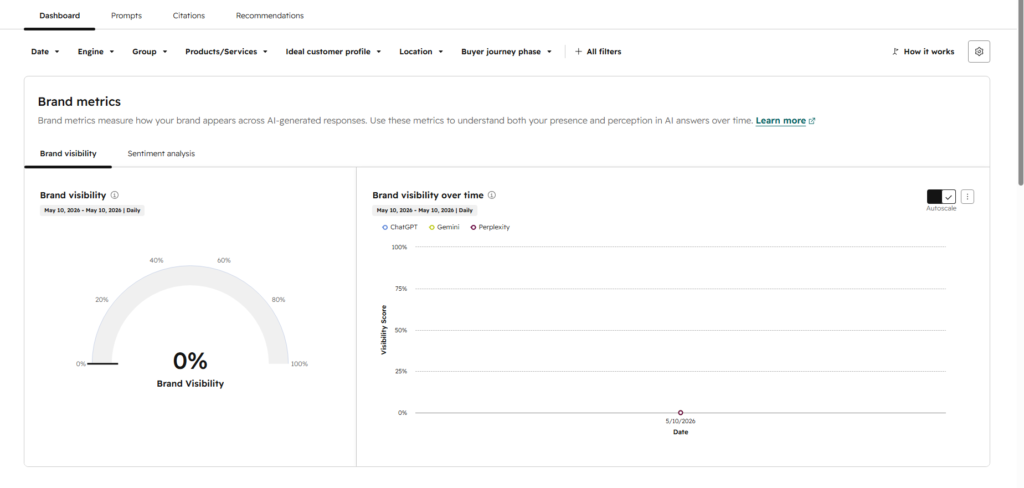
Brand Visibility Score
This is the core dashboard. It tracks how often your brand appears in AI answers across ChatGPT, Gemini, and Perplexity on an ongoing basis, with a sentiment breakdown showing whether those mentions are positive, negative, or neutral. Unlike the one-time Grader, this tracks performance over time so you can spot changes in your AI visibility.
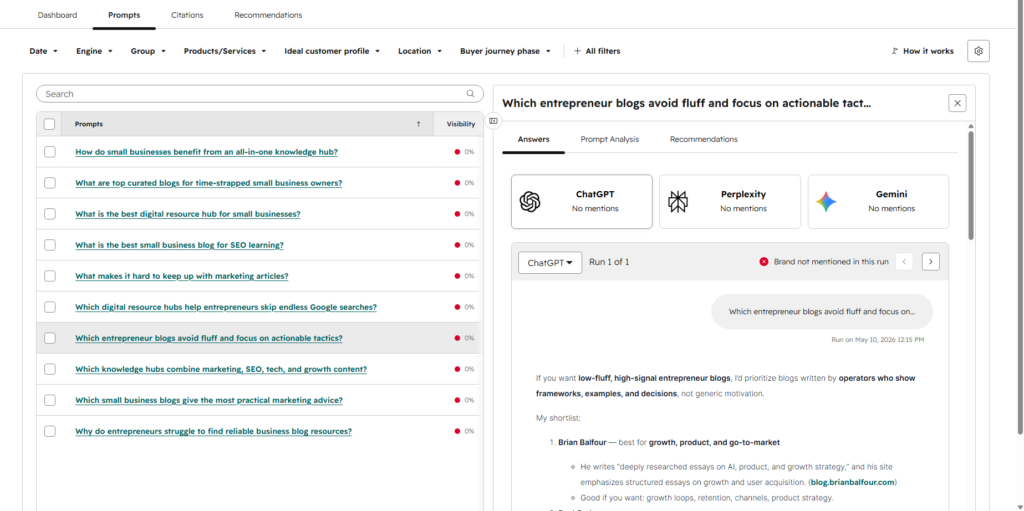
Prompt Tracking
You can monitor specific prompts your buyers may be asking AI tools. This is where you find out whether someone asking “best email marketing platform for e-commerce” gets your brand in the response or your competitor’s.
The standard AEO plan tracks 25 prompts, with each prompt run daily across ChatGPT, Gemini, and Perplexity. Marketing Hub Enterprise raises that limit to 50 prompts.
Citation Analysis
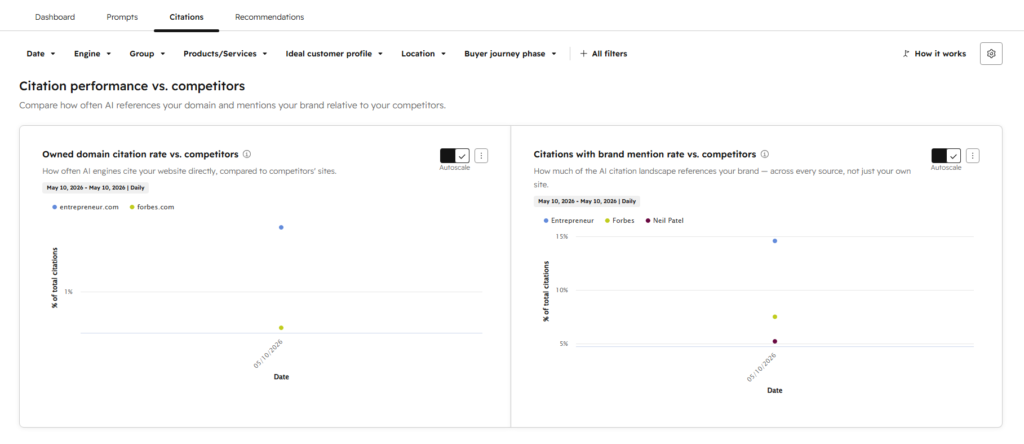
This shows you exactly which domains, pages, and content types are being referenced when AI engines generate answers about your industry. You can see your citation rate and compare it against competitors over time.
If a competitor’s blog post keeps getting cited and yours doesn’t, you’ll know exactly which content to prioritize.
CRM-Powered Prompt Suggestions
This is the feature that gives HubSpot its clearest advantage, but it’s only available to Marketing Hub users. HubSpot pulls from your CRM data, including your industries, competitors, and customer segments, to suggest prompts that reflect actual buyer behavior rather than generic category guesses.
Prioritized Recommendations
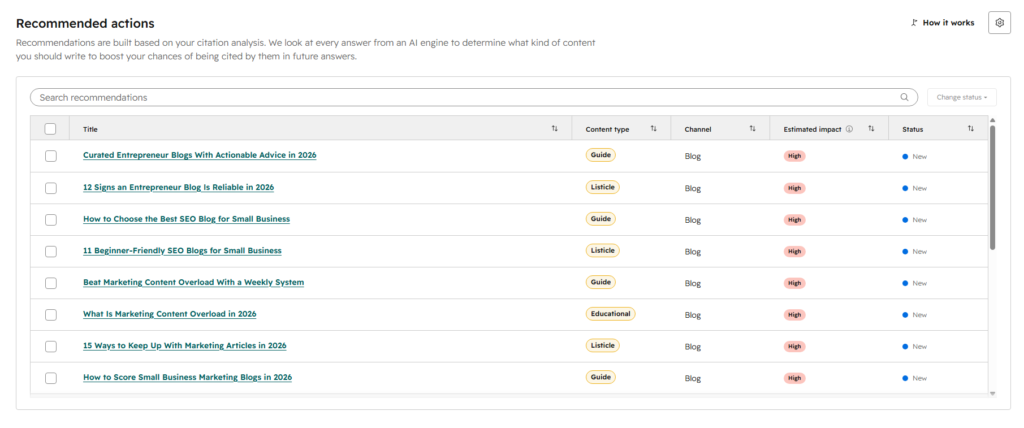
When the tool identifies a visibility gap, it gives you prioritized recommendations for what to create, update, or publish next.
Marketing Hub users can jump directly to HubSpot’s content tools to act on these recommendations, though the workflow still may not be as hands-off as HubSpot’s broader AI positioning makes it sound.
Pricing and What Each Tier Gets You
HubSpot’s AEO pricing is most attractive if you already use Marketing Hub Pro or Enterprise.
The free AEO Grader is available at no cost, with no credit card required. It’s a smart first step regardless of whether you plan to invest further.
The standalone AEO plan runs $50 per month and includes 25 tracked prompts, with each prompt run daily across three engines for up to 2,500 answers per month. It also includes visibility tracking, citation analysis, and prioritized recommendations. If you need more volume, HubSpot offers AEO Answers Limit Increase packs at $20 per month for 10 additional prompts and 1,000 additional answers per month. The tradeoff is that it doesn’t include CRM integration, so prompt suggestions won’t be as tailored to your actual buyer data. HubSpot offers a 28-day free trial with no credit card required.
If you’re already on Marketing Hub Pro, AEO is included at no additional cost. You get everything in the standalone plan plus CRM-powered prompt suggestions and a connected workflow to HubSpot’s content tools for acting on recommendations. For businesses already paying for Marketing Hub Pro, that makes AEO easier to test.
Marketing Hub Enterprise adds a higher prompt limit of 50 on top of the Pro features.
The pricing takeaway is simple: existing Marketing Hub Pro and Enterprise users get AEO at no extra cost, so it’s worth testing. For everyone else, the $50 per month standalone plan is an accessible entry point, though you should factor in the CRM integration gap when weighing it against competitors.
Real-World Results Worth Knowing About
The early results are where HubSpot AEO gets more interesting.
During the beta period, HubSpot customers who prioritized AEO saw their AI referral traffic grow 20% compared to customers who weren’t using the tool. That’s a meaningful lift for a channel that barely existed two years ago.
HubSpot also applied its own AEO framework to the HubSpot brand. The company reports a 1,850% increase in qualified leads from AEO efforts, with those leads converting at three times the rate of traditional search leads. They also reported 40% more AI citations, 40% growth in AI referral traffic, and visitors from AI channels converting at four times the rate of other channels. The results are useful, but they should be read with context: they’re HubSpot’s own numbers, based on a brand that already had major authority before the tool launched.
The customer case studies are more useful for comparison. Docebo, an enterprise learning platform, now gets nearly 15% of its leads from AI traffic. Sandler drove 8,000 new website visitors in just a few weeks, resulting in 12 new account conversions and a 10% year-over-year increase.
Another example is a net-new content page built using the AEO framework, which earned 159 AI citations and over 1,000 page views from AI referral traffic across four different engines within four weeks of launch.
Cons of HubSpot AEO
HubSpot AEO has real gaps you should know about before investing.
Limited engine coverage is the most obvious one. HubSpot AEO only tracks ChatGPT, Gemini, and Perplexity. Claude, Microsoft Copilot, Google AI Overviews, and Google AI Mode are not part of HubSpot’s current engine coverage. For teams that care about broader AI visibility, that’s the real limitation.
Tight prompt caps could be a friction point for larger businesses. The standalone and Pro versions are positioned around 25 tracked prompts, while Enterprise raises the limit to 50. If you’re tracking multiple product lines, buyer personas, or geographic markets, that ceiling can come fast. You’ll need to be selective about which prompts you monitor.
The workflow may not be as automated as some teams expect. HubSpot positions AEO as a connected workflow where you can spot a visibility gap, get a recommendation, and act inside HubSpot’s content tools. That’s useful, but HubSpot’s public AEO materials emphasize recommendations and connected workflows more than fully automated content creation.
Standalone users miss the best part. The CRM-powered prompt suggestions are HubSpot AEO’s biggest differentiator, but they’re only available to Marketing Hub subscribers. Without that CRM connection, the standalone plan relies on generic prompt suggestions instead of prompts shaped by your actual buyer data. For $50 per month, you’re getting a useful monitoring tool, but you’re not getting the feature that makes HubSpot’s approach most interesting.
How It Compares to the Competition
AEO is a new category, and several tools are already competing for your attention. Here’s how HubSpot stacks up against the most notable alternatives.
Semrush AI Visibility Toolkit gives teams AI visibility benchmarking, brand sentiment tracking, prompt research, competitor gap analysis, AI Overview tracking, and AI crawler-blocking audits inside a broader SEO workflow. If your team already uses Semrush for SEO and wants AI visibility data inside the same workflow, it’s a strong option.
Rankability tracks Google and up to nine AI platforms, including ChatGPT, Google AI Mode, Gemini, Perplexity, Google AI Overviews, Claude, Grok, Brave Summaries, and Bing Deep Answers on its Agency plan. That’s a significantly wider net than HubSpot’s three engines. It’s a particularly strong fit for agencies that need white-label reporting, since it combines traditional rank tracking with AI visibility in one platform.
Profound is a standalone AEO platform built for depth. It offers more granular analytics than HubSpot, including detailed competitor mention analysis and content optimization for AI search. The pricing is steeper, but for brands that need maximum visibility into how they’re performing across AI engines, it delivers more data.
HubSpot’s edge over all of these is the way it connects AI visibility data, CRM-informed prompt suggestions, and content execution inside one ecosystem. That’s the main reason Marketing Hub subscribers get more value from AEO than standalone users do.
Final Verdict: Who It’s For and Whether It’s Worth It
HubSpot AEO stands out because it connects AI visibility monitoring to marketing execution inside a platform millions of businesses already use.
If you’re already on Marketing Hub Pro or Enterprise, AEO is worth testing first. It’s included in your plan at no extra cost, and the CRM-powered prompt suggestions give HubSpot a real advantage over many standalone AEO tools. You’re getting AI visibility data tied more closely to your CRM, plus a content platform that helps you act on it.
If you’re new to AEO and want a low-friction starting point, the $50 per month standalone plan is a solid way to establish a baseline. The free AEO Grader can also give you a quick snapshot before you pay for anything. The trial is 28 days with no credit card, so it’s easy to test before committing.
If you’re an agency needing broad engine coverage and white-label reporting, or a data-heavy team that needs granular citation benchmarking across more than three platforms, you’ll be better served by Rankability, Semrush, or Profound. HubSpot’s engine coverage and prompt limits aren’t built for that use case, at least not yet.
Here’s the bigger takeaway, though. AEO is getting harder to ignore. Your buyers are already asking AI tools for recommendations and comparing solutions in ChatGPT threads. Whether you choose HubSpot’s tool or a competitor, the point is the same: you need to know how your brand shows up in those answers. In AI search, being absent can be just as costly as ranking poorly in Google.
Tech Help Canada Staff researches, writes, and reviews practical content for business owners and professionals. Our coverage spans business, marketing, SEO, technology, and the tools and systems people use to grow and operate online. We focus on clear, useful information backed by research, hands-on experience, and editorial review. Learn more about our team and editorial standards. Need help with something? Contact Us