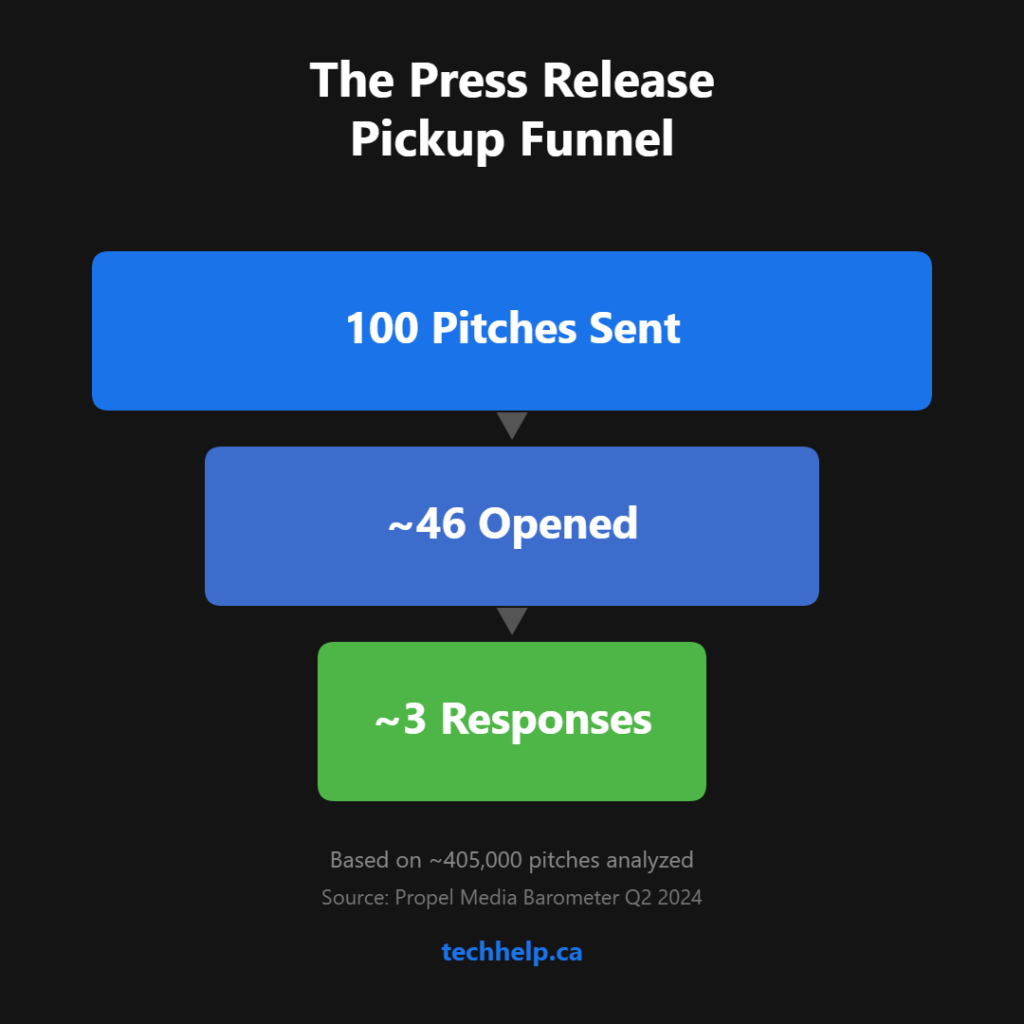
The average press pitch has a 3.43% response rate. Out of every 100 emails you send to journalists, roughly three will even acknowledge you exist. And of those, only a fraction will turn into actual coverage.
That’s not because reporters are lazy or because PR is broken. Most press releases aren’t stories. They’re announcements dressed up as news, and reporters can spot the difference in under 10 seconds.
Better writing won’t save a weak angle. A stronger angle will.
A press release “gets picked up” when a journalist reads it, follows up, and writes a story that cites the information inside it. Wire syndication doesn’t count. Neither do SEO backlinks from distribution sites. Those have their own value, but they’re a different game from the one most people think they’re playing when they send a release.
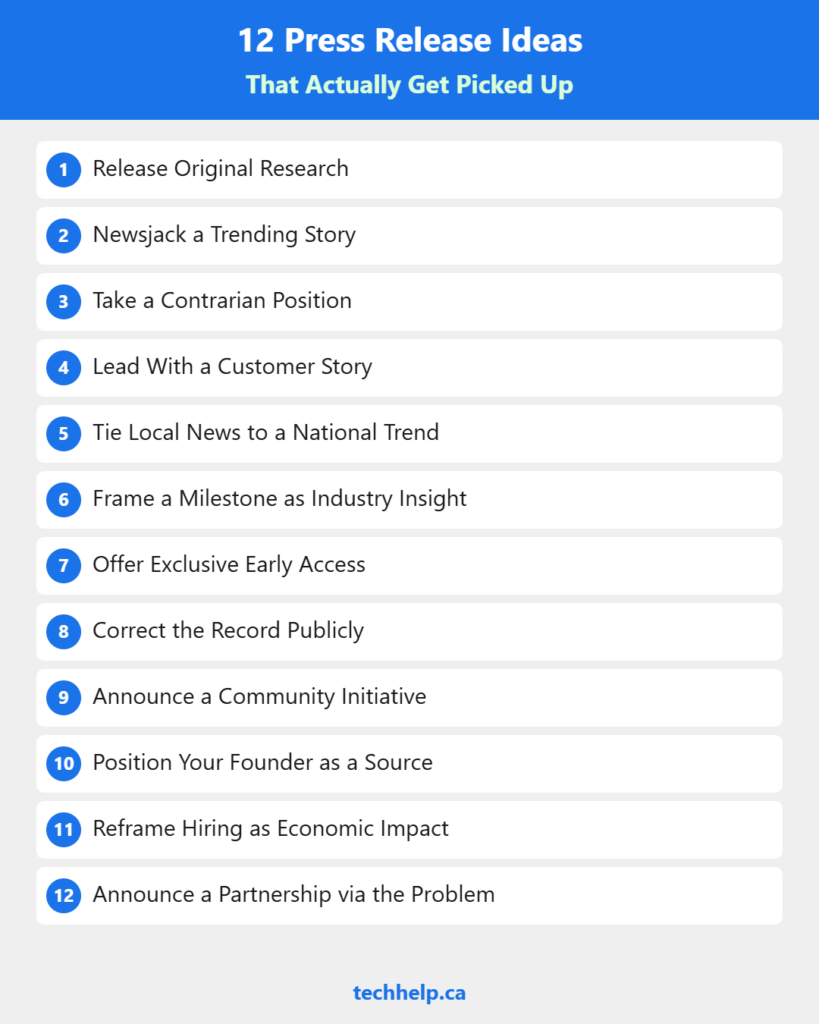
Here are 12 press release ideas with real pickup potential, plus what makes each one work and how to pull it off.
1. Release original research or proprietary data
This is the single most reliable way to earn media coverage. Reporters need data. They get pitched products all day. A release that hands them something they can cite — something they couldn’t get anywhere else — stops being an ask and becomes a resource.
You don’t need a massive budget to do this. A survey of 500 people in your industry, internal analytics from your own platform, or a benchmarking study pulled from your customer base all qualify. What matters is that the data is original, the methodology is defensible, and the findings say something worth saying.
Structure the release around the single most counterintuitive finding. That’s your headline. Include the sample size, the timeframe, and enough detail for a reporter to reference without needing a follow-up call. Then gate the full report behind a landing page so you capture leads from the coverage.
One analytics company used this approach to land coverage in Bloomberg and Quartz without ever mentioning their product. They released a report on remote work patterns with ten charts and a summary release built around the five most surprising findings. Every reporter who covered it credited the company as the source and linked to a landing page where readers could download the full report.
2. Newsjack a trending story
When a major story breaks in your industry, there’s a window — usually measured in hours, not days — where reporters are actively looking for expert voices, supporting data, and fresh angles. If you can get into their inbox during that window, your odds of coverage increase dramatically.
Newsjacking works because you’re not asking a reporter to care about something new. You’re offering yourself as a source for something they already care about.
The execution requires speed. Keep a draft release template ready with your boilerplate, founder bio, and contact info already filled in. When a relevant story breaks, write a 300-word release that connects your expertise or data to the headline. Get it into reporters’ hands before the second news cycle — that’s when the original story matures and reporters move on.
One brand did this during a wave of sustainability legislation. Within hours of a new packaging regulation making headlines, they sent a 250-word release positioning their CEO as a source who could explain what the regulation meant for manufacturers. Two trade reporters and a regional business journal picked it up the same day. The company hadn’t planned the release a week in advance. They built it in under two hours because they had a template ready and a clear point of view on the topic.
The risk with newsjacking is forcing a connection that isn’t there. If you have to stretch to explain why your business is relevant to the headline, skip it. Reporters can spot an opportunistic pitch immediately, and it damages your credibility for future outreach.
3. Take a contrarian position and back it with evidence
Reporters love a source who’s willing to say what everyone else in the industry won’t. If you’ve got data or direct experience that contradicts conventional wisdom, that’s a press release.
This goes beyond having a “hot take.” The position has to be specific, backed by numbers, and tied to a business decision you’re actually making. A founder in the creator economy used this approach by announcing she was sunsetting a feature that every competitor was racing to build. The release was one page. The headline was blunt: the feature doesn’t work, here’s why, here’s what we’re replacing it with. She included user adoption data showing the feature was collapsing.
That release got picked up by a newsletter with 40,000 subscribers, then Morning Brew, then Forbes. Two funded competitors had to respond publicly.
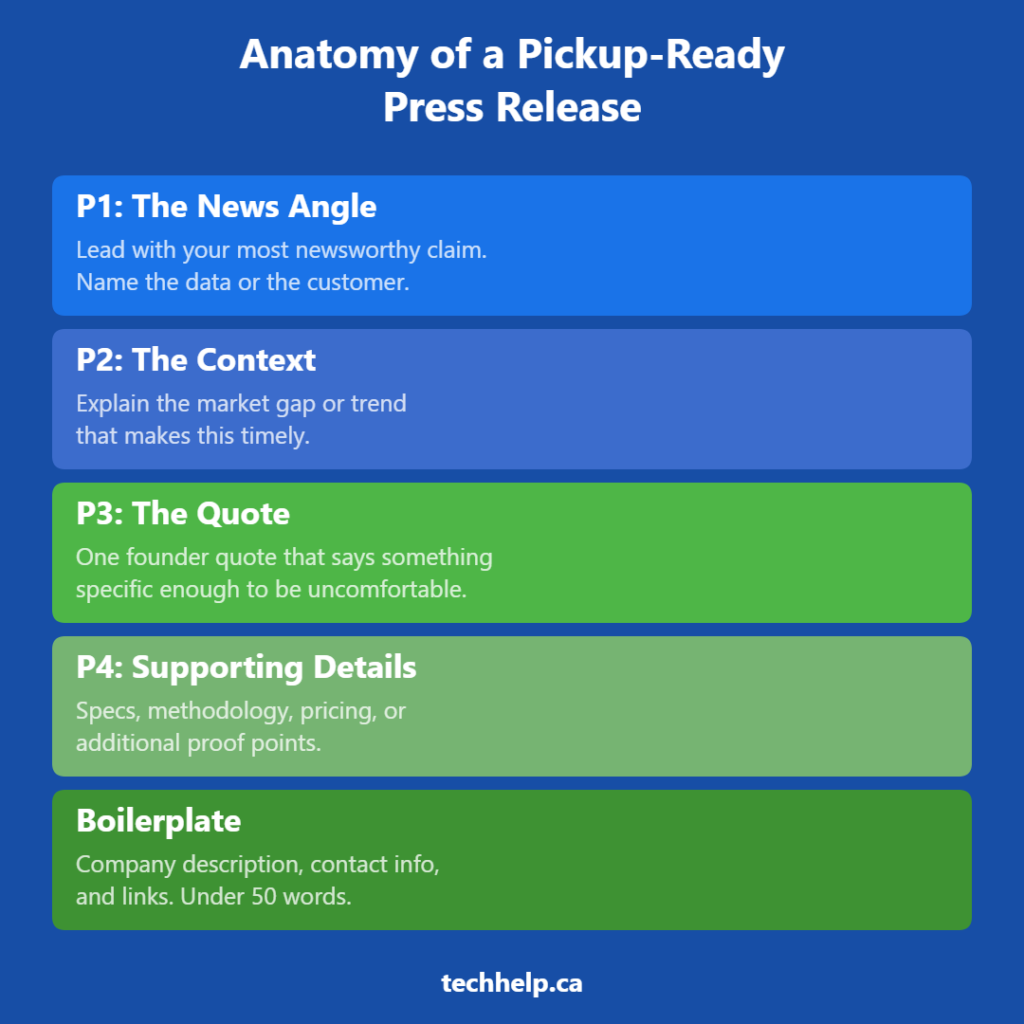
The structure that works: state the position in the headline, back it with your data in paragraph one, explain what you’re doing differently in paragraph two, and include a founder quote that says something specific enough to be uncomfortable. Generic quotes get ignored — 72% of reporters say press releases are their preferred content type, but they need quotes that actually say something to justify the story.
If your contrarian position doesn’t make your board slightly uncomfortable, it’s probably not contrarian enough to be news.
4. Lead with a customer story, not your product
Most product launch releases follow the same formula: new product name, feature list, CEO quote about innovation, boilerplate. Reporters have read thousands of these. After the tenth one in a single morning, they all look identical.
The fix is structural. Instead of leading with what you built, lead with who’s using it and what changed for them.
Open with the customer name, the specific use case, and the metric that improved. Follow with what the product does and who it’s for. Third paragraph is a founder quote about the category, not the product. Specs and technical details go last. Most reporters won’t need them, but the ones covering your vertical will appreciate having them.
“Fortune 500 manufacturer cuts defect rate by 40% using new inspection system” is a story a beat reporter can write. “Company launches new inspection SKU” is a product update that belongs on your blog.
According to Cision’s data, releases that name at least one customer in the headline or first paragraph receive 4.2x more journalist opens. That’s not a marginal improvement. It’s the difference between getting read and getting deleted.
The catch: you need the customer’s permission, and you need them to be willing to talk to a reporter if asked. Line that up before you write the release, not after.
5. Tie a local announcement to a national trend
National reporters covering broad trends (AI adoption, reshoring, climate policy, remote work) constantly need specific, local examples to anchor their stories. They need a person, a company, and a place. If you hand them that package, you’ve done half their job for them.
This is one of the most underused angles for businesses outside major metro areas. A regional logistics company used this approach when announcing a $50 million facility investment. Instead of framing it as a standard expansion release, they positioned it as a direct response to the reshoring trend. Domestic manufacturers were pulling supply chains back from overseas, and this company was building the infrastructure to handle the shift.
That release landed coverage in the local paper, the regional NPR affiliate, and a USA Today piece on reshoring that used the facility as its lead anecdote.
To execute this, start by identifying which national conversations your announcement connects to. Then restructure your release so the trend is the frame and your announcement is the evidence. Include the human details (names, job counts, the specific community affected) because those are the details national reporters can’t get from a desk in New York.
Local media outlets and podcasts are actively short of this kind of story. They don’t require the same level of effort to pitch as national outlets, and coverage there often gets picked up by larger publications looking for exactly the kind of local detail you’re providing.
6. Frame a milestone as an industry insight
Hitting a million customers, processing your billionth transaction, or reaching a revenue target feels like a big deal internally. Externally, reporters don’t write standalone stories about another company’s vanity metric.
But they will write an industry analysis piece that quotes a founder who has the scale to back up an opinion.
Use the milestone as the setup, not the headline. The headline should be about the industry: a trend you’re seeing, a shift in customer behavior, a prediction backed by your numbers. The milestone appears in paragraph two as proof that you have the authority to make the claim.
A direct-to-consumer brand that hit a million customers used this approach. Instead of a celebratory announcement, they wrote a release critiquing the broader category they operated in. The million-customer figure appeared as evidence of scale, not as the hook. Coverage landed in Retail Dive and Modern Retail, and none of the outlets framed it as a milestone piece. All of them framed it as industry analysis.
You’re giving the reporter a full story with a quotable source who has receipts. That beats a one-line mention buried in a roundup every time.
7. Offer exclusive early access or a preview
Exclusivity is currency in newsrooms. When a reporter knows they’re one of a small number of people who’ve seen something before it goes public, they’re more likely to prioritize it over the hundred other pitches in their inbox.
This applies to almost anything you’re releasing: a book excerpt before publication, beta access to a product, advance data from a report, or early results from a pilot program. The key is making the access feel scarce and the ask specific.
A founder with a book launch six months away used this approach by sending a release three months early, offering an advance excerpt to a limited number of reporters on request. Nineteen reporters requested it. Four wrote pre-publication pieces. By the time the book launched, it already had four features in print and a pre-order campaign that cleared its target in the first week.
To execute this, frame the release as an invitation rather than an announcement. State what you’re offering, who can access it, and how to request it. Keep the release itself short (under 400 words) and include just enough of the most compelling material to create genuine interest without giving everything away.
The psychology here is simple: receiving something feels different from being pitched something. Turn your release from an outbound push into an inbound pull.
8. Correct the record or own a mistake publicly
Most companies hide from errors. They issue vague statements, bury corrections in footnotes, or wait for the news cycle to move on. That’s exactly why a press release that openly corrects the record stands out.
A cybersecurity company discovered that a widely-cited industry report had used their data incorrectly. Instead of sending a legal letter, they wrote a release that corrected the methodology and offered the full raw dataset to any reporter who wanted to verify the numbers themselves.
It worked. The trade publication that originally cited the wrong data covered the correction, a Wired columnist picked it up, and two specialized security newsletters ran it. The company became the authoritative source on the topic for the rest of the year.
Transparency and raw data are rare in industries where most companies guard their methodology. Reporters who’ve been burned by bad data are relieved to find a trustworthy source, and the correction angle gives them a natural story hook.
You can apply this same principle to your own mistakes. If you shipped a product with a flaw, lost customer data, or made a strategic decision that didn’t work out, owning it publicly can generate coverage that a positive announcement never would. Be specific about what happened, what you learned, and what you changed. The coverage you earn from honesty tends to build trust rather than erode it, because readers remember how you handled the problem long after they’ve forgotten the problem itself.
9. Announce a community or social impact initiative
Local media outlets are hungry for stories about businesses that do tangible things for their communities. Not vague corporate social responsibility statements — specific actions with specific numbers.
“We’re committed to sustainability” is a blog post. “We’re funding 50 clean water installations in rural Ontario this year, and here’s the first one” is a press release.
The specificity is what separates a pickable release from a forgettable one. Include the dollar amount, the number of people affected, the timeline, and at least one named person or organization involved. If you’ve partnered with a nonprofit, include their quote alongside yours.
This angle works especially well for businesses that don’t have constant product news to announce. A local bakery sponsoring a youth sports league probably won’t get national coverage, but a feature in the regional paper and a mention on local radio can drive more relevant traffic than a TechCrunch mention ever would.
The 67% of journalists who prefer custom story angles tailored to their audience applies here too — a community impact release sent to the local business reporter who covers your area is far more effective than blasting it to a national media list.
Where this falls apart: when the initiative is clearly performative. If your $5,000 donation gets a $50,000 PR campaign, reporters notice the ratio. The initiative should be worth announcing on its own merits, with the media coverage as a bonus, not the goal.
10. Position your founder as an expert source
Sometimes the best press release doesn’t announce anything about your company at all. It offers your founder as a source for stories reporters are already working on.
Reporters writing trend pieces, investigative features, or analysis articles need human sources they can quote. If your founder has direct experience with the topic they’re covering, a short release that positions them as available for comment can get you into stories you’d never have been pitched for.
Keep it to one page. State the topic your founder can speak to, their relevant credentials or experience, two to three specific talking points they can address, and direct contact information. No product pitch. No company history. Just a clear offer of expertise tied to a specific news cycle.
Over 60% of earned media coverage for B2B brands features executive commentary, and podcast bookings as a PR tactic have grown by double digits, with more than half of B2B marketers increasing their investment in 2025. The demand for sources is there. Most businesses just don’t position themselves to meet it.
To find the right opportunities, set up Google Alerts for your industry’s key topics, monitor hashtags reporters use when sourcing (like #journorequest), and track which reporters have covered your space in the last 90 days. When a relevant story breaks, get your founder’s availability and talking points into that reporter’s inbox within hours, not days.
11. Reframe a hiring push as economic impact
A press release that says “Company X is expanding” is background noise. A release that says “200 new full-time positions are opening in a city where the largest employer just closed” is a front-page story.
Hiring announcements get media pickup when they’re framed around what the jobs mean for the community, not what they mean for the company. Lead with the number of positions, the wage range, the location, and the context. If you’re hiring in an area that recently lost jobs, mention that. If the roles don’t require a degree, say so. If you’re offering benefits that are unusual for your industry, highlight them.
The company details (what you do, why you’re growing) belong in the second half of the release. The first half is about the people who’ll fill those roles and the community that gains from them.
This angle is strongest with local media, but it can reach national outlets if the scale or context is significant enough. And local coverage shouldn’t be underestimated. About 18% of press releases receive pickup from at least one outlet within 24 hours, and local reporters are often the ones who respond fastest because they’re closer to the story’s impact.
12. Announce a partnership through the problem it solves
Partnership announcements are among the most common press releases and among the least covered. That’s because most of them read like this: “Company A and Company B are pleased to announce a strategic partnership to deliver integrated solutions.”
That sentence tells a reporter exactly nothing about why their readers should care.
The fix: write the release as if the partnership doesn’t exist. What problem are you solving? What changes for the end user? What was impossible before that’s possible now? Lead with that, and introduce the partnership as the mechanism in paragraph two.
“Freelancers in Canada can now file quarterly taxes in under 10 minutes” is a headline a business reporter will read. “Two fintech companies announce integration” is a headline that gets archived unread.
Include at least one specific user benefit with a number attached — time saved, cost reduced, a process simplified. If you have a beta user or early adopter willing to be quoted about the experience, even better. PRLab reports that press releases with well-crafted quotes can see pickup rates up to 40% higher than those without.
What to do after you write it
A well-angled release still needs the right distribution strategy. And for most businesses, that means targeted outreach, not wire blasts.
Send it to a small, specific list
Identify five to six reporters who’ve written about your space in the last 90 days. Check their recent bylines, not just their beat description. If you’ve done guest post outreach before, the research process is similar. A reporter who covers “tech” might have spent the last month writing about AI regulation — if your release is about e-commerce logistics, they’re not the right target this week.
Write a personal note for each one
Three to four sentences at the top of the email explaining why you’re sending it to them specifically. Reference a recent piece they wrote. Explain how your release connects to their coverage area. This alone will separate you from the 86% of pitches that get rejected for irrelevance.
Time it right
Tuesday and Wednesday in the late morning, roughly 10 a.m. to noon in the recipient’s time zone, are commonly cited as strong windows for journalist outreach.
Keep it short
The optimal press release length is 300 to 500 words. Short enough to read in under a minute, long enough to include the data and the quote a reporter needs to write their own version.
Include multimedia if you have it
According to Business Wire, multimedia releases generate roughly 50% more engagement than text-only releases. A high-quality photo or a single well-labeled chart can make the difference between “I’ll get to this later” and “I can use this now.”
Wire distribution services still have value for SEO backlinks and broad syndication, but they solve a different problem than targeted media pickup. If you’re trying to get a specific reporter at a specific outlet to write a specific story, direct outreach is the only path that works consistently.
The angle matters more than the writing
You can polish a press release until every sentence gleams. If the underlying angle doesn’t give a reporter a story they can write, it won’t matter. Before you spend time on the draft, answer one question: why would a reporter at your target outlet cover this?
If the answer is “because it’s important to us,” you’ve got a blog post. Publish it on your own site and move on.
If the answer is “because it gives their readers something they don’t already know,” you’ve got the start of a release. Pick the angle from this list that fits your news, put the most specific detail in paragraph one, and send it to the five people most likely to care.
Tech Help Canada Staff researches, writes, and reviews practical content for business owners and professionals. Our coverage spans business, marketing, SEO, technology, and the tools and systems people use to grow and operate online. We focus on clear, useful information backed by research, hands-on experience, and editorial review. Learn more about our team and editorial standards. Need help with something? Contact Us